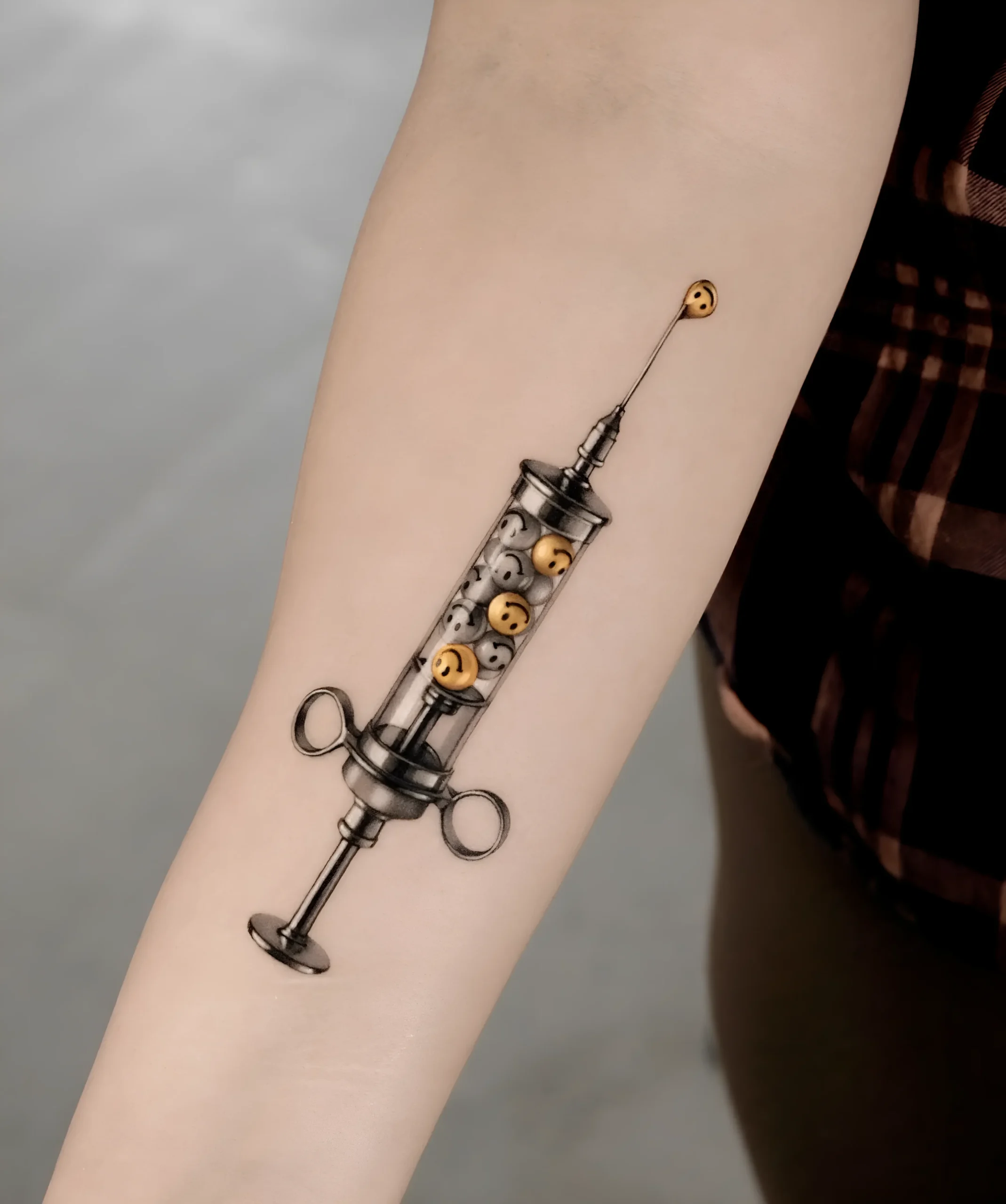
On the forearm, a syringe filled with smiles, and on the tip of the needle, a tiny golden face floats. This is not a medical illustration, but the work of Dionne, whose real name is Gyumi Yun, a 26-year-old tattoo artist whose micro-realism is structured like an optical joke: pixel-perfect graphics infused with a light, almost childlike humor. Her signature technique is to transform familiar objects into chrome, mirrored glass, liquid metal, foil, or plastic, making the tattoo appear voluminous and “wet” even on flat skin.
Light as the Primary Material
Chrome and glass in tattoos are not a new theme, but Dionne explains her attachment to them simply: “I became interested in materials like metal and glass because of how dramatically their appearance changes depending on light and reflection.” For the artist, this is not just aesthetics, but a working tool: gradients, highlights, and shadows replace color transitions here, which means the entire burden falls on controlling ink density and needle depth. In tattoo culture, this approach is referred to as “sentimental realism”—a movement where hyper-detailed imagery coexists with ironic subjects, and it is at this intersection that Dionne feels most confident.
Technique and References
The artist’s favorite needle is the 3RL, and this is no accident: this configuration provides the clean, thin lines necessary for her signature details. Her portfolio intertwines three layers:
- fine-line botany — flowers tattooed with jeweler-like precision;
- pet portraits, where the animal’s character is conveyed through micro-details of fur and gaze;
- artistic tributes — from Gustav Klimt and René Magritte to Hajime Sorayama.
It is Sorayama, according to Dionne, who would be the most “kindred spirit” among the classics: a shared obsession with shiny surfaces makes their visual languages compatible. The ideal collaboration in her imagination would be the Japanese master’s sexy robots integrated into her own whimsical, almost toy-like universe.
On Size: Why an Inch Isn’t Enough
It is worth addressing the practical side, which Dionne voices directly. Clients often ask to fit a complex design into an inch (about 2.5 cm), and here the artist honestly explains the physics of the process: ink migrates into the intercellular space over time, which means small details in a small area will inevitably start to “blur” and lose sharpness. Her advice is not to simplify at the expense of the concept, but to either increase the size or reduce the number of elements. For clarity: the disco-snail from her series takes up about four inches, and it is this scale that allows for the preservation of both the chrome shine and the readability of the pattern.
The Path: From Busan to Vancouver
Dionne was born in 2000 in Busan. She began her schooling at an art school in Korea and finished high school in Canada, where the encounter with other cultures forced her to look at tattooing in a new way—as a full-fledged fine art, rather than just a subcultural marker. She did not go to university: she returned to Korea, began learning the craft alongside her studies, and made tattooing her profession—the first and, as she emphasizes, the only job of her life. Now, Dionne lives in Vancouver and works at Studio Halfday.
For the reader accustomed to perceiving micro-realism as a cold, “technical” discipline, her practice is a useful reminder: precision and irony are not mutually exclusive. A syringe with smiling capsules, a disco-snail, chrome flowers—these are not just “cute pictures,” but calculated work with light, scale, and ink behavior in the skin. It is this combination of engineering discipline and a childlike sense of humor that makes her work recognizable in a sea of generic realism.
Photo © Dionne.