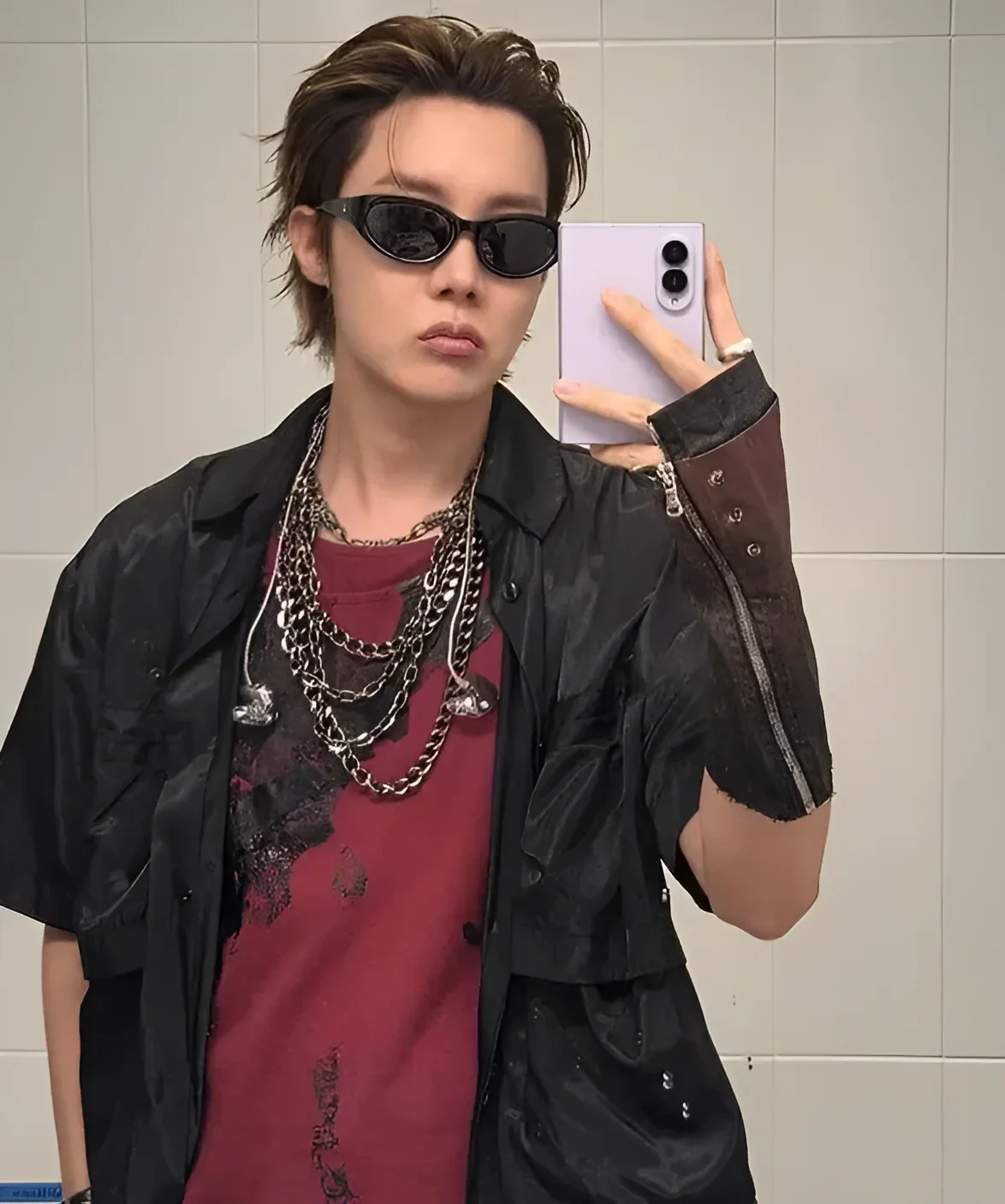
When an artist decides to etch not just a word but an entire story onto their skin, it’s almost always a deliberate gesture. This is precisely the case with J-Hope from BTS’s latest body art: the artist’s forearm now features the silhouettes of all seven group members, whose poses and gestures literally form the letters of the word “ARMY” – the name of their fan community. The work was published on September 10th on social media, accompanied by the caption “BTS WORLD TOUR ‘ARIRANG’, LOS ANGELES,” and the black-and-white shot of the tattoo instantly captured the audience’s attention.
The design is built on clever geometry. The members on the edges spread their limbs to form the letters “A” and “Y,” while the three in the center lean in and hold hands to create “R” and “M.” The tattoo is small in scale, but it’s precisely this small format that enhances the effect: each gesture reads as a distinct letter of the alphabet. The members themselves, by the way, had already used this idea in the 2021 music video for “Butter,” where they formed the word A-R-M-Y with their bodies. It turns out J-Hope has now permanently imprinted this visual code, which was once just a scene in a video, onto his own body.
Why It’s Not Just an Inscription, But a System
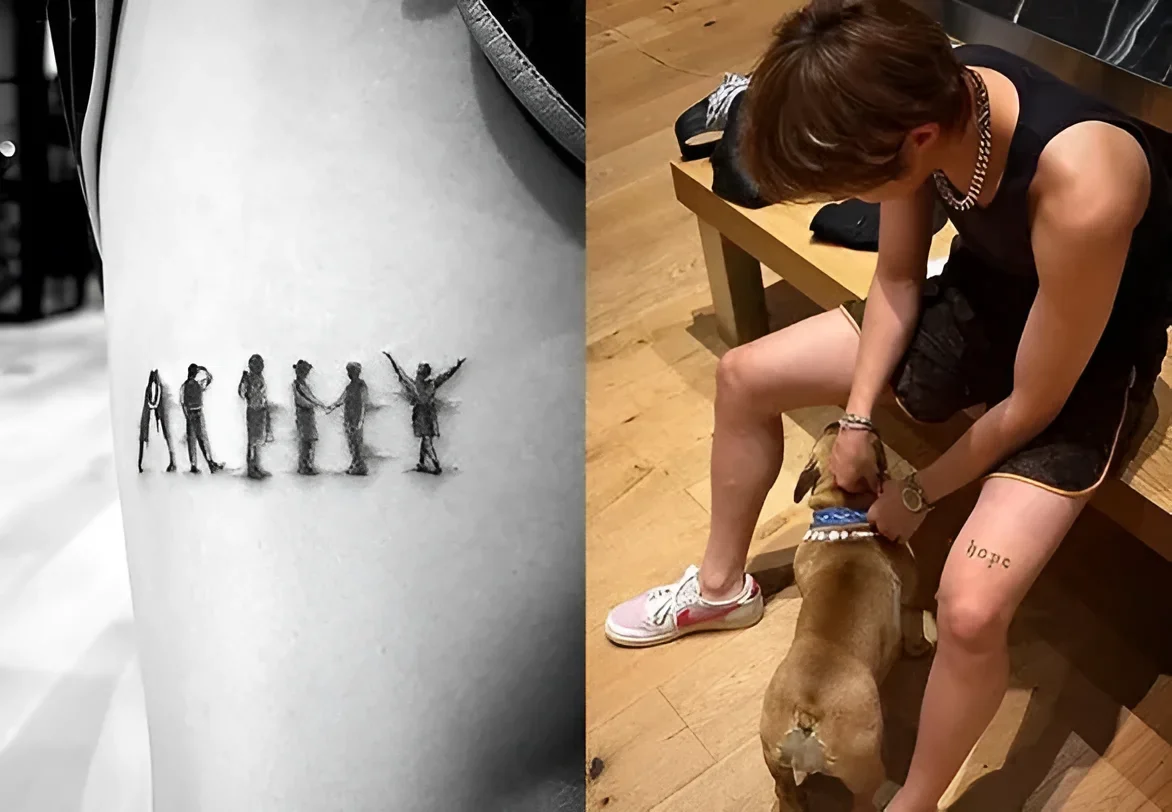
The key meaning lies in the fact that the artist didn’t just get the word tattooed. He incorporated the forms of the members themselves, thereby solidifying the idea: BTS and ARMY are not two separate entities, but a single construct where each part complements the other. This is a characteristic technique in tattoo culture: a semantic tattoo, where meaning arises not from the image itself, but from the relationship between its elements. Here, the body becomes not a carrier of a logo, but a mini-manifesto about the mutual dependence of the group and its fans.
This is far from the first meaningful mark in J-Hope’s collection. Previously, BTS members got the number “7” tattooed as a symbol of the group’s unity, and J-Hope himself already had the word “HOPE” – a reference to his name and personal identity. Now, a three-tiered system of messages has formed on his body:
- “7” – the team and its unity;
- “HOPE” – himself, his name, and his inner strength;
- “ARMY” – the fans, without whom the group’s story is incomplete.
According to publications, the work was done by the renowned artist Dr. Woo, whose name in the tattoo community has long been associated with neat minimalism and clean lines – precisely what is needed for such a detailed silhouette design.
Context: How Tattoo Art Became the Language of K-pop
Looking more broadly, J-Hope’s gesture aligns with the general trend in Asian pop culture, where body art increasingly serves as a public narrative rather than mere personal adornment. Unlike the Western tradition, where tattoos have historically leaned towards street and rebellious aesthetics, in K-pop, they are increasingly becoming a tool for communication with the audience: artists encode relationships, dates, names, and symbols within them, which fans then decipher and discuss. Minimalist linear works, like J-Hope’s, benefit from their readability – they are easy to recognize in a frame, easy to discuss, and easy to turn into memes or fan art. This makes tattoos an integral part of an artist’s visual ecosystem, not just a detail of their image.
J-Hope himself has consistently developed this dialogue beyond the tattoo studio. His solo journey – from his debut studio album “Jack In The Box” in 2022 to his headlining performance at the American festival Lollapalooza – has shown his ability to expand his musical expression beyond the group’s brand. Even during his military service, he maintained contact with fans through content, and back in 2021, during an online fan meeting, the group dedicated a special segment called “ARMY TIME,” emphasizing that the fan community are not just spectators but co-creators of their journey.
A Tattoo as a Harbinger of Return
The timing of this new body art adds particular weight: BTS is preparing for their 2026 world tour titled “ARIRANG.” The performances in Busan, held two days before the stage, attracted over 110,000 spectators, and the group performed hits like “Butter” – the very song whose choreography formed the basis of the tattoo. This creates a closed loop: a symbol created on stage has returned to the artist’s body, and the artist’s body now carries this symbol back to the stage.
Ultimately, J-Hope’s tattoo transcends a mere fashionable gesture. The word “ARMY,” assembled from the gestures of the seven members, functions as a visual cipher of their shared history: “7” for the team, “HOPE” for himself, and “ARMY” for the fans. These three tattoos combine to form a permanent record of the inseparable bond between BTS, J-Hope, and their community. And this is precisely why this gesture is received so warmly – as a quiet but deeply personal confirmation that, ahead of a new tour, the artist returns to his fans with the same promise he once inscribed on his skin: that their connection doesn’t end, it merely changes form.