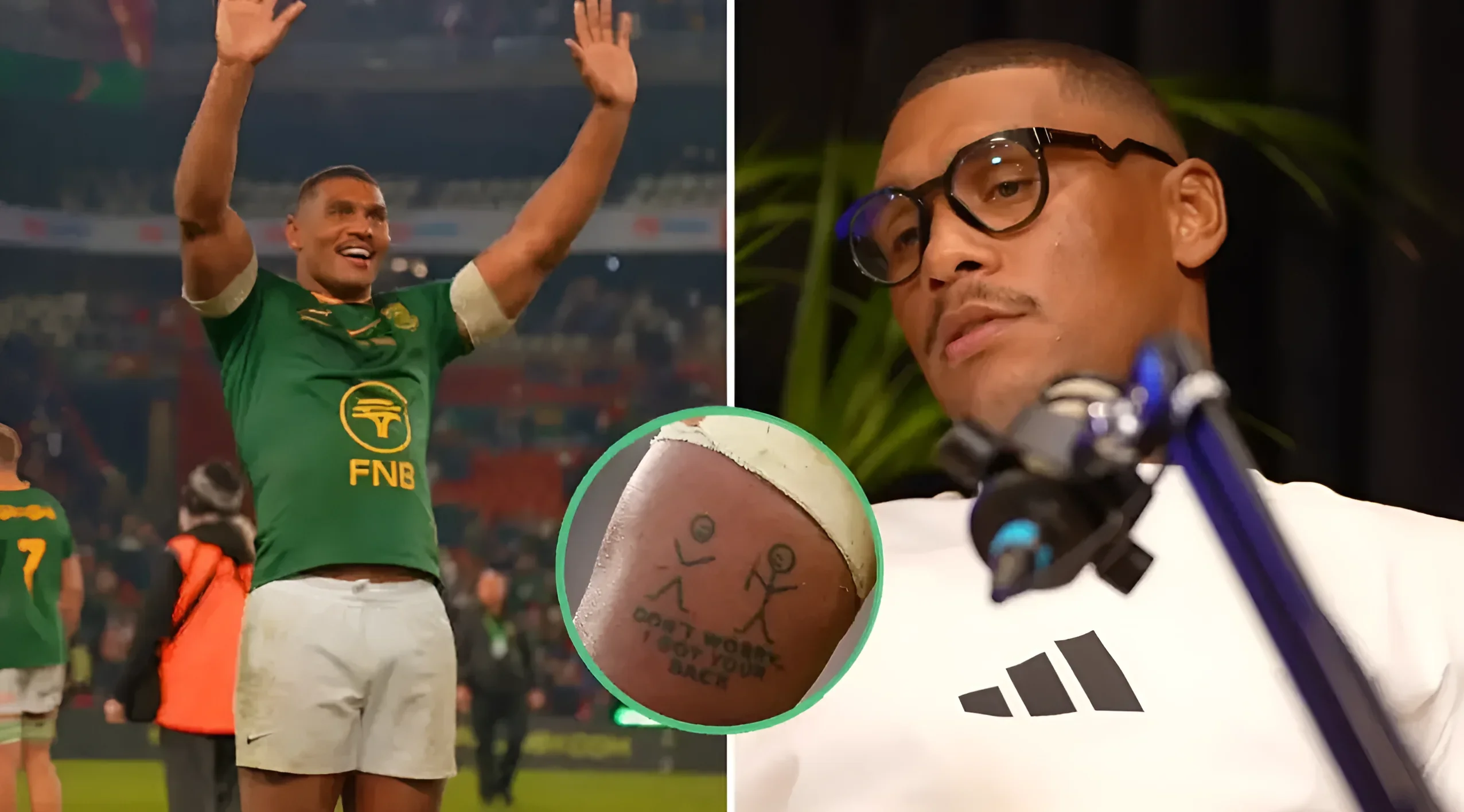
Damian Willemse, the versatile back for the South African rugby team, has unexpectedly become a trending topic on rugby social media – not for another interception, but for a forearm tattoo. Two naive stick figures and the short inscription “DON’T WORRY, I GOT YOUR BACK” have sparked a storm of discussion: some fans are calling it the best tattoo in world rugby, while others joke that the player drew it himself.
Minimalism That Divided Fans
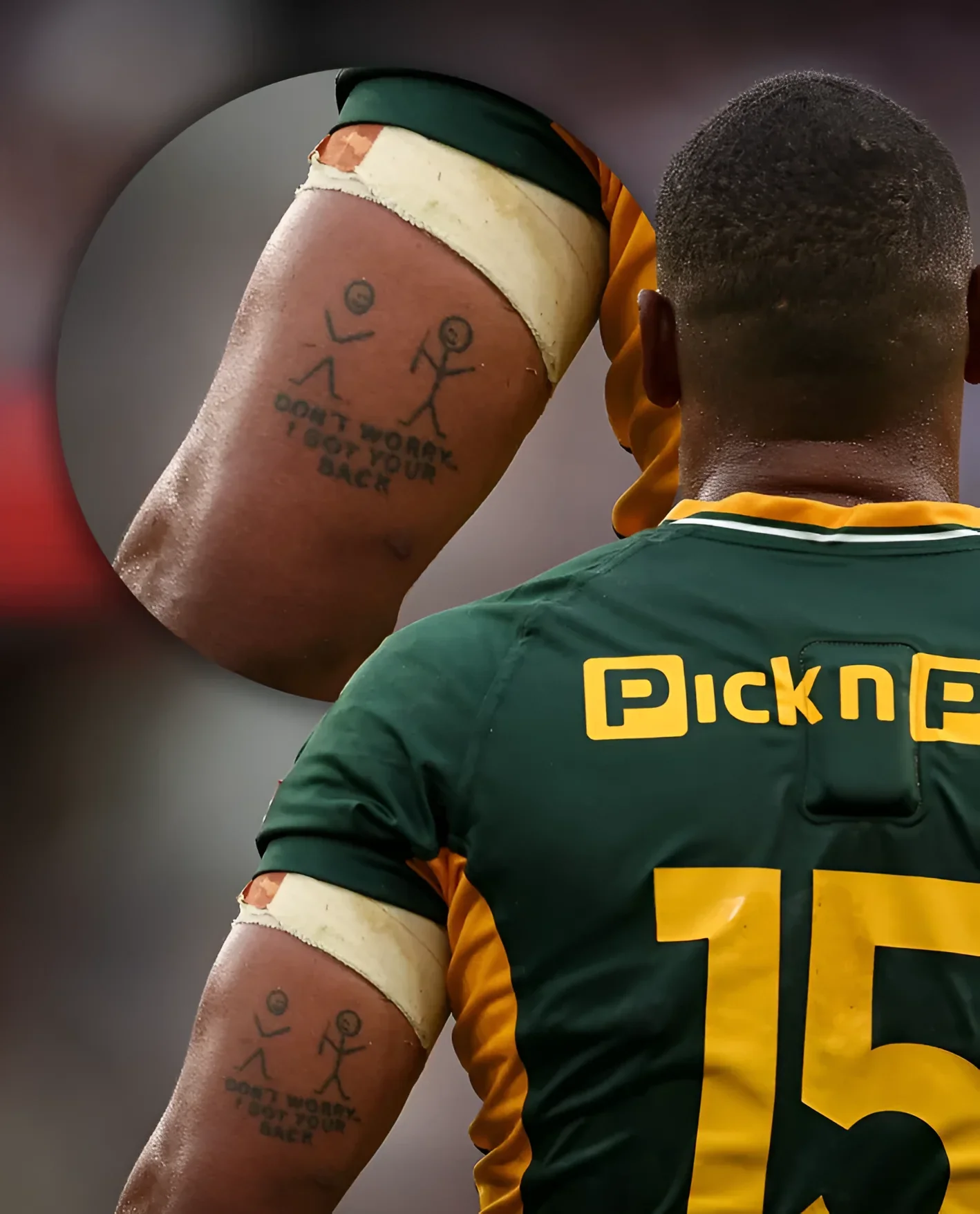
Everything about this tattoo is built on contrast. No artistic elaboration, no gradients or details – just two schematic silhouettes and a concise phrase. It’s this simplicity that resonated with the audience. One rugby account called the sketch a “strong contender for the best tattoo in world rugby,” and followers in the comments unanimously supported it: “Winner,” “Pure Leonardo da Vinci,” “Did he draw it himself?”
Fan reactions can be neatly categorized:
- Praise – “Winner,” “Contender for best rugby tattoo”;
- Ironic – “Did he draw it himself?”, “Genius on the level of Leonardo da Vinci”;
- Provocative – drawing comparisons to Malcolm Marx’s tattoos.
Malcolm Marx Gets Involved in the Debate
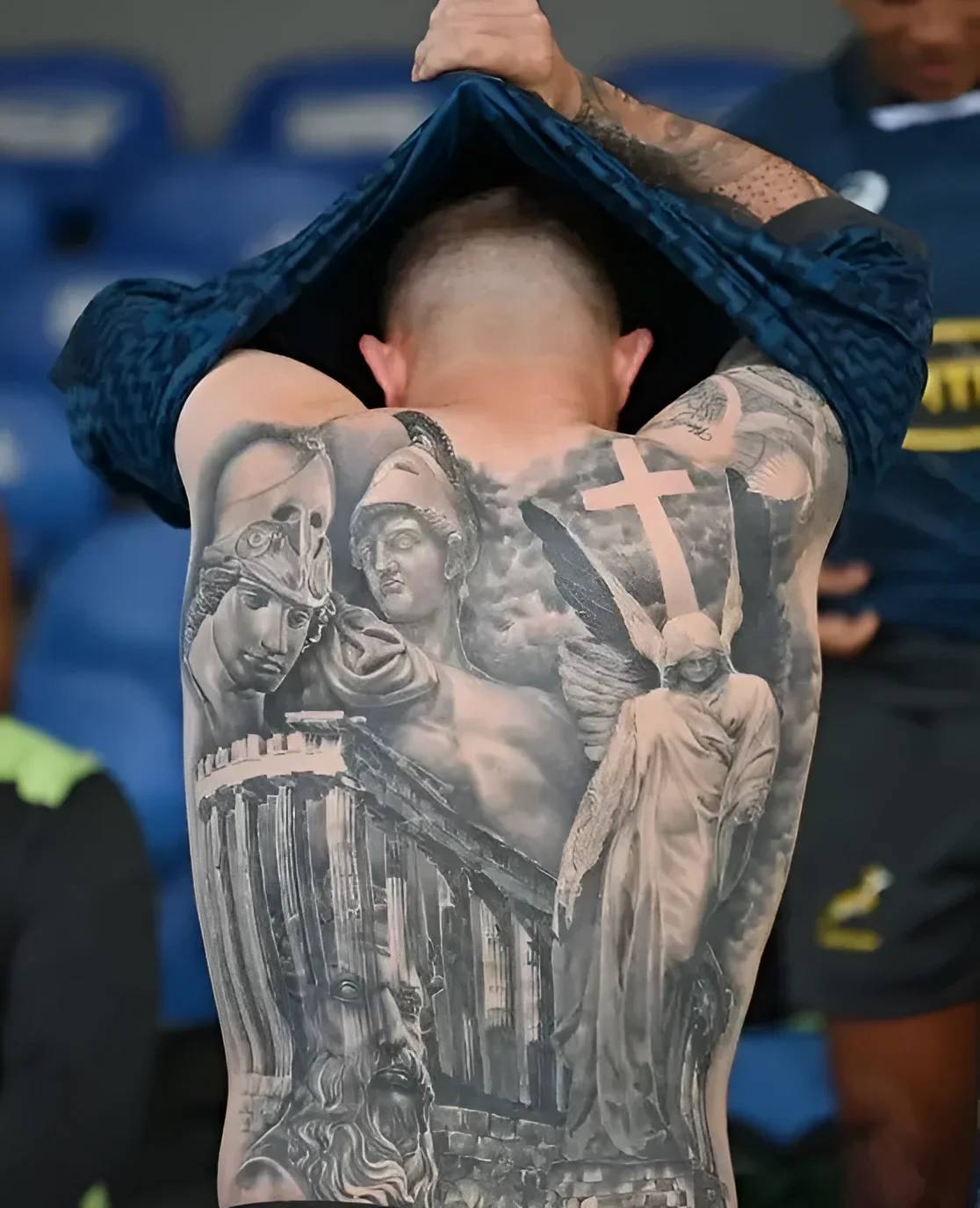
Naturally, Springboks fans couldn’t overlook another tattooed player. Malcolm Marx was immediately drawn into the discussion: according to some fans, his works “have no competition.” Marx’s back features a massive religious back-piece: angels, a cross, and detailed figures executed in black and white. This presents a clear example of two poles of sports tattoo culture: on one hand, a humorous sketch on the forearm; on the other, a monumental religious composition covering the entire back.
What Tattoo Culture Says
From a tattoo culture perspective, Willemse’s case falls into a stable trend of “sketch tattoos” and minimalist inscriptions. Stick figures have long been a universal symbol of friendship, teamwork, and mutual support – they are inked by couples, brothers, and teammates. In rugby, where team cohesion is crucial, such a tattoo reads as a personal manifesto: “I’ve got your back.” Experts note that it’s precisely these simple, “imperfect” sketches that often go viral because they evoke resonance and recognition, unlike technically flawless but anonymous works.
The other extreme – Marx’s back-piece – reflects a different tradition: tattooing as a personal statement, often with religious or memorial undertones, occupying a large area and requiring many sessions. Both approaches are legitimate and demonstrate the wide spectrum of tattoo expression in professional sports.
Who is Willemse?
Damian Willemse has been part of the Springboks since 2018, when he played his first match for the national team. His ability to play multiple positions in the backline has made him a regular option for South Africa; his official SA Rugby profile lists him as a utility back. He holds two World Cup winner’s medals. Willemse was part of the squad at the 2019 World Cup in Japan and played a key role four years later: in the 2023 final, he started at fullback as South Africa defeated New Zealand 12-11, securing a record fourth title.
So, the debate about Willemse’s tattoo is not just a joke in the comments. It’s a clear snapshot of how tattoo culture in sports operates on two levels: the public, viral level, and the personal, hidden under the jersey until the moment the player takes it off after a match. And the fact that fans can’t decide if it’s the “best” or “worst” work is the highest compliment to both.