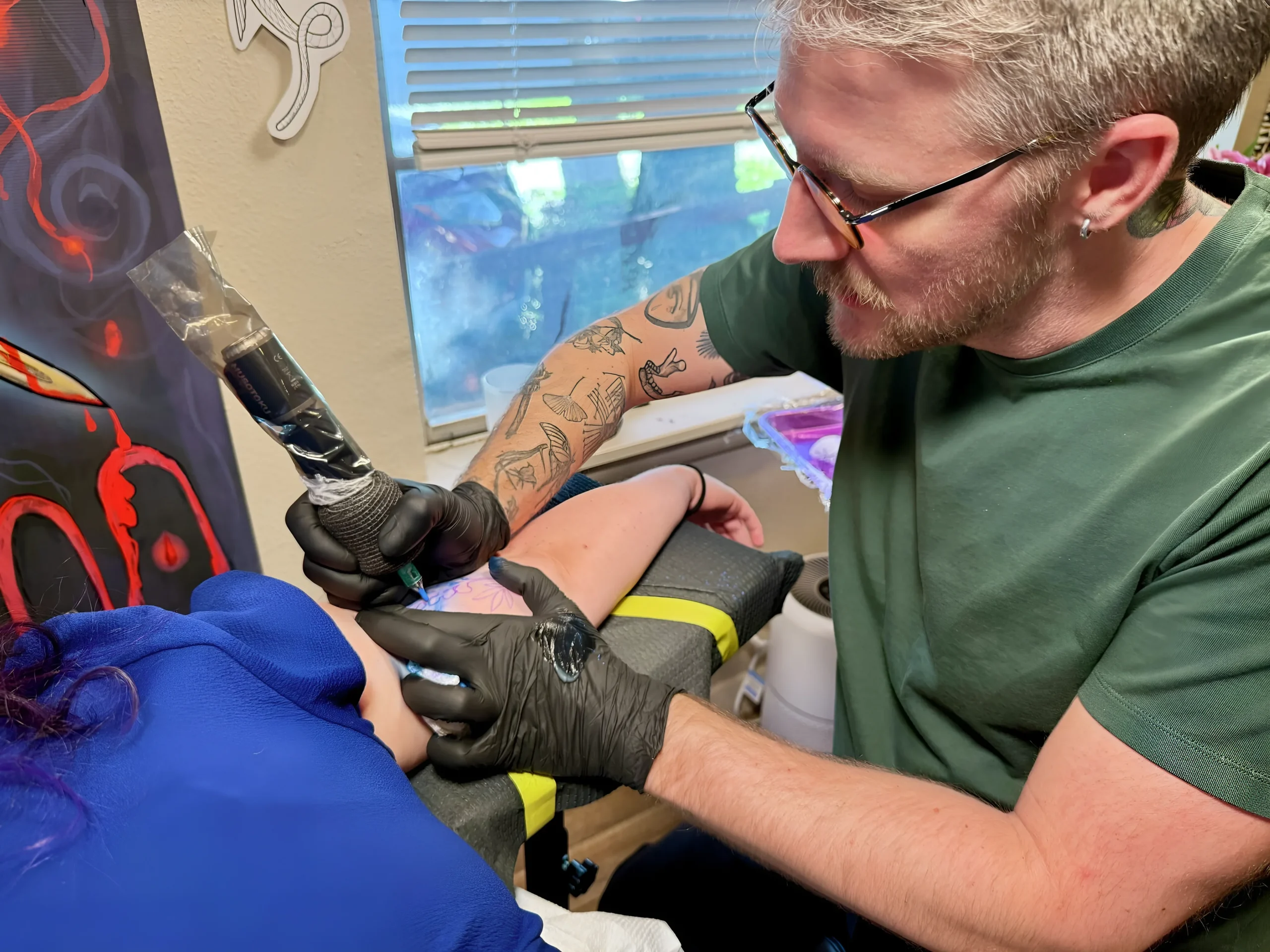
Kristin Rhodes lies in a chair at the 444 Tattoo studio in Austin, breathing deeply as artist Jordan Hughes applies a stencil of a bluebonnet—the Texas state flower—to her right forearm. She is afraid of needles, and this is only her second tattoo ever: she got her first one impulsively on her thigh many years ago. But this one, highly visible and permanent, feels both deliberate and spontaneous—it marks the moment her home state “turned blue.”
Tattoo as a marker of a historical moment
Two days after what residents call a “historic blue wave” in the midterm elections, Rhodes and her friend Caroline Goldberg, whose friendship spans over a decade, get matching bluebonnet tattoos. Goldberg, for whom this design will be her eighth, notes that the old idea that “it’s forever, you’re ruining your body” is long outdated: “I’m just decorating my body.” Hundreds of other Texans are waiting at the studio, eager to cement this shift on their skin.
Hughes is one of dozens of artists in the state who are offering themed, discounted, and sometimes completely free flash designs these days. Even before the polls closed on Tuesday, he posted his designs on Instagram with prices: one cost if James Talarico won his senate seat, and even lower if Gina Hinojosa also won her race. His flash sheet includes two bluebonnets, two Texas outlines, the cursive word “Yeehaw!”, and a blue Tobias Fünke from the show “Arrested Development” inside the state border.
What’s behind the wave of political tattoos
Hughes admits he was one of those who was “delirious” and believed in Hinojosa’s victory, so he decided to “manifest it” through ultra-cheap tattoos. Now he has to extend the availability of the designs to keep up with demand—he already tattooed the blue Tobias Fünke on a colleague on Thursday morning. Disbelief still lingers near the chair: the friends were “cautiously optimistic” but didn’t expect Democrats to vote for the lieutenant governor, the railroad commissioner, and other down-ballot races.
For experts in tattoo culture, this case is a clear example of how a permanent drawing turns into a personal memorial of a collective event. The tattoo here acts as a talisman and simultaneously as a diary entry: it captures not just an emotion, but a specific date and a specific political shift which, according to Goldberg, hasn’t happened in Texas for thirty years.
Why Texas remains Texas
Everyone in this room is a native Texan. Rhodes and Goldberg have lived here their whole lives; Hughes lived in the Pacific Northwest for a while. Hughes, who grew up as a “visibly gay person” in Texas, says he has seen both the ugliest sides of the South and the most compassionate, and that is exactly what keeps him in the state. Goldberg and her husband play a game of “where would we move,” and every time the answer is the same—nowhere.
For some residents, the shift in the political wave means changes in education, healthcare, infrastructure, and disaster relief. Rhodes puts it this way: “In Texas, the sense of community is more than anything else. We do things with our whole hearts.”
An hour later, the friends leave with matching bluebonnets, having permanently inscribed this moment into their skin, while Hughes prepares his workspace for the next client. “Holding space for a person in any phase of their life—in grief, in a breakup, in death, or in a joyful event like this—is a true honor,” the artist concludes.