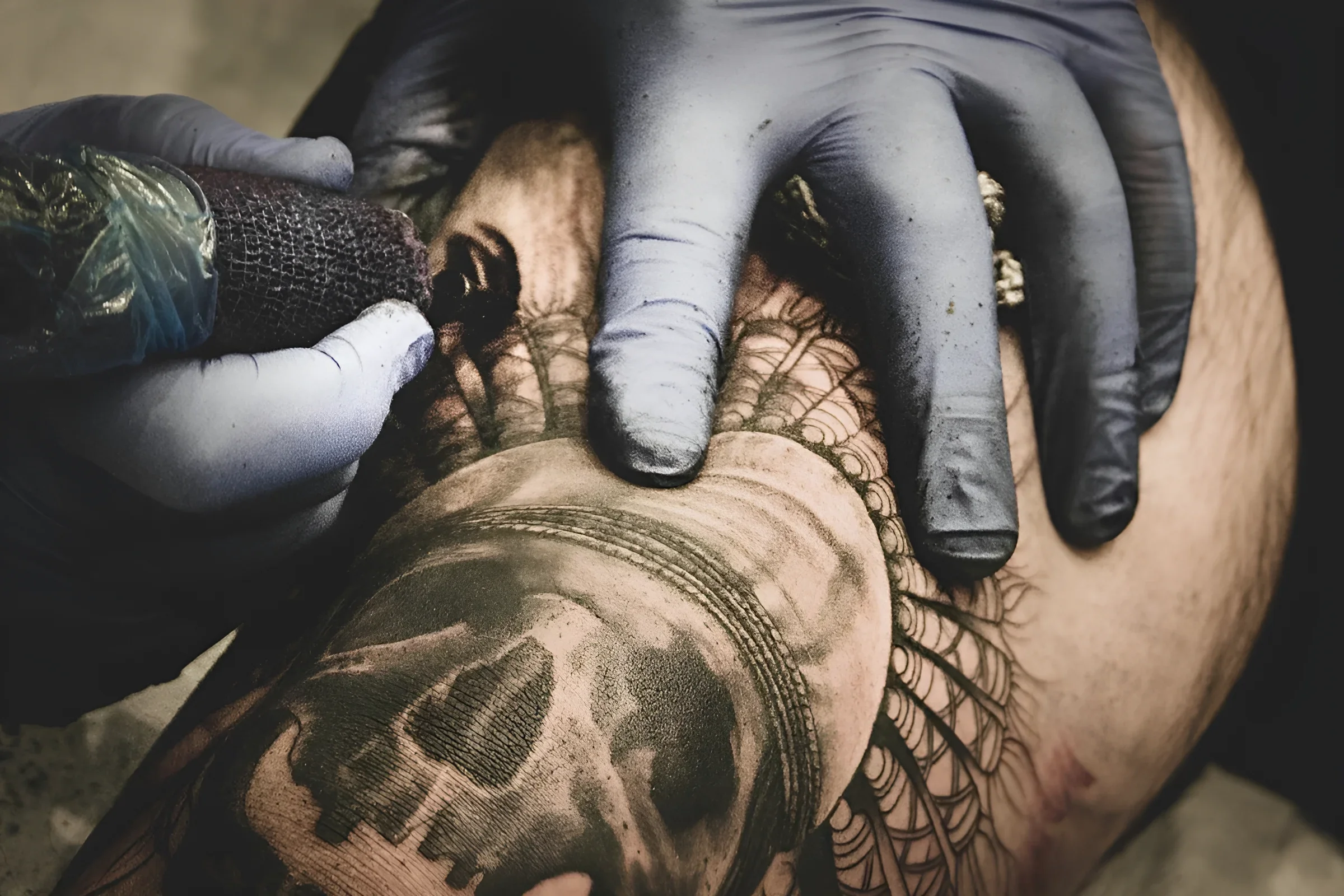
Imagine a person who stands by the chalkboard every day explaining fractions to children, while his own eyeballs feature ink patterns and his nipples have simply been cut off. It sounds like a plot from a thriller, but this is the biography of a real educator. Sylvain Helaine, an elementary school teacher working in the UK and France, has turned his own body into the most controversial art piece in the world of education. He is now in his forties, and after over thirty years of active work with the needle, he has managed to cover almost his entire skin with ink, earning him the unofficial title of the most tattooed schoolteacher on the planet.
How an Educator Became a Living Canvas
The decision to radically redesign his own body came to Helaine at age twenty-seven. Before that, he was an ordinary teacher, and afterwards — a person who looks at skin as a material for sculpture. Over three years of transformation, he accumulated a massive number of designs: from delicate black line graphics to dense color compositions where ornaments, anatomical forms, and personal symbols intertwine. His tattoos are not random fragments, but a cohesive system where every element echoes its neighbor.
The most discussed procedures are, without a doubt, the eyeball tattooing and the nipple removal. The former still remains on the borderline between art and medical experiment: pigment is injected into the sclera, and here the slightest mistake threatens vision loss or chronic inflammation. The latter is a classic body modification considered within the tattoo community as one of the ways to “reset” the gender and bodily codes imposed by culture.
Two minutes, two hours, two days
Appearing on the ITV morning show “This Morning,” Helaine honestly spoke about how he is perceived in the classroom. He noticed a pattern that is easy to verify in any school: children accept his appearance in about two minutes, parents need about two hours, and grandparents “digest” the image for a full two days. According to him, it is precisely this difference in the speed of adaptation that shows how much tattooing still remains a marker of the “outsider” for the older generation.
The educator himself describes his position in the collective through a simple formula: if he does something good, people around him say that he is already the best and the tattoos have nothing to do with it. But any minor mistake is instantly attributed to his appearance — as if “such a person cannot be normal.” This is a classic halo effect, where a striking detail of personality overshadows everything else.
Pain as Fuel
Helaine does not hide the fact that the tattooing process is an addiction for him in the truest sense. He hates pain, counts down the days until his next session, experiences anxiety before sitting in the chair, but after the session is over, he feels a surge of pride and a sense of invulnerability. Psychologists have long described such states: in the context of body modification, pain works as a tool of self-identification, a way to “seal” a new version of oneself.
For tattoo culture, Helaine’s figure is important not just because of the exoticism. It shows where the industry is moving: from ornamentation to a total bodily statement, where the boundary between fashion, art, and radical modification is blurred. More and more artists are mastering color graphics, anatomical work, and even mucosal tattooing, and the demand for “full body” is growing along with the popularity of documentary projects about body art.
Context: Why This Matters for the Tattoo Community
Helaine’s case is convenient to view as a cross-section of several trends at once. First, it is the trend toward total body coverage, where a tattoo ceases to be an accent and becomes the background of life. Second, it is the entry of body modification into the mainstream: what used to be discussed in narrow subcultures is now discussed on morning talk shows and school hallways. Third, it is a matter of professional ethics: society is increasingly forced to decide whether a radical appearance is acceptable in “public” professions.
For the reader who is choosing a tattoo or simply following the culture, there is a simple conclusion here: the body remains the most honest bearer of meaning. And the further we get from the times when ink was considered a sign of marginality, the harder it is to separate an artistic statement from provocation. Helaine, with his pictorial eyes and missing nipples, is not an anomaly, but the logical continuation of the line that tattoo culture has drawn over the past thirty years.