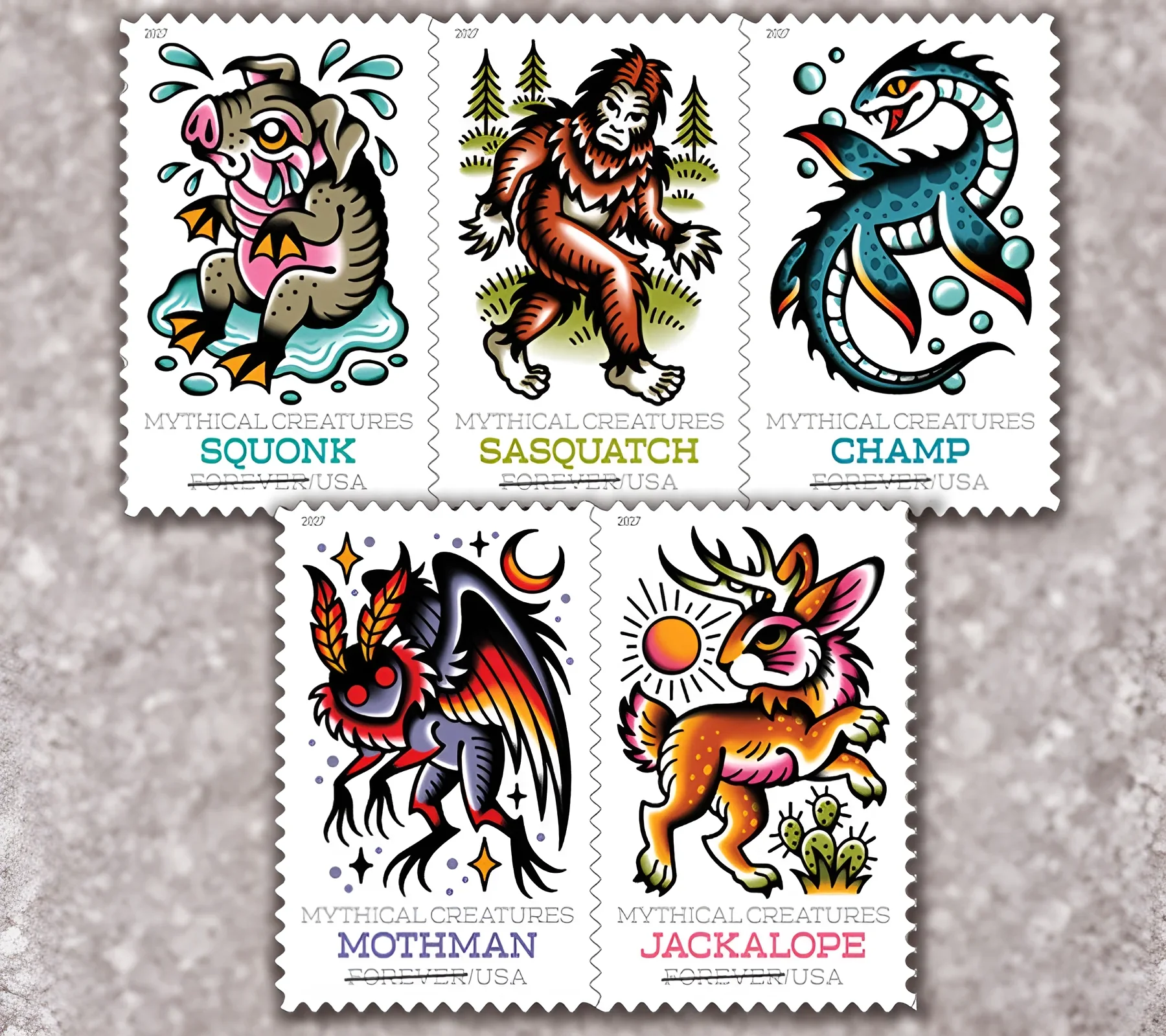
While the tattoo industry typically lives in its own world—between sterile rooms, the smell of antiseptic, and a queue of clients—one of its representatives has unexpectedly found herself at the very center of the American mainstream. On postage stamps. We are talking about Nat Power, a tattoo artist from Austin whose work has been appearing on the skin of Royal Legion Tattoo studio clients since 2019. It is her graphic style that forms the basis of the new series of US postage stamps, which the United States Postal Service (USPS) announced on November 9.
Five creatures from American folklore
The “Mythical Creatures” series is slated for 2027 and includes five stamps, each dedicated to a regional folklore character. According to the USPS, Power digitally illustrated the creatures and symbols of their habitats using bold black outlines and a vibrant color palette characteristic of her tattoo work. The final stamp layout was designed by the Postal Service’s art director, Antonio Alcalá. Here is the full composition of the series:
- Squonk — a water spirit from New England folklore that cries when pursued;
- Sasquatch — the “Bigfoot,” a forest giant of the western states;
- Champ — the legendary sea serpent from Lake Champlain, New York;
- Mothman — a winged creature from the town of Point Pleasant, West Virginia;
- Jackalope — a rabbit with antlers, a symbol of the state of Nevada.
All five characters are not Power’s inventions, but established elements of American folk folklore, and the choice of these specific ones suggests that the USPS intends to appeal to a “folk” audience, not just collectors.
From print graphics to skin and paper
Power’s path to postage stamps is no accident. The artist grew up in Cedar Hill, a suburb of Dallas, and then moved to Austin, where she received a Bachelor of Fine Arts degree from the University of Texas in 2016. During her studies, she delved into printmaking and serigraphy, and it is this background that is visible in her style: clear shapes, dense color spots, and expressive black line work. She began her apprenticeship at Royal Legion Tattoo in 2019, and since then, her specialization has become animals—from the familiar to monsters and chimeras.
It is important to establish the context here for those who follow tattoo culture as an independent phenomenon. For many years, tattooing existed on the periphery of “high” art: it was recognized in galleries, but not by state institutions. A US postage stamp is, in essence, public art that every American holds in their hands when sending a letter or postcard. The fact that the USPS has turned to tattoo art aesthetics for the first time, rather than classical illustration or photography, is a notable shift. Power’s partner, Rory Blank, emphasized exactly this on his X account: “Nat might be the first person to draw US postage stamps in a tattoo art style.”
For the tattoo community, this is a double signal. On one hand, it is validation: street, “skin-based” graphics are gaining legitimacy at the level of a federal institution. On the other, it is a cause for discussion about where the line lies between subcultural expression and a commercial product. Stamps are not tattoos: they do not live on the body, do not carry personal meaning for a specific person, and do not require pain or commitment. But their visual language—bold outlines, flat colors, decorative stylization—is entirely borrowed from the tattoo tradition, and in this sense, Power has become a bridge between two worlds that have looked at each other with distrust for decades.
It is also worth noting the logic of the selection itself. The USPS has long released thematic series—from space to dinosaurs—but mythical creatures in a tattoo style is a rare move. It works for a young audience that grew up with tattoo culture and for whom a tattoo has long ceased to be a mark of “deviance,” becoming a norm of everyday aesthetics. Power, with her bright animals, insects, and even Pokémon characters, was already familiar to this audience through Instagram and tattoo conventions; now her work will be seen on envelopes across the country.
For tatufoto.com, this case is a clear example of how tattoo culture is ceasing to be a niche phenomenon and becoming part of the country’s visual code. An artist who was working in a studio in Austin yesterday is defining the look of state products today. And perhaps the most interesting thing about this story is not the fact that tattoo graphics are appearing on stamps, but that it looks natural rather than sensational. This is a sign of a subculture’s maturity: when its language stops surprising and simply starts being used.