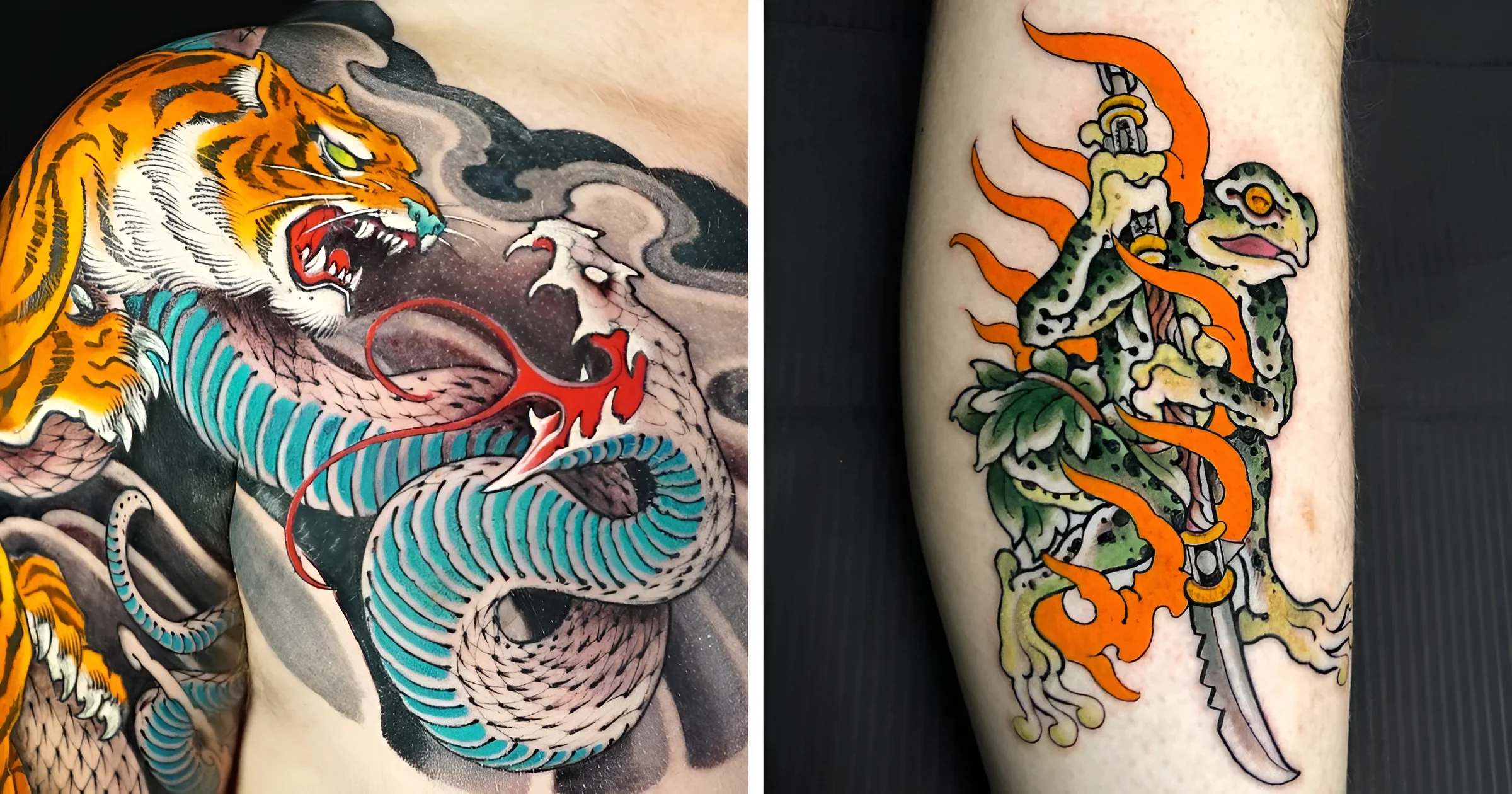
The five tattoos in this collage are not just striking images, but an entire system of signs inherited from classic Japanese woodblock prints and the theatrical stage. Each piece here reads like a separate chapter: from the eternal confrontation between the tiger and the dragon to a ninja riding a toad. To understand what exactly makes these sketches truly Japanese, rather than just Oriental in style, it is worth breaking them down layer by layer — from the symbolic code to the craftsmanship technique used to apply them.
Tiger and dragon: two poles of one world
In the Japanese visual tradition, the tiger and the dragon are not just two powerful beasts, but two poles between which a silent war is constantly being waged. The dragon rules the clouds and the rain, that is, everything above; the tiger holds the wind and the earth, everything below. Their rivalry is so deeply rooted in the culture that there is a separate word in the language for two perfectly equal opponents — “ryuko,” literally “dragon and tiger.” When a master puts this pair into a single sketch, they embed the idea of balance and eternal tension into it. This is especially evident in the first work of the collage: a ginger tiger with a snarl presses against the turquoise body of a dragon, while gray clouds of smoke or steam between them act as a border between the two elements.
Seasonality as a law of composition
The second important principle is linking each plant to its season. A traditional master will never mix up the seasons: cherry blossoms live in spring, peonies bloom in early summer, and maple leaves fall in autumn. This is not a whim, but a way to “ground” the composition in time and give the viewer an instant hint about the mood. The logic is the same as in “hanafuda” cards, where each month of the year is assigned its own plant. The table below helps you quickly navigate this code:
| Plant | Season | Meaning in the sketch |
|---|---|---|
| Sakura | Spring | Fleeting beauty, beginning |
| Peony | Early summer | Wealth, blooming, good luck |
| Maple | Autumn | Maturity, change, fading warmth |
Expert perspective: it is this discipline that distinguishes competent traditional work from an “Oriental” style assembled from random pictures. If a winter motif sits next to a summer one in a sketch without reason, the composition loses the internal logic that holds the entire Japanese school together.
Yokai and Noh theater masks
Many creatures in these sketches are “yokai,” a generalizing word for the monsters, ghosts, and spirits that fill Japanese mythology. A significant part of their appearance has reached us in the form recorded by the artist Toriyama Sekien in his illustrated catalog of 1776. The ninja on a toad is a prime example: the toad here is not a random companion, but a typical yokai image, and the character himself is assembled from theatrical and folkloric details. The history of the masks is even longer: many of them came from the “Noh” theater, which is over 600 years old. The masks are carved so cleverly that a slight tilt of the actor’s head changes the emotion — lift the face, and it seems joyful; lower it, and the same mask becomes sorrowful. In tattooing, the master transfers this lively play of expressions into a static drawing, embedding hidden dynamics into the face.
Horishi and the tebori technique
Now about who does this and how. Traditional tattoo masters are called “horishi,” and their name almost always begins with the root “hori” — “to carve”; this name is given by a teacher and is itself a sign of the school’s lineage. Some masters still work entirely by hand using the “tebori” technique: needles attached to a long rod are inserted into the skin one by one, without a single machine. It is slower, more painful, and more meditative than the machine method, and it is in this manual work that the character of the stroke is preserved, which is impossible to replicate with a machine. The dragon “looking” at the viewer and the spider by the waterfall in the collage — both sketches benefit from such a dense, drawing-like stroke that holds its form even in the details.
Bottom line: a Japanese tattoo is not a collection of “beautiful beasts,” but a strict language where the season, the creature, and the technique are subject to a single logic. Having understood this language, the reader stops seeing the sketch as mere decoration and begins to see a story that has rules, names, and nearly seven hundred years of stage tradition behind it.