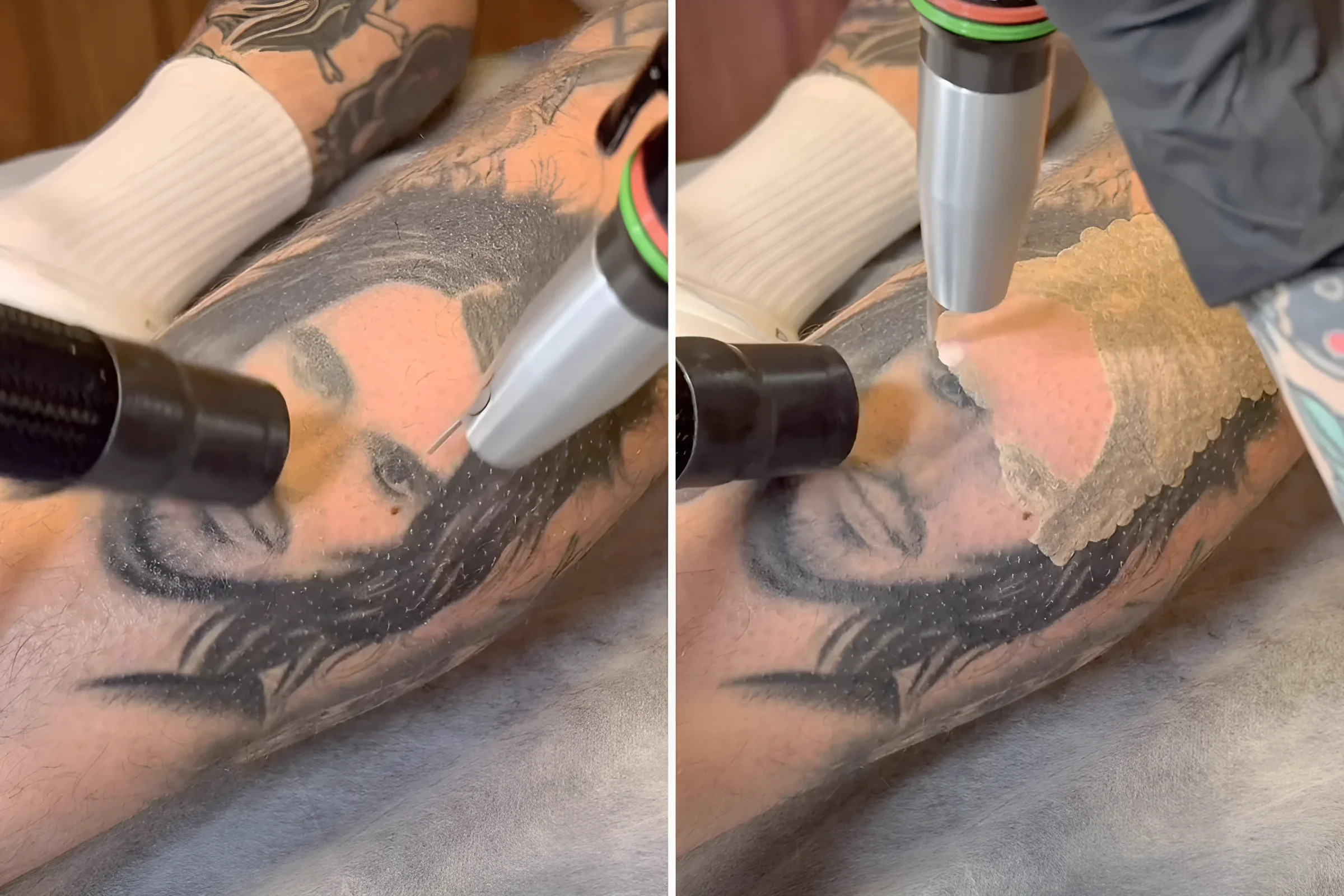
In Melbourne, a laser tattoo removal studio has found itself at the center of viral attention after posting a video of a client getting rid of a large portrait of Russell Brand on their thigh. Specialist Kelly Swift showed the process of lasering away the design layer by layer, and the clip garnered over 5.5 million views in just a few days. For a niche that usually discusses new work rather than its erasure, this is an anomalous level of reach.
The tattoo itself was applied 17 years ago, when Brand was at the peak of his fame: comedy shows, Hollywood films, and status as an idol for an entire generation. The client was 18 at the time, and the design became, in essence, an imprint of a specific moment in life—a fascination that lost its meaning over the years. As Swift explained, people’s interests change, and that is a normal part of growing up. But it was the combination of a personal story with a high-profile legal outcome that made the video go viral.
Context: why this became news
The client’s decision was made against the backdrop of a high-profile sentencing. Brand was found guilty of rape and a series of sexual assault incidents against four women, committed between 2004 and 2009. The court sentenced him to 10 years and 6 months in prison. For the tattoo community, such a turn of events is not just gossip, but a confrontation with the fact that a design on the skin does not exist in a vacuum: it carries someone else’s biography and actions, which can flip one’s assessment of a person.
Tattoo culture experts have long noted that portraits of public figures are one of the most “fragile” subjects. A tattoo of an idol’s face captures not only their image but also an emotional connection to them. When an idol gets caught in a scandal, the owner of the tattoo finds themselves in an awkward position: wear someone else’s face that they are now ashamed of, or erase it. In this sense, the case from Melbourne is not an isolated story, but a typical example of how tattoo culture experiences the “aftermath.”
What’s next for the design
According to Swift, complete removal of the portrait will take between six and nine sessions. But the client won’t have to wait that long for the skin to be clear: after a few procedures, the design will be prepped for a cover-up—replacing it with a new image. This is standard practice, which turns removal from mere “erasure” into a transition to a new meaning.
Swift also admitted that she did not expect such a response: “I forget that there are so many people in the world. It’s a nice way to feel very insignificant.” For a studio that regularly posts laser videos and “before/after” shots, such reach is a rare case where a technical procedure becomes a social narrative.
Key facts
To keep track, here is the main information in a table:
| Parameter | Detail |
|---|---|
| City | Melbourne, Australia |
| Specialist | Kelly Swift |
| Tattoo subject | Portrait of Russell Brand on thigh |
| Client age at application | 18 years old |
| Tattoo age | 17 years |
| Video views | over 5.5 million |
| Brand’s sentence | 10 years and 6 months |
| Period of incidents | 2004–2009 |
| Number of female victims | 4 |
| Sessions for full removal | 6–9 |
The bottom line is simple: a tattoo is not just ink, but a contract with oneself that can be terminated. The story from Melbourne shows that tattoo removal today is not a sign of a mistake, but an independent part of tattoo culture, where skin remains a space for rethinking rather than a life sentence.