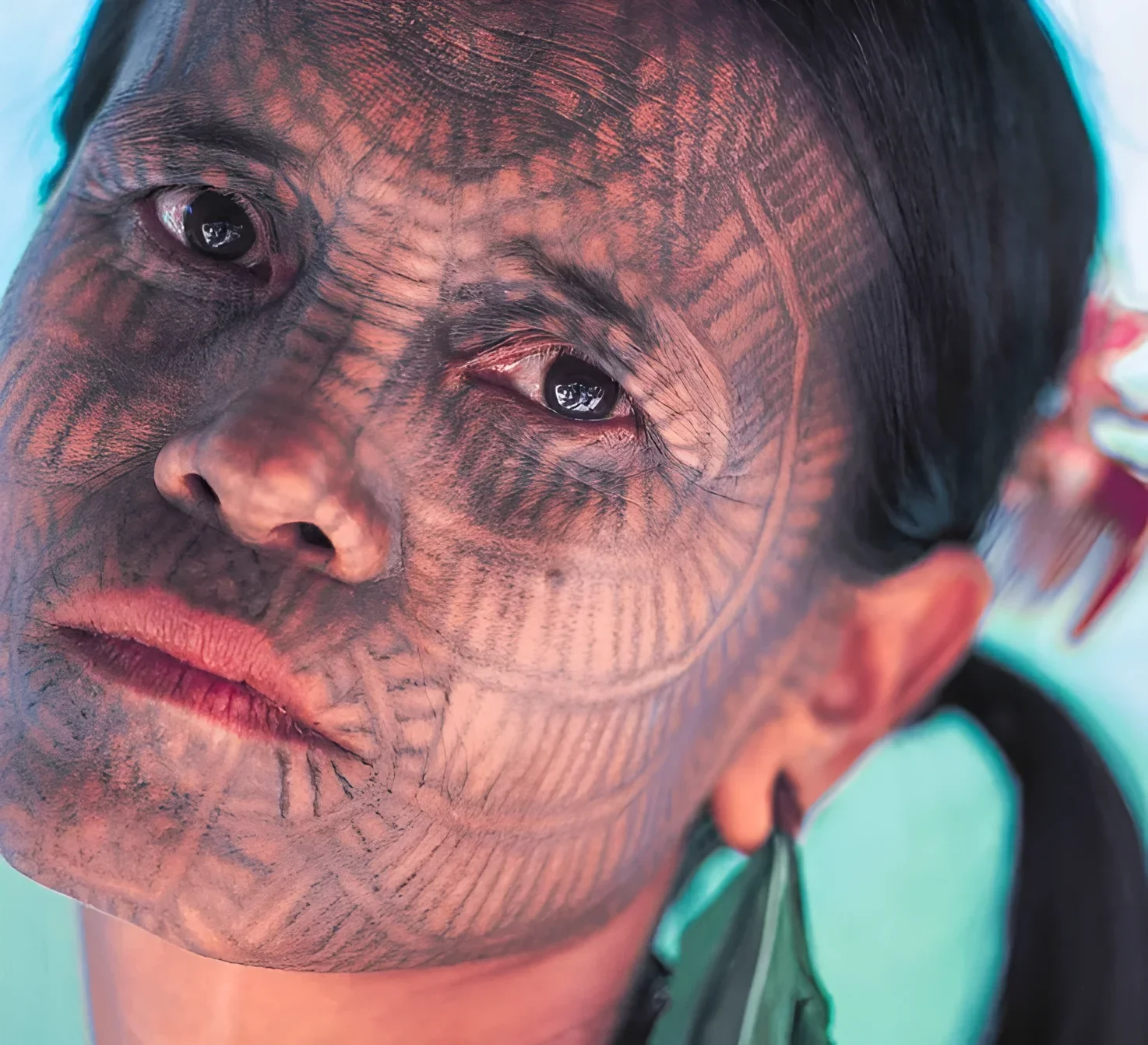
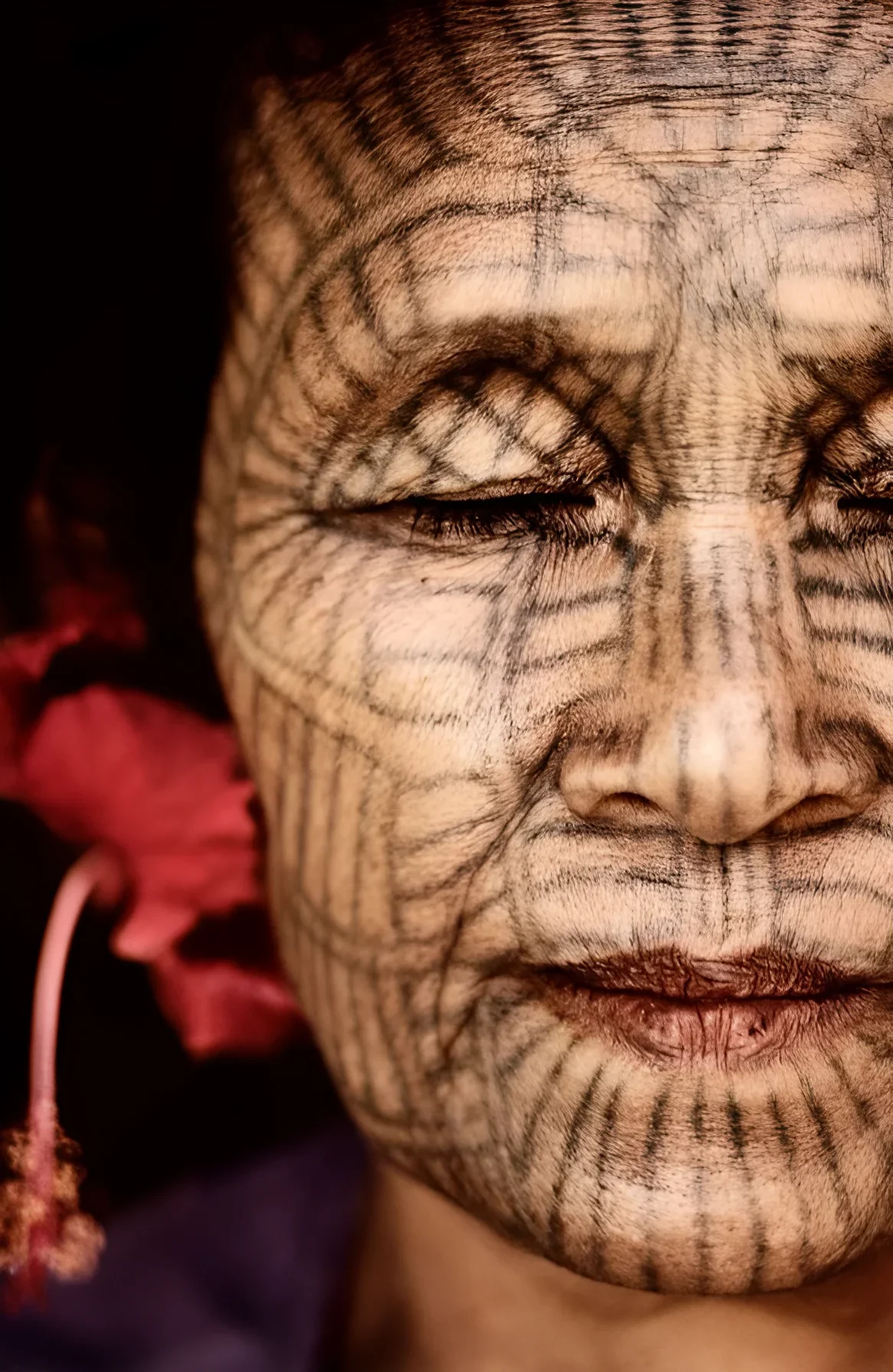
The woman in the photo is not smiling – and she doesn’t have to. A network of fine dark lines covers her face from forehead to chin, applied decades ago in the Chin State mountains. Her eyes are closed, and in this lies the complete peace of someone with nothing to hide. It was with such a meeting – a chance encounter in 2001 in southern Chin State – that the project began, which German photographer Jens Uwe Parkitny has been pursuing for a quarter of a century. From October 14 to 17, his works will be shown in the AIA Khit exhibition space, located in the restored colonial halls of The Secretariat in Yangon.
Three Traditions That Can No Longer Be Repeated
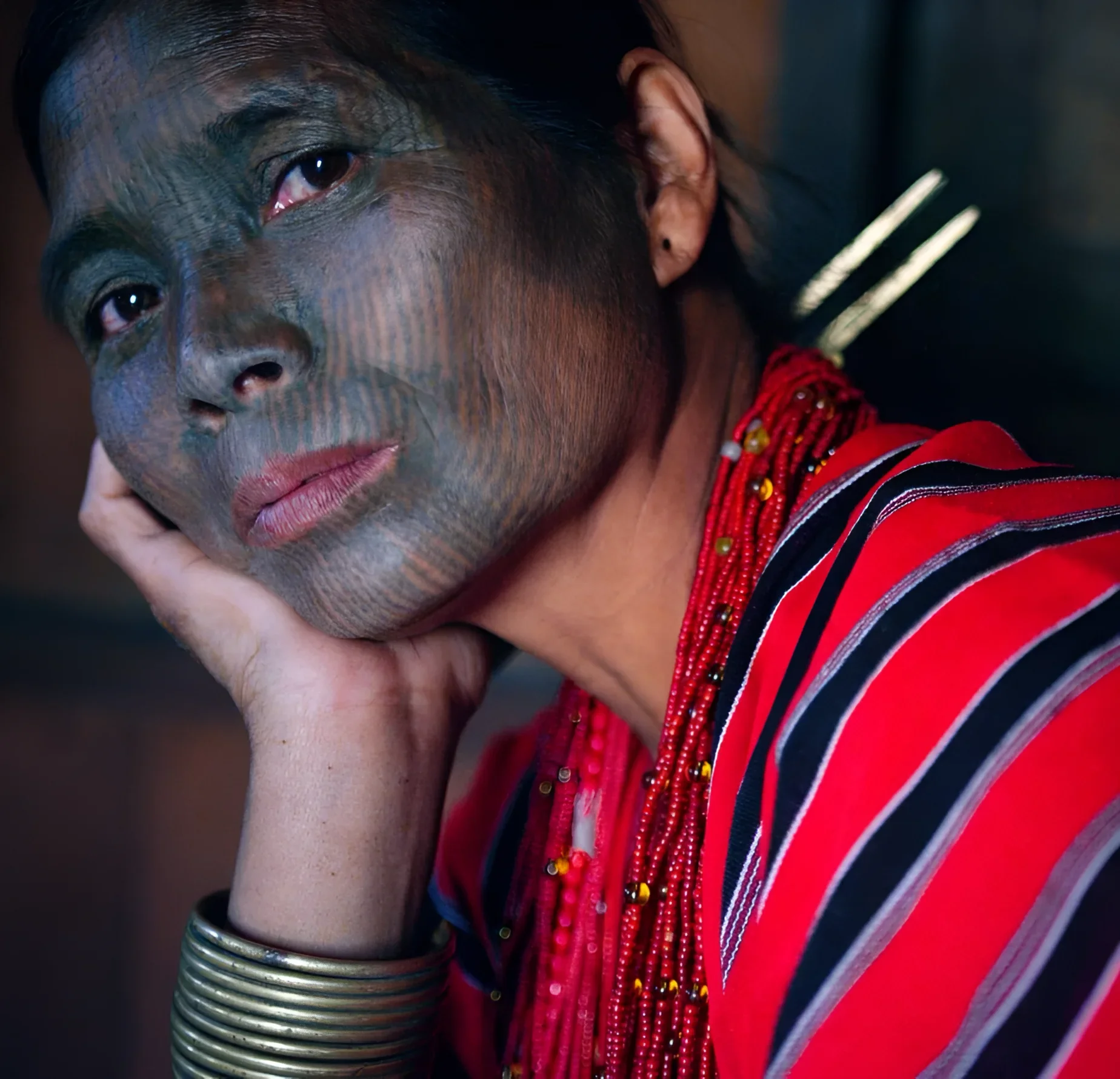
The exhibition „Myanmar’s Untold Tattoo Stories“ brings together three independent series: the facial tattoos of Chin women, the leg tattoos of Kayin men, and the ritual markings of Manawsaitopat healers. Together, they essentially form the only comprehensive photographic documentation of Myanmar’s tattoo traditions, which have either already disappeared or are recorded fragmentarily. This is not a collection of „exoticism“ – it is a cultural archive that, once the last carriers are gone, will cease to be replenished.
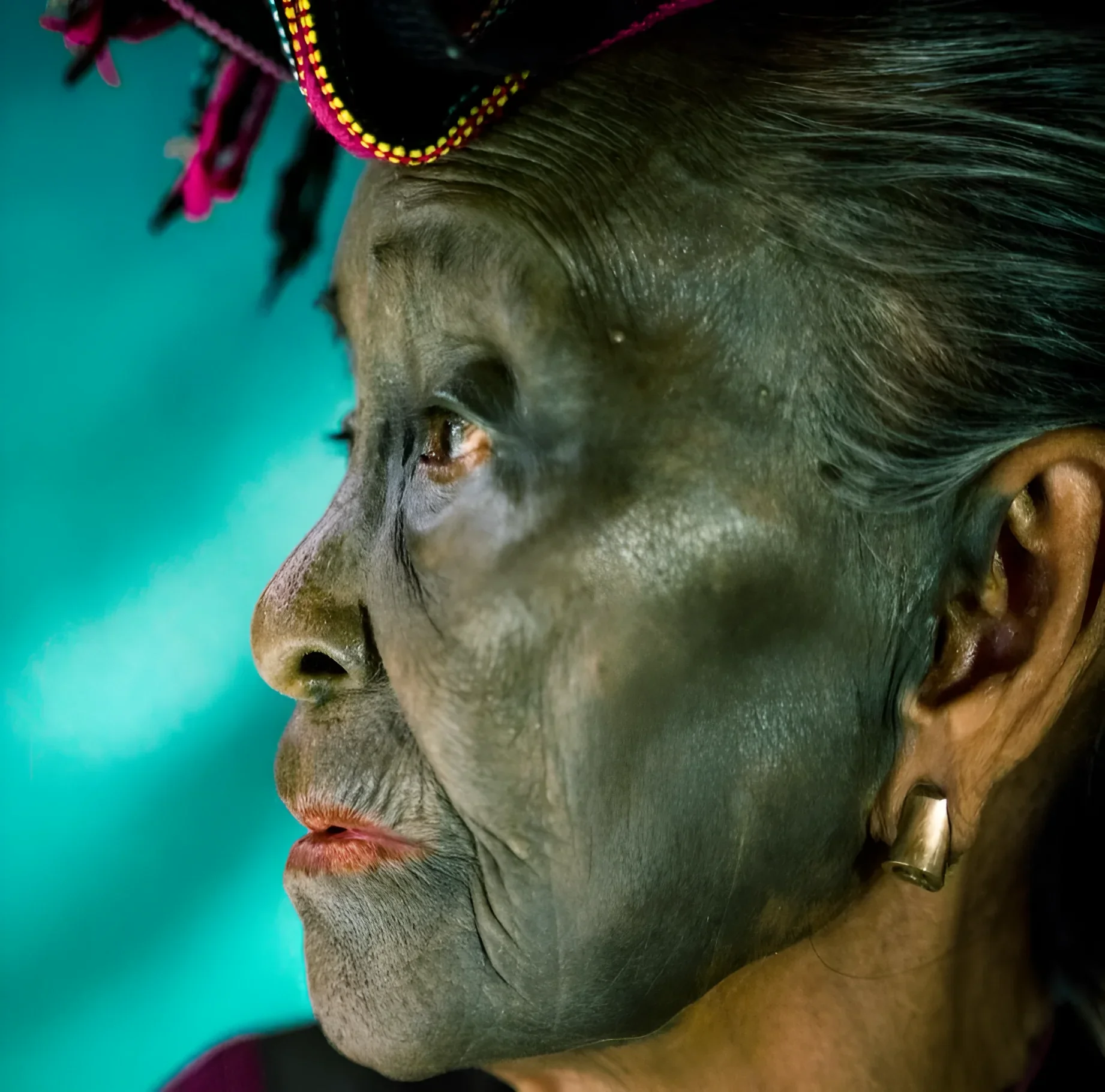
To an outside observer, the facial tattoos of Chin women were long perceived as deformation or „ugliness.“ Within the communities themselves, the meaning was the opposite: the patterns signified belonging to a specific group, social status, beauty, and spiritual protection. Different Southern Chin groups had their own patterns – from dense solid fields of ink to fine geometric lines and dots. The tradition has not been passed down for several decades, and the women who carry it are elderly. Parkitny’s portfolio remains the only known complete photographic record of this phenomenon.
Ink as Proof of Courage
The photographer began the second series – the leg tattoos of Kayin men – in 2014. The markings were applied from the waist to the knees and served as a ritual of initiation, a sign of coming of age, and a confirmation of bravery. As with the Chin faces, the practice has practically disappeared: the men who still wear these tattoos belong to the last generation, and Parkitny’s portraits capture them while they can still be found.
The third series is the least known. Since 2016, Parkitny has been photographing members of the Manawsaitopat order, Myanmar healers whose lineage dates back about 250 years. Here, the tattoo is not an adornment. It carries rank and healing power, is part of the initiation and protection practice, which few outsiders have seen up close. Alongside the three main series, the exhibition also features contemporary photographs of protective motifs, showing how the old belief in „marking“ the body for protection lives on in Myanmar today.
Trust is More Important Than the Shutter
It is worth mentioning the method separately. For twenty-five years, Parkitny has traveled through Myanmar, often defying both politics and geography. Many portraits are built on relationships established over years, others on trust earned in a single brief encounter. The result is a quiet, unhurried style: the subjects are not presented as ethnographic curiosities; their dignity speaks for itself. Parkitny’s visual language echoes the ethnographic portraiture of Edward Curtis from a century ago, although the photographer himself discovered it independently – he only found Curtis’s works when the Chin portraits were already well underway.
His photographs have been exhibited abroad since 2004. Key shows include a solo exhibition at the Bavarian State Museum of Ethnography in Munich (2010), the large-scale „Tattoo“ projects at Gewerbemuseum Winterthur in Switzerland (2013–2014) and the Museum für Kunst und Gewerbe in Hamburg (2015), a solo exhibition at Pataka Art + Museum in Porirua, New Zealand (2014), which was visited by over 36,000 people, as well as invited shows at Asia Society Hong Kong (2009), Goethe-Institut Myanmar (2016), and the Foreign Correspondents‘ Club of Thailand in Bangkok (2024). Now, for four days, this work returns to Yangon – the country where it was created.
For the tattoo community, this project is important not as „exoticism from Asia,“ but as a reminder that tattooing is one of the oldest forms of body writing, where the line carries meaning, not just aesthetics. In an era when tattooing has become a mass decorative market, such archives return its ritual dimension: here, each pattern is an identity, status, protection, and memory inscribed on the skin. And the fact that these inscriptions are captured by a photographer who has spent twenty-five years building trust, rather than just arriving with a flash, makes the material irreproducible. In a generation, these people will be gone – only Parkitny’s frames will remain, and this, perhaps, is the main price and the main value of this exhibition.