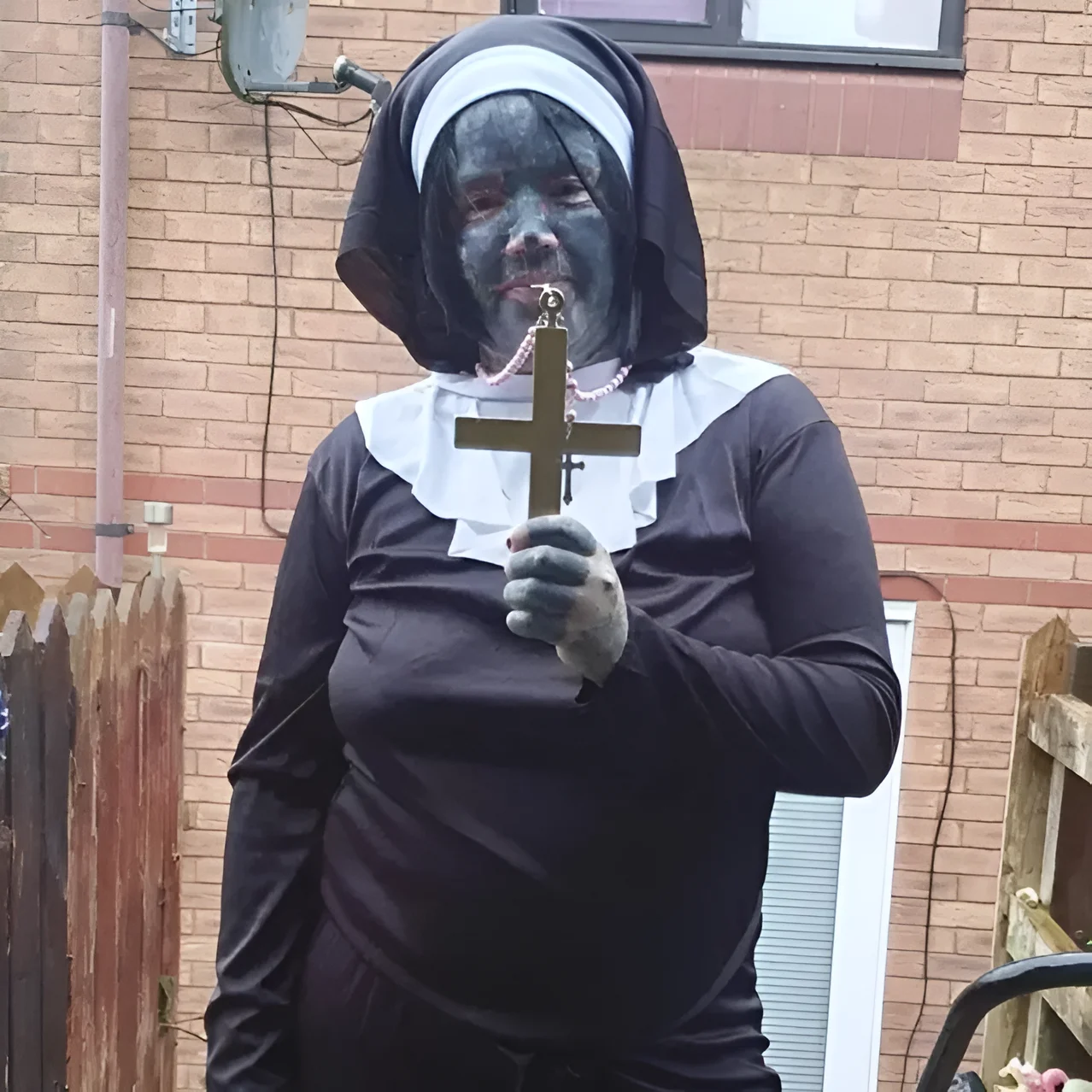
Melissa Sloan, a resident of Kidderminster, known in the British media as the mother with the most tattoos, has found paradoxical solace in Halloween. According to her, this holiday is the only night of the year when she doesn’t have to hide her face from judgmental stares. In a culture where extreme modifications often evoke rejection, Halloween paradoxically becomes a day of natural disguise for Sloan.
Life as a Canvas: 800+ Designs and the Price of Transformation
Melissa “Missy” Sloan has covered her body and face with over 800 tattoos. This journey towards total modification, which she herself describes as an addiction, has not been easy. Due to the scale and location of the designs (many of which were done by herself, as she was banned from local tattoo parlors), she regularly faces severe discrimination and prejudice.
The consequences of her radical appearance extend far beyond public opinion. Earlier this year, Missy admitted that she had to spend Mother’s Day at home because her tattoos were too off-putting. Furthermore, she claims that her appearance even hinders her ability to leave the country
due to issues with personal identification and obtaining visas.
Her case is a stark example of how permanent ink can affect basic civil liberties and daily life, turning a person into an outcast in modern society. Missy, who previously stated, I am a canvas
, is now forced to pay the price for her artistic stance with complete isolation.
Halloween: When a Mask Isn’t Needed
Speaking about her annual Halloween experiences, Missy Sloan highlighted the irony of the situation. In an interview with What’s the Jam, she stated:
I don’t need to dress up because of my face. People say I look scary enough already.
I’ve been told I look like a freak or even a gang member.
Thus, what is a cause for her alienation for 364 days a year transforms into the perfect, natural costume on the night of October 31st. She simply accompanies her children as they go trick-or-treating, remaining in the shadows
without changing her appearance.
Interestingly, her current comment contrasts with last year’s statements. In 2022, Missy worried that she would have to hide even on Halloween, as local children were too scared
of her appearance. This shows how dual her experiences are: from the fear of frightening others to using her image as a shield against the need to pretend.
The Burden of Ink: Regret and Social Pressure
Despite her uniqueness, Sloan does not hide that her extreme modifications have brought her more suffering than joy. She has openly expressed regret about her choices.
I wish I had never gotten them [татуировки]. I’m tired of people judging me. They look at me like I’m crazy and say I’ve ruined my face
, Missy confessed.
This admission calls into question the romanticized image of a “canvas” and highlights the tragic aspect of tattoo addiction, where the pursuit of self-expression leads to social isolation and a deep personal crisis.
Expert Analysis from tatufoto.com: The Sloan Phenomenon and the Culture of Stigmatization
Melissa Sloan’s story is not just a sensational news item about the amount of ink; it is a critical case reflecting deep cracks in the modern perception of body modifications. While small and moderate tattoos have become mainstream, total coverage, especially on the face, remains taboo and is perceived as an act of aggression or, at best, a sign of mental distress.
Sloan’s case raises the question of “tattoo addiction.” Although it is not a clinically recognized diagnosis in most classifications, psychologists often link the compulsive desire for modification with Body Dysmorphic Disorder (BDD) or an attempt to cope with trauma by controlling one’s appearance. When tattoo parlors refuse to work with a client due to their extreme requests, it is often an attempt to exercise professional ethics and protect the individual from irreversible social consequences, which, as Sloan’s example shows, can be catastrophic.
The paradox of Halloween, which Missy describes, has a deep cultural context. Halloween, as a carnival, has historically served as a temporary valve, allowing people to break social norms without punishment. For Sloan, this means a temporary alignment of her permanent mask
with the generally accepted standard of scary
. For one night, her appearance ceases to be an anomaly and becomes part of the norm.
However, her regret about the tattoos she has received is the most important aspect of this story for the tattoo industry. It serves as a reminder that permanent decisions require not only skill but also psychological assessment. The discrimination she has faced (from being unable to celebrate holidays with her children to problems with documents) demonstrates that society is still not ready to accept totally modified individuals as full members of society, especially if they are in a parental role.
Ultimately, Melissa Sloan remains a living, albeit tragic, embodiment of the limits of freedom of expression in the 21st century. Her story serves as a cautionary tale that even the most personal decisions come with a high social price.