A Cartouche tattoo is not just a beautiful Egyptian motif. It is one of the most profound, ancient, and symbolically rich signs you can choose for your body. In ancient Egypt, the Cartouche served as an eternal seal, designed to preserve the pharaoh’s name from oblivion and protect their essence in the afterlife. By choosing this symbol, you not only pay homage to history but also attract powerful energy of protection, identity, and immortality.
Cartouche Tattoo: What is this symbol and why is it so popular
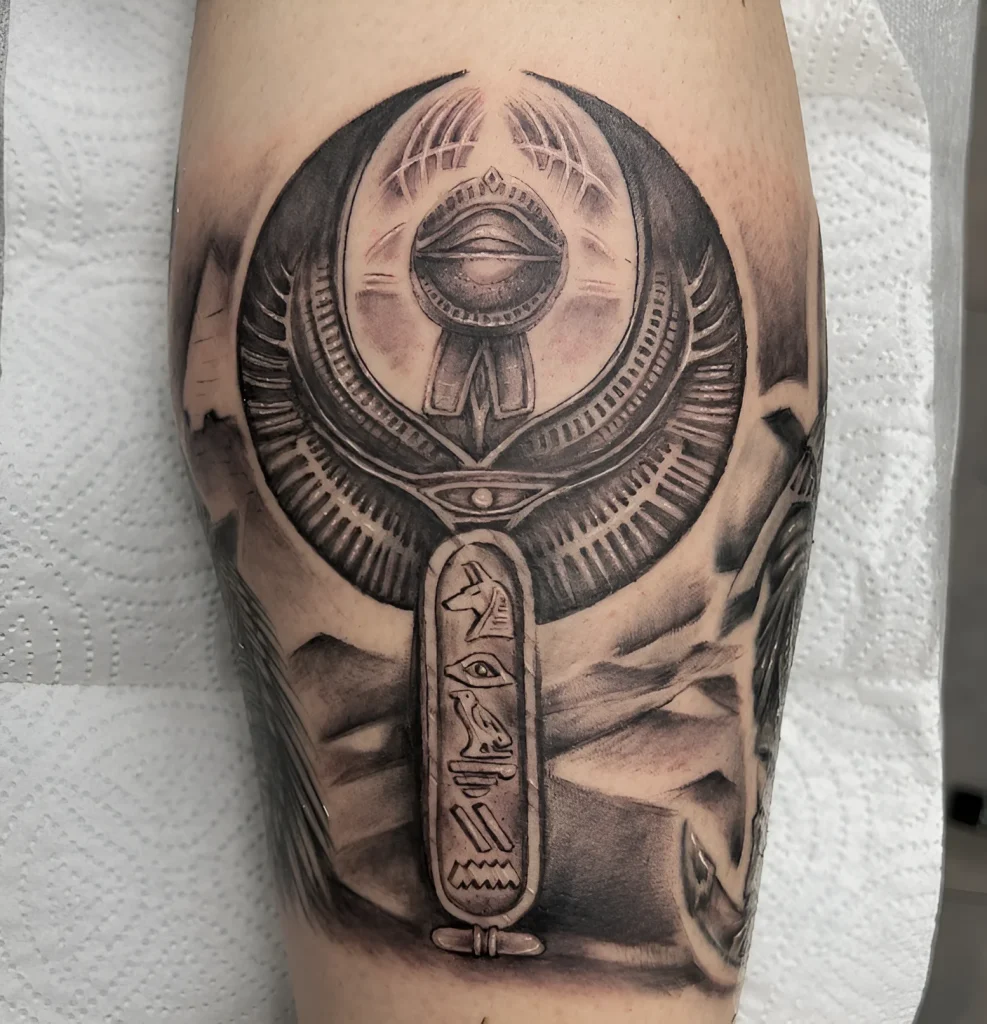
A Cartouche (French: cartouche – cartridge, case) is an elongated oval, based on the ancient symbol shen (Shen ring), which in turn symbolized infinity and eternity. This oval is enclosed by a horizontal line serving as a base or pedestal. Inside the Cartouche, ancient Egyptians recorded the personal name (Ren) and throne name (Niswt Bity) of their pharaohs using hieroglyphs.
The popularity of the Cartouche tattoo in the modern world is due to several key factors:
- Uniqueness and Identity: The Cartouche allows for personalization of a tattoo by inscribing one’s name or the name of a loved one, using one of the oldest and most mysterious writing systems – Egyptian hieroglyphs.
- Powerful Symbolism of Protection: The oval frame served as magical protection for the name, which in Egyptian culture was inseparable from the personality and soul. It was believed that as long as the name existed, the person existed.
- Aesthetic Appeal: Graphically, the Cartouche looks strict, elegant, and intriguing, fitting perfectly into both minimalist and grand compositions dedicated to Egyptian mythology.
The shen symbol, which forms the basis of the Cartouche, originally represented a rope loop with its ends tied at the bottom. This loop symbolized the protection of everything within its boundaries and represented the cyclical nature of time and eternal reign. When this loop was elongated into an oval to accommodate long names, it became the Cartouche, but its primary function – eternal protection – remained unchanged.
The History of the Cartouche: From Ancient Egyptian Pharaohs to Modern Tattoos
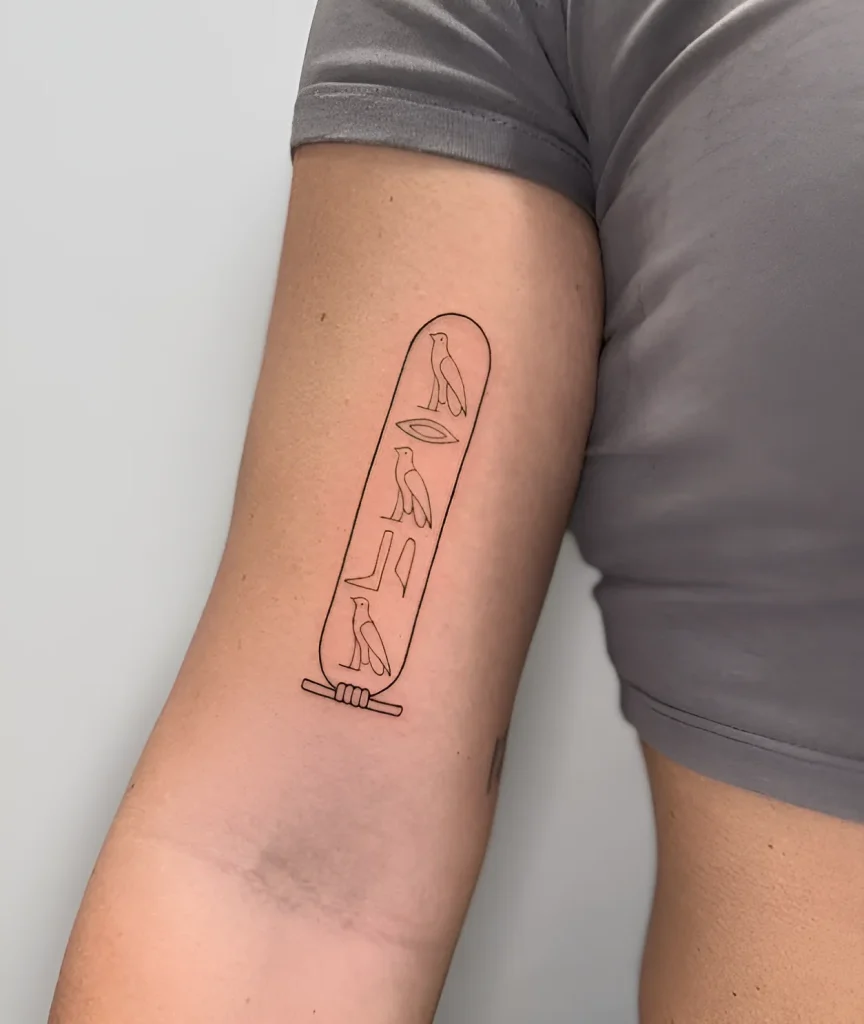
The history of the Cartouche spans over four and a half millennia. It first appeared during the 4th Dynasty of the Old Kingdom (around 2600 BC). Before that, pharaohs used a rectangular symbol called a serekh to record their names. The serekh mimicked the facade of a palace and was more associated with earthly power.
Transition from Serekh to Cartouche
The transition to the Cartouche marked a significant shift in the Egyptian worldview. If the serekh protected the pharaoh’s earthly power, the Cartouche, with its symbolism of eternity (shen), protected their Ren (name) and Ba (soul) for the journey to the afterlife. This was critically important because, according to beliefs, if the pharaoh’s name was erased, their soul could not find its body and achieve immortality.
Important Historical Examples:
- Tutankhamun: His tomb was replete with Cartouches, which not only confirmed his royal status but also ensured his eternal life. It was thanks to the Cartouches containing his name that archaeologists were able to identify the mummy and reconstruct his history.
- Hatshepsut: As a female pharaoh, she used the Cartouche to legitimize her rule, emphasizing that she was a rightful successor whose name was protected by eternal forces.
In the modern context, the Cartouche tattoo has become popular due to the increased interest in Egyptology in the 19th and early 20th centuries. People began to seek not only historical but also personal mystical protection in this symbol. A modern Cartouche on the skin often serves as a personal amulet, connecting the wearer to millennia of ancient wisdom and power.
Tattoo artists working in Oriental or Blackwork styles often use detailed Cartouches to emphasize the connection between personal identity and the monumentality of ancient civilization. This makes the Cartouche an ideal choice for those seeking a tattoo that combines deep meaning and high aesthetics.
The Meaning of a Cartouche Tattoo: Protection, Name, and Connection to the Afterlife

Understanding the true meaning of a Cartouche tattoo requires delving into the Egyptian concept of the soul and identity. In Ancient Egypt, a person’s personality consisted of multiple elements, among which the key ones were the Ka (life force), Ba (soul/personality), and Ren (name).
Ren (Name) and Eternal Life
Ren was what the Cartouche protected. Egyptians believed that a person lived as long as their name was spoken. If the name was destroyed (erased from temple walls or not magically protected), the person ceased to exist in the afterlife. The Cartouche, being a physical, magically charged barrier, ensured that the name (and thus the personality) would be preserved forever.
Thus, a Cartouche tattoo symbolizes:
- Eternal Protection: It is a powerful amulet, protecting your personal essence and identity from negative forces and oblivion.
- Identity and Self-Determination: By inscribing your name, you declare your uniqueness and the indestructibility of your “self.”
- Immortality and Legacy: The Cartouche is a promise that your story and your name will live on, even after you leave this world.
Connection with Divine Forces
The border of the Cartouche, as mentioned earlier, is derived from the shen symbol, which was often depicted in the claws of gods (like Horus or Ra), symbolizing their dominion over eternity. This means that the Cartouche not only protects the name but also places it under the patronage of cosmic and divine forces. Choosing a Cartouche tattoo can reflect your aspiration for:
- Patronage of Higher Powers: The desire to be protected from chaos (Isfet) and evil.
- Stability and Order: A symbol that was an integral part of the strict and ordered world of the pharaohs.
- Royal Dignity: The Cartouche was historically a prerogative of rulers, and wearing it on the skin can symbolize inner strength and dignity.
For many modern people, a Cartouche tattoo becomes a symbol of their personal journey towards self-discovery and spiritual protection in the complex modern world. It is a deeply personal choice that carries not only aesthetics but also a millennia-old magical function.
Cartouche Tattoo Styles: From Traditional Egyptian to Modern Interpretations

Although the Cartouche itself has a strict geometric shape, its artistic execution provides tattoo artists with a wide field for creativity. The choice of style is crucial, as it determines how clearly and durably the inscribed hieroglyphs will appear.
1. Traditional Egyptian Style
This style is as close as possible to the images found in temples and tombs. It is characterized by:
- Color Palette: Use of earthy tones – ochre, terracotta, deep blue (symbolizing lapis lazuli and the sky), green (symbolizing the Nile and rebirth).
- Lines and Detailing: Clear, bold outlines around the hieroglyphs. Hieroglyphs are often stylized to resemble relief, creating a sense of volume.
- Context: The Cartouche is often integrated into a larger scene with other Egyptian deities (Anubis, Isis) or symbols (Eye of Horus, Ankh).
2. Blackwork / Linework Style
The most popular modern approach. The Cartouche is done exclusively in black ink. This style is ideal for those who appreciate minimalism and clarity:
- Clarity and Readability: In blackwork, it is easy to achieve perfect readability of hieroglyphs, which is especially important given their symbolic meaning.
- Graphic Quality: The Cartouche looks like a strict, architectural element. Dotted shading (dotwork) is often used to add depth.
- Advantage: Blackwork ensures maximum tattoo longevity, as black pigments are less prone to fading.
3. Realism and 3D Effect
In this style, the artist aims to create the illusion that the Cartouche is carved from stone or gold. It uses a complex play of light and shadow, as well as imitation of texture (e.g., cracked sandstone or polished metal). Such works require high skill and typically occupy a large area on the body.
Recommendations for Choosing a Style
When choosing a style for a Cartouche tattoo, especially if you plan to inscribe a name, always consult with an artist specializing in fine work. Hieroglyphs are small, complex symbols that can blur or merge if the tattoo is not done well or if it’s too small. Blackwork or fine linework are usually the best choices for maintaining the clarity of hieroglyphs for years to come.
Where to Best Place a Cartouche Tattoo on the Body: Options and Recommendations

The choice of location for a Cartouche tattoo should be guided not only by aesthetic considerations but also by the symbolic meaning of protection that this sign carries. The placement of the Cartouche is often interpreted as a strategic positioning of the amulet on the body.
Symbolically Significant Locations
1. Forearm or Wrist (Visible Protection)
- Meaning: Placement on the arm, which actively interacts with the world, symbolizes active protection and the wearer’s ability to influence their destiny. This location is ideal for a medium-sized Cartouche where the hieroglyphs will be clearly legible.
- Practicality: An excellent choice for linework or blackwork options that do not require too much space.
2. Back (Center of Strength and Amulet)
- Meaning: In tattoo culture, the back is often associated with protection from external blows and is considered a “shield.” A Cartouche placed along the spine or on the shoulder blade enhances this function, becoming a powerful amulet for the entire personality.
- Practicality: Allows for large-scale compositions, integrating the Cartouche into more complex Egyptian scenes (e.g., depicting it as part of a temple wall).
3. Chest (Protection of Heart and Soul)
- Meaning: Placing the Cartouche close to the heart or solar plexus symbolizes the protection of the most intimate aspects of personality, emotions, and soul (Ba). This is a very personal and intimate location for such a significant symbol.
4. Shin or Calf (Symbol of the Path)
- Meaning: Placement on the leg symbolizes protection on life’s journey, guarding the wearer in their travels and aspirations.
Important Recommendations on Size
A Cartouche containing a name requires sufficient size so that the hieroglyphs do not merge over time. If your name is long (e.g., contains 6–8 hieroglyphs), the minimum length of the Cartouche should be at least 15–20 cm, depending on the complexity of the chosen symbols. If the Cartouche is too small, the lines may “run” after a few years, making the text illegible, which completely negates the magical meaning of the symbol.
Cartouche Tattoo with a Name: How to Choose Hieroglyphs and Avoid Mistakes

The most complex and responsible part of creating a Cartouche tattoo is the correct transliteration of your name into Egyptian hieroglyphs. Egyptian writing is not an alphabet in our understanding; it is a complex system combining phonetic signs, logograms, and determinatives.
Key Rule: Phonetic Transliteration
Ancient Egyptian Cartouches contained names written phonetically, i.e., by sound. Your Russian name (e.g., “Alexey” or “Marina”) must be converted into a set of Egyptian signs that together reproduce this sound. It is important to remember that Egyptian writing did not have vowels (they were implied).
Steps for Correct Transliteration:
- Breakdown into Sounds: Break down the name into consonant sounds (e.g., “M-R-N” for Marina).
- Choosing Hieroglyphs: Use standard phonetic signs (e.g., “hand” for the sound D, “owl” for the sound M).
- Determinatives (Optional): At the end of the name, a determinative can be added – a sign that is not pronounced but indicates the category of the word. For a person’s name, this is usually the hieroglyph for “seated man” or “seated woman.”
Critical Mistakes to Avoid
1. Using Online Translators: Most free online hieroglyph generators use simplified tables that may be inaccurate or use signs from different historical periods. This can lead to a meaningless set of symbols.
2. Direct Translation of Meaning: You cannot translate a name by its meaning (e.g., “Victor” as “winner”). The Cartouche is intended exclusively for the phonetic recording of a personal name (Ren).
3. Incorrect Orientation: Hieroglyphs in a Cartouche are usually written from top to bottom, and their “faces” (if they are depictions of people or animals) should always face the beginning of the Cartouche. An experienced artist or Egyptologist should verify the correct direction.
Expert Advice
Before getting a Cartouche tattoo with a name, consult a professional Egyptologist or linguist to get an accurate and verified transliteration. This will ensure that your “Ren” is properly protected. Investing in a consultation is incomparably less than regretting an incorrect symbol on your skin.
- M: Hieroglyph “owl”
- R: Hieroglyph “mouth”
- N: Hieroglyph “water” (wavy line)
- K: Hieroglyph “basket with handle”
- Z/S: Hieroglyph “bolt”
Remember, these are just basic examples. Full transliteration requires considering context.
Cartouche Tattoo Care: Tips for Maintaining Brightness and Longevity

A Cartouche tattoo, especially if it contains many small hieroglyphic details, requires careful care to maintain its clarity and symbolic integrity. Improper care can lead to the blurring of fine lines, which is critical in the case of hieroglyphs.
Healing Phase (First 2–4 Weeks)
- Hygiene: In the first few days, strictly follow the artist’s instructions for using special healing films or regular washing with antibacterial soap without fragrances.
- Moisturizing: Use recommended ointments (e.g., based on dexpanthenol) in a thin layer. Over-moisturizing can blur the pigment.
- Protection from Friction: Avoid wearing tight clothing that can rub against the tattoo, especially if the Cartouche is located on the wrist or shin.
Long-Term Care and Detail Preservation
Over time, the fine lines of hieroglyphs may begin to fade or lose contrast, especially if the Cartouche is done in a fineline or dotwork style. To avoid this, follow these rules:
- Sun is the Main Enemy: Ultraviolet radiation destroys pigment, causing it to fade and lines to expand. The Cartouche, as an Egyptian symbol, often has dark or bright colors that are particularly sensitive to the sun. Always use sunscreen with SPF at least 50.
- Regular Moisturizing: Keep the skin in the tattooed area moisturized even after complete healing. Healthy, hydrated skin holds pigment better.
- Touch-up: If you notice that the small hieroglyphs are starting to lose clarity after a few years, do not hesitate to contact an artist for a touch-up. This is a standard procedure for detailed tattoos.
Remember that preserving the clarity of the Cartouche is preserving your Ren (name). Careful care is part of respecting the deep symbolism you have chosen.
Frequently Asked Questions about Cartouche Tattoos (FAQ)

1. Should a Cartouche be vertical?
Historically, Cartouches could be both vertical and horizontal, depending on their placement on walls or papyri. Vertical orientation (top to bottom) is more common and traditional for recording names. In the context of tattoos, the choice depends on body anatomy (e.g., a horizontal Cartouche might look better on the lower back or chest).
2. Can a word, like “love,” be inscribed in a Cartouche instead of a name?
While technically possible (Egyptian writing allows for any words to be written), from the perspective of authentic symbolism, the Cartouche was created exclusively for recording and magically protecting the personal name (Ren) of the pharaoh. Using it for abstract concepts diminishes its historical and magical significance as an identity amulet.
3. Can two names be combined in one Cartouche?
Typically, a Cartouche is intended for one name. If you want to combine names, it’s better to use two separate Cartouches side-by-side, or to create a double Cartouche, which was very rarely used in the late period (e.g., for the names Ptolemy and Berenice), but this requires a very large space for the tattoo.
4. What is the approximate cost of a Cartouche tattoo?
The cost varies greatly depending on the size, style, and complexity of the hieroglyphs. Since a Cartouche requires high precision and is often considered a detailed work (Fine Line or Blackwork), the price will be higher than for a simple outline. Be sure to factor in the cost of consultation and transliteration from a specialist if your artist is not an expert in Egyptology.
Interesting Facts about Cartouches and Their Meaning in Ancient Egypt

The Cartouche is a symbol steeped in history and mysticism. Knowing these facts will help you understand the meaning of your tattoo more deeply:
- Role in the Rosetta Stone: It was the Cartouches that became the key to deciphering Egyptian hieroglyphs. Champollion noticed that the repeating groups of hieroglyphs enclosed in Cartouches corresponded to royal names (Ptolemy and Cleopatra) written in Greek, which allowed him to match the phonetic values of the signs.
- Cartouche and the Curse of the Pharaohs: In ancient times, the destruction of a Cartouche was considered an act of the greatest vandalism and magical murder. If a pharaoh’s name was erased (e.g., Thutmose III tried to erase the name of his predecessor Hatshepsut), it was an attempt to deprive them of eternal life.
- Two Names in a Cartouche: Pharaohs often had five names, but only two of them – the throne name (Niswt Bity) and the personal name (Sa Ra, son of Ra) – were enclosed in a Cartouche. This emphasized their divine and earthly origins.
- Etymology: The term “Cartouche” is a French word given by Napoleon’s soldiers during the Egyptian campaign. They thought the oval shape with a horizontal line resembled a cartridge or case (cartouche). The Egyptians themselves called it simply shenu (shemu), derived from the Shen symbol.
By choosing a Cartouche tattoo, you become a keeper of this ancient tradition, carrying on your skin a symbol that has survived millennia and served as a shield for the most powerful rulers in human history. It is a choice that requires attention to detail, precision in execution, and a deep understanding of its eternal symbolism.
Additional Images
Gallery of remaining images (click to view):


