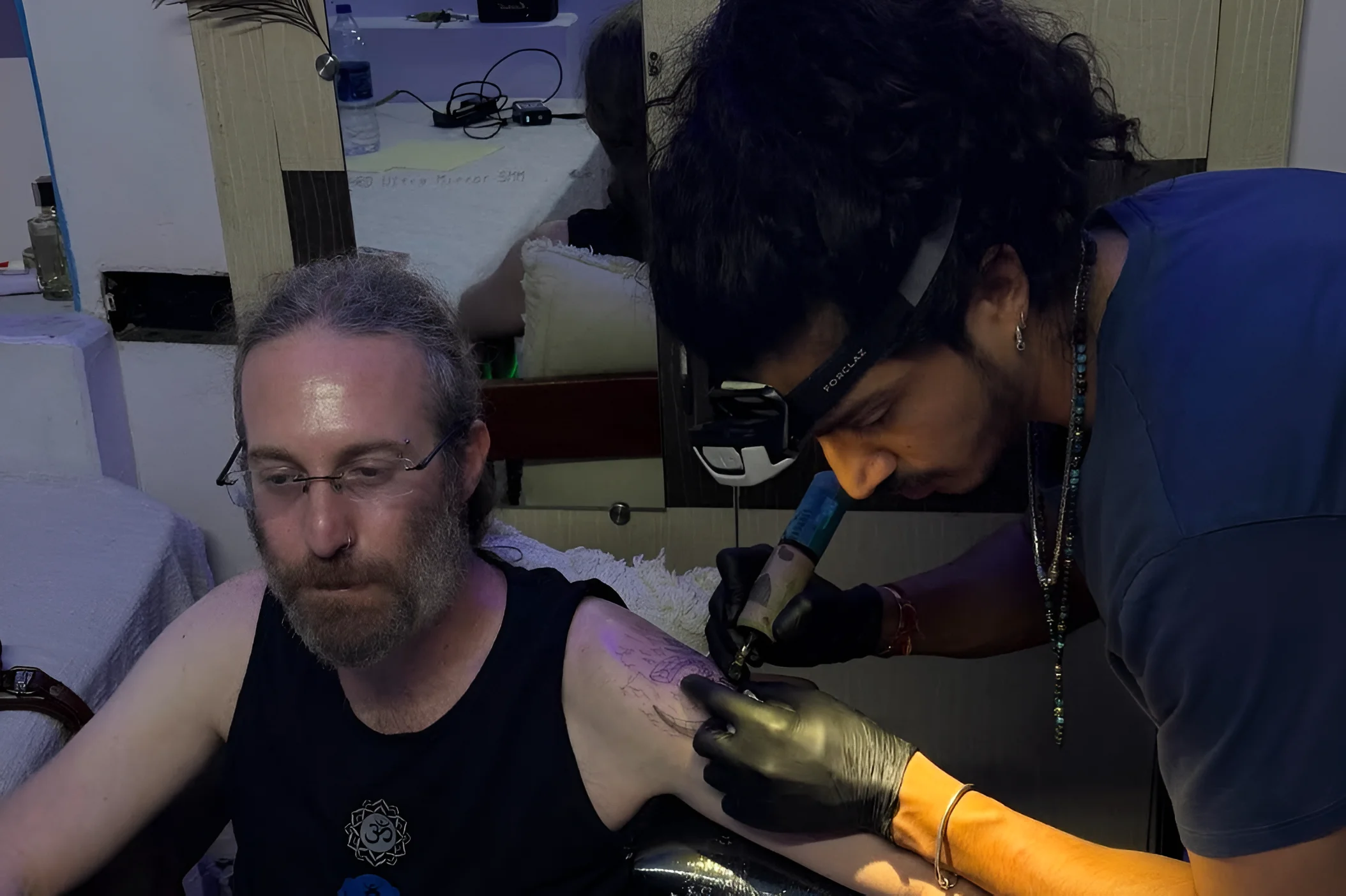
While the Pushkar Camel Fair was immersing the desert state of Rajasthan in an incredible kaleidoscope of colors, music, and ancient rituals, Israeli music producer Omer Goren decided to capture the vibration of this place on his own skin. Goren, known to the world by his pseudonym Electrockrat, whose work is defined by his debut album Mind Travel and singles Sometimes, Fade Away, Ready to Leave, and Place to Go (you can follow his rhythmic experiments on Instagram @electrockrat_official), got his first tattoo. This event, which took place on November 5, 2025, became significant not only for the musician himself but also for tattoo culture, uniting East and West through sacred art.
Sacred Rhythm Frozen in Stone
Goren’s choice fell on the eternal symbol “Om” (Om) – the primordial sound of the Universe in Indian philosophy. However, the realization of this symbol was far from traditional minimalist designs. The project was undertaken by Indian artist Jimmy Kalyana (@jimmyartifex), known for his unique approach to realism and symbolism.
Kalyana created a masterpiece in the 3D Cracked Stone Realism style, which not only depicts the symbol but transforms it into living, pulsating energy. The composition visually merges the ancient strength of stone with an electric, dynamic flow. Veins of bright blue lightning, rendered in a style mimicking a thunderclap, emanate from the Sanskrit syllable. This visual effect is not just decoration; it symbolizes vibration and movement – key aspects of both the “Om” mantra and Goren’s electronic music.
“‘Om’ is not just a symbol, it’s a vibration,” explains Jimmy Kalyana, delving into the philosophy of his work. “When you consciously chant this mantra, your breath and body synchronize. I wanted to make this vibration visible, to capture energy as if frozen in motion.” Technically, Kalyana achieved this effect by combining the precision of digital sketching with freehand mastery, allowing the spiritual resonance to be translated into a tangible physical form where vibration meets art.
Fusion of Worlds: Pushkar, Electronics, and Spiritual Realism
For Omer Goren, whose musical endeavors are dedicated to exploring rhythm, emotions, and transcendence, this experience became a deeply personal manifesto. He emphasized that the location of the tattoo, the ancient city of Pushkar in Rajasthan, was crucial.
“Pushkar has its own frequency, just like the mantra ‘Om’,” Goren shares. “Getting this tattoo right here, amidst this ancient energy, gave me the feeling that the sound had finally found its form.”
The collaboration between an Israeli representative of the electronic scene and an Indian artist took place against the backdrop of the boiling energy of the Pushkar Fair. While the streets were filled with camel caravans, chants of pilgrims, and tourists from all over the world, two creators from completely different cultures connected through a common rhythm – the vibration of creation.
Expert Analysis from tatufoto.com: Why This “Om” is Important for the Tattoo Industry
Jimmy Kalyana’s and Omer Goren’s work goes beyond personal choice and reflects several key trends in contemporary tattoo culture, especially in the context of spiritual art and realism. This project demonstrates how high technique can be used to visualize metaphysical concepts, marking a new stage in the development of realistic tattoos.
1. Expanding the Boundaries of 3D Realism
The 3D Cracked Stone Realism style, which Kalyana masterfully employs, is one of the most complex and symbolic directions. Typically, photorealism focuses on portraits or tangible objects, but here it is used to give physical tangibility to an abstract, spiritual concept. The cracked stone aesthetic symbolizes antiquity, resilience, and connection to the earth (grounding), which perfectly contrasts with the electric, glowing veins. The blue lightning erupting from the stone is a metaphor for awakening and pure energy, making the tattoo not a static image but a dynamic process. This clearly shows how realism can be applied to visualize metaphysics and create the effect that Kalyana calls “energy frozen in the moment.”
2. Globalization of Spiritual Symbolism and Authenticity
Tattoos with Eastern, especially Indian, symbols (lotuses, mantras, deities) have long been popular in the West. However, they often lack deep context. The collaboration between Goren and Kalyana, taking place in a sacred location (Pushkar is one of the oldest cities and a pilgrimage site), lends authenticity and depth to the work. This is not just a trendy symbol, but the result of deep immersion in the cultural environment. For the tattoo community, this is an important signal: spiritual symbolism requires respect for context and, where possible, working with artists who understand it from within. In this case, Kalyana acts not just as an artist but as a cultural mediator.
3. Vibration as a Conceptual Trend
The idea of “frozen vibration” or “visible sound” is becoming a strong conceptual trend in tattoo art. In an era when people are looking for ways to visualize the invisible – emotional states, energy flows, sound waves – tattoos using elements of glow, movement, or electricity will gain popularity. This “Om” is a perfect example of how to connect sound frequency with visual aesthetics. For Goren, as an electronic producer, this becomes a visual representation of his musical philosophy, where every beat is part of a cosmic rhythm, and the tattoo is a constant reminder of the transcendence of sound.
Omer Goren’s tattoo, created by Jimmy Kalyana, is an impressive example of how contemporary tattoo art can serve as a bridge between ancient spirituality and cutting-edge visualization technologies. It is not just an adornment; it is a manifesto frozen in time about the search for rhythm in chaos and the connection between consciousness and creation.