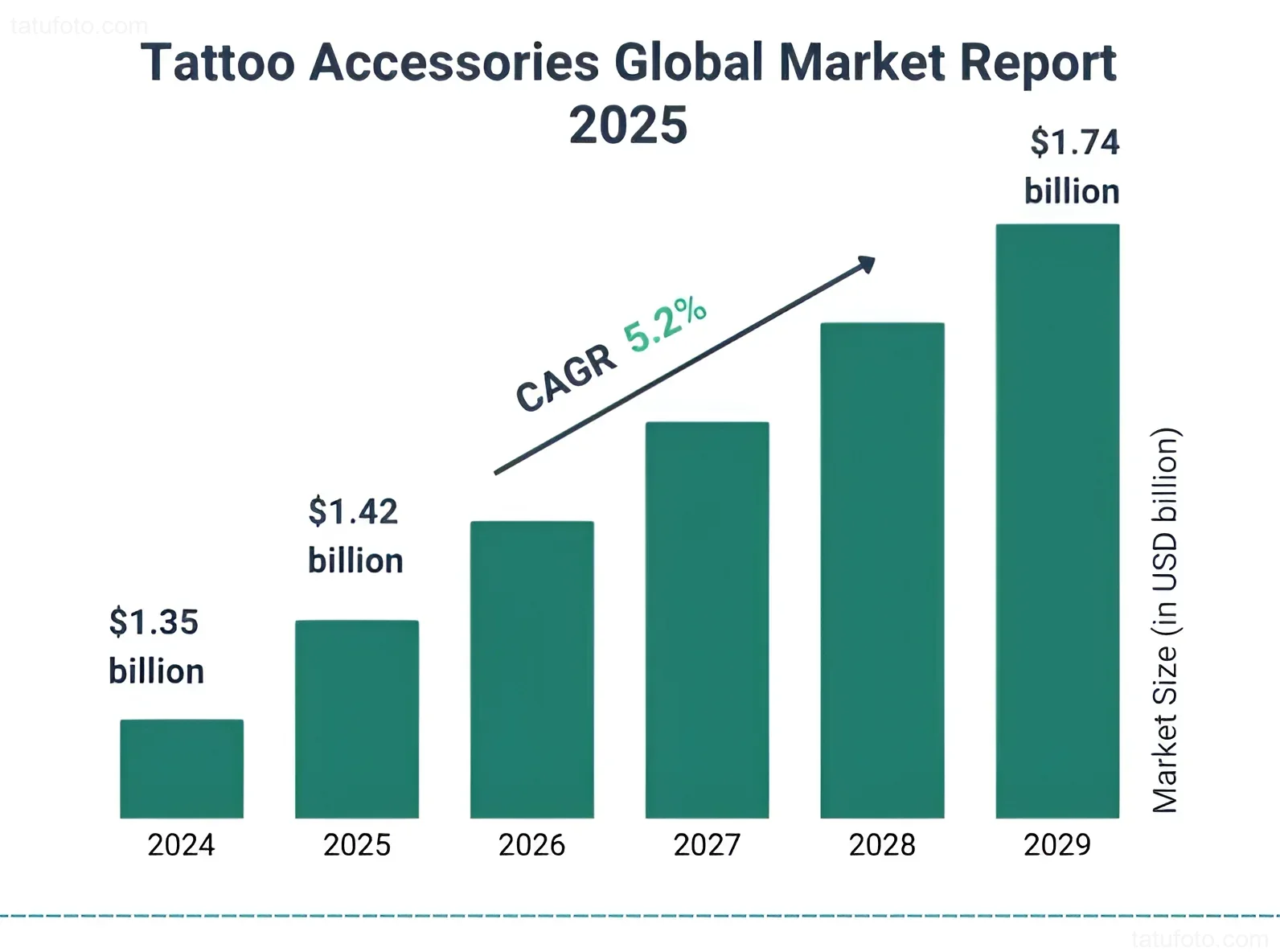
The global tattoo accessory market is experiencing a period of rapid growth, confirming the status of tattoo culture as a powerful mainstream phenomenon. According to recent analytical data, the industry, which includes inks, machines, needles, and aftercare products, is demonstrating impressive financial dynamics. By 2029, the volume of this segment is expected to reach $1.74 billion USD, driven not only by the growing popularity of body art but also by revolutionary innovations in tattoo safety and longevity.
Financial Dynamics: From $1.35 Billion to $1.74 Billion
The tattoo accessory market has been steadily gaining momentum in recent years. While its volume was estimated at $1.35 billion in 2024, growth to $1.42 billion is projected by 2025. This surge corresponds to a compound annual growth rate (CAGR) of 4.8%. Historically, this growth has been fueled by increased interest in body modifications, the rise of social media where tattoos have become a key tool for visual self-expression, and the development of tourism.
Mid-term forecasts are even more optimistic. By 2029, the market is expected to reach the stated $1.74 billion, accelerating the CAGR to 5.2%. The main catalysts for this growth will be the expansion of tattoo culture itself, increased awareness of procedures, rising disposable incomes, and, importantly, a growing number of professional tattoo studios worldwide.
Driving Force: Youth Demographics and the Search for Identity
A key factor ensuring the sustainable development of the market is youth demographics. Teenagers and young adults, in the process of self-discovery and seeking individual style, actively use tattoos and related accessories as a platform to showcase their unique personalities.
These accessories, whether temporary stickers, henna, or specialized care products, allow young people to experiment with body art before committing to a permanent step. Demographic data confirms the scale of this influence: for example, in the UK, according to the Association for Young People’s Health (AYPH) in August 2024, there were 8 million people aged 10–19 and 12 million people aged 10–24. The teenage group (10–19 years old) constituted 12% of the country’s total population. This numerous and active cohort, striving for self-expression, is the main consumer driving the market to new records.
Innovations in Aftercare: The Era of Antibacterial Kits
The modern tattoo industry is moving away from rudimentary methods and actively adopting high technologies to ensure maximum longevity and safety of the artwork. Leading market companies are focused on developing innovative solutions, among which antibacterial aftercare kits hold a special place.
These kits are not just lotions; they are specialized products designed to cleanse, protect, and accelerate the healing process of a fresh tattoo while simultaneously preventing infections. The evolution from petroleum jelly to medical-grade formulas is one of the most significant recent trends.
A pioneer in this field was the American company H2Ocean, specializing in products for piercings and tattoos. In August 2024, H2Ocean introduced its first-of-its-kind Antibacterial Tattoo Aftercare Kit. This kit includes two key products:
- Blue Green Foam Soap: An organic vegan foam soap with aloe vera that disinfects the skin without drying it out.
- Aquatat Tattoo Ointment: A breathable ointment that protects the tattoo, reduces healing time, and prevents pore blockage.
In addition to specialized care, breakthrough trends such as the development of biodegradable and vegan inks, the implementation of “smart” stencil technologies, and the release of high-tech tattoo machines and next-generation balms are expected in the coming years.
Expert Analysis from tatufoto.com: Why Accessory Quality Has Become a Priority
The growth of the accessory market to billion-dollar figures is not just a commercial success; it’s an indicator of tattoo culture’s maturity. If tattoos were once perceived as an impulsive act, they are now an investment in art. The increased demand for high-quality needles, sterile machines, and, most importantly, advanced aftercare, indicates that clients and artists prioritize longevity and safety. Antibacterial kits, like those offered by H2Ocean, address a critical issue: reducing the risk of infection and ensuring optimal color retention. This fundamentally changes the approach to work, raising hygiene and professionalism standards in studios. Investments in this segment confirm that tattoos have definitively transitioned from a subcultural hobby to a sphere of high-end aesthetic services requiring appropriate equipment and maintenance.
Market Structure: What Exactly is Growing
The tattoo accessory market is highly segmented, reflecting the complexity of creating and caring for body art. The main market segments driving growth include:
By Product Type:
- Tattoo inks (black, color, UV, organic, and vegan).
- Tattoo machines (coil, rotary, wireless, pen-style).
- Tattoo needles (liners, shaders, magnums, curved magnums).
- Consumables (ink caps, tips, grips).
- Aftercare products (ointments, lotions, soaps, sunscreens).
- Bandages and films (clear, waterproof, antibacterial).
By Sales Channel:
- Hypermarkets and supermarkets (for simpler accessories and care products).
- Specialty stores (professional equipment).
- E-commerce (leading channel, providing convenience and global reach).
Key players shaping the competitive landscape include giants like FK Irons Inc., Cheyenne Professional Tattoo Equipment, Dragonhawk, and Ink Machines, as well as leaders in aftercare such as SecondSkin Tattoo Aftercare, Saniderm Tattoo Aftercare, and Mad Rabbit Tattoo. Geographically, North America remained the largest market in 2024, but analysts indicate that the Asia-Pacific region will be the fastest-growing during the forecast period, signifying the global expansion of tattoo culture.