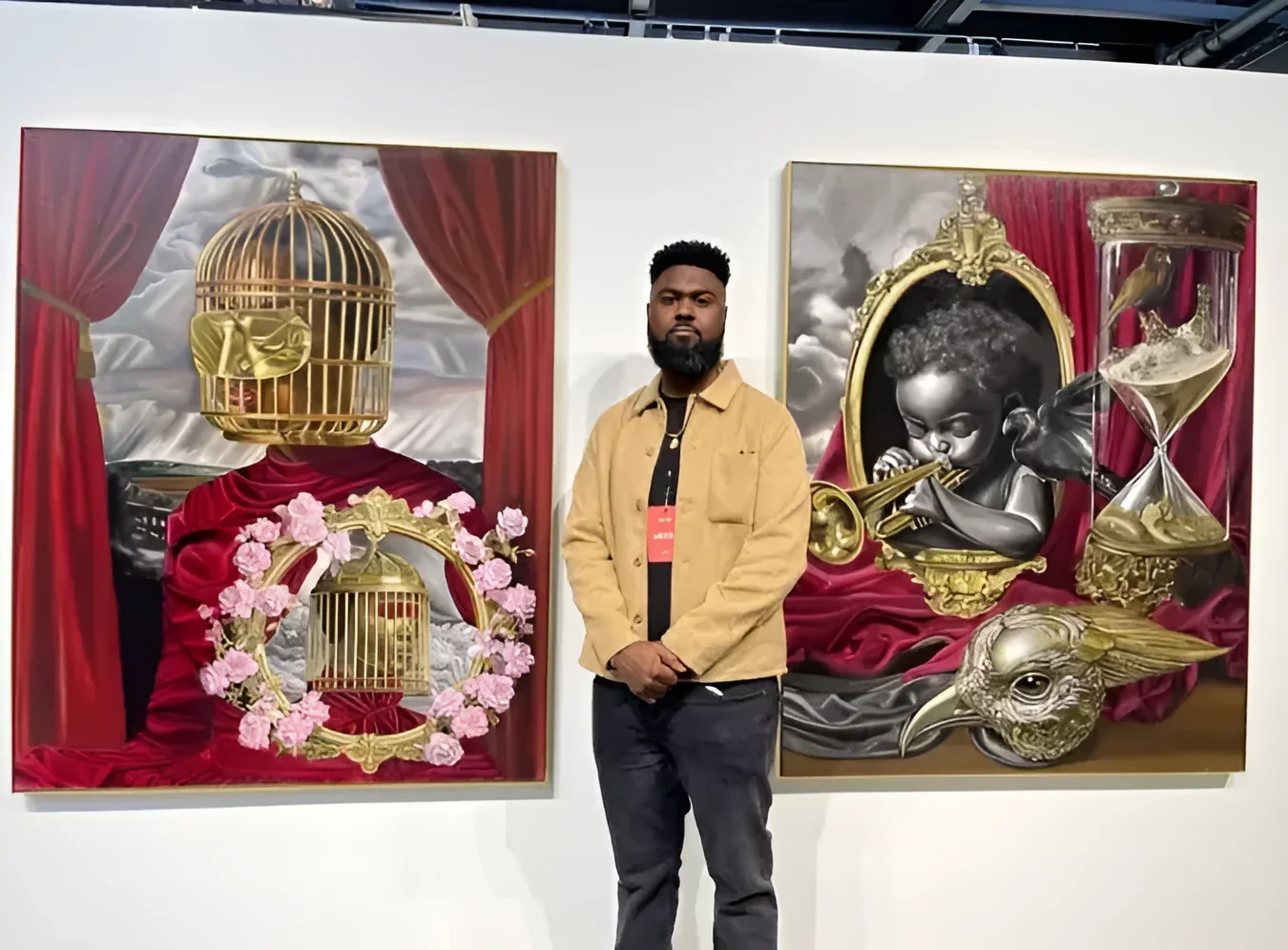
The transformation of an artist is always a painful and exciting process, especially when it comes to transitioning from the tattoo industry, where every stroke is final, to the world of oil painting, where layers can be built up over decades. Marcus Robins has become a prime example of how the discipline and technical rigor of a tattoo artist can breathe new life into the classical canons of the Renaissance. His journey is not just a change of tools, but a deep exploration of identity through the lens of fine art, where the monumental canvas now replaces human skin, and the most complex glazing techniques of the old Flemish masters replace dermal pigments.
Roots of Mastery: Family Influence and Early Lessons in Discipline
For many artists, the path begins in a studio, but for Marcus, it began in his father’s home workshop. Robins’ father, a sculptor, master carpenter, and cabinetmaker, instilled in his son the understanding that art is, above all, a craft and hard work. In the tattoo industry, we often talk about “setting the hand,” and this is precisely what Marcus’s father did, making him draw an ordinary chair for hours. While his peers played outside, the future master studied perspective, chiaroscuro, and the structure of objects.
This experience of “forced” drawing, which Robins disliked as a child, later became his greatest asset. An expert eye for form and the ability to see an object’s structure are what distinguish a professional tattoo artist from an amateur. Marcus’s father possessed a kind of “predictive vision,” understanding that without a basic academic foundation, there was no place for oneself in the world of visual art. Today, Robins admits that it was those tedious hours with a chair and pencil that shaped him as an artist capable of working with hyperrealism and complex compositions.
Army Hardening and Tattooing: Finding Balance in Extreme Conditions
Marcus’s true development as a tattoo artist took place in an unexpected place—during his service in the U.S. Air Force. The high level of stress and strict discipline demanded an outlet for creative energy. For Robins, drawing became a method of decompression, a way to maintain mental health in a harsh environment. It was in the army that he began practicing tattooing, which became an ideal combination of technical precision and artistic self-expression for him.
Ten years of work in the tattoo industry taught him the most important lesson: no room for error. In tattooing, unlike painting, you can’t just “cover up” a faulty line or incorrect tone. This cultivated in him incredible concentration and confidence in every movement of the brush. Later, when he transitioned to oil painting, Marcus felt a paradoxical freedom: the fear of ruining a piece disappeared, as the canvas, unlike a client, forgives mistakes and allows for endless refinement of the image.
Journey to Europe: Encountering Classics and a Crisis of Representation
After serving in the army and working in the aerospace industry (Rolls-Royce), where he was involved in experimental engine configurations, Robins traveled to Europe. Visits to Venice, Versailles, and Greece marked a point of no return for him. He was captivated by the works of the Renaissance and Baroque periods, their grandeur and technical perfection. However, standing before masterpieces in museum halls, he acutely felt a dissonance.
As a professional, he admired the chiaroscuro technique and the drama of Caravaggio, but as a person, he didn’t see his reflection in these canvases. The absence of Black figures in the classical context of “high art” evoked a sense of alienation and even guilt for his love of this style. This became a catalyst for his own creative work: Marcus decided to use classical techniques to depict Black models, restoring them to their rightful place in art history, from which they had been excluded for centuries.
Technical Peculiarities: The Flemish Method and Tattoo Aesthetics
Marcus Robins doesn’t just paint with oils; he employs the complex Flemish seven-layer painting method. This process includes:
- Imprimatura: creating a colored ground that sets the overall tone of the work.
- Underpainting (Grisaille): detailed work on light and shadow without using color.
- Dead Layer: working in cool gray tones to create volume.
- Color Layers and Glazes: sequential application of transparent paint layers to achieve depth and luminosity.
Interestingly, his tattoo past manifests in a “thirst for saturation.” Unlike classical masters, Robins strives for higher contrast and pigment density, characteristic of high-quality neo-traditional or realistic tattooing. He literally “drives” color into the canvas, creating incredibly vibrant and deep skin tones.
Symbolism in Works: “See No Evil” and “Triumphant”
At the BUTTER 5 exhibition, Robins presented two monumental works that became manifestos of his style. The canvas “See No Evil” is a contemporary interpretation of an ancient allegory, translated into the context of modern African-American culture. Here, classical poses and lighting in the style of Artemisia Gentileschi are combined with modern facial features and deep psychologism.
The work “Triumphant” demonstrates the triumph of the human spirit. In it, Robins uses all his anatomical knowledge gained over years of tattooing to convey muscle tension, skin texture, and the gleam in the eyes. His paintings are a dialogue between tradition and modernity, where the author’s Nigerian heritage is woven into the fabric of the European painting school.
The Artist’s Mission: Education and Legacy
Today, Marcus Robins sees his task not only in creating paintings but also in educating. He is concerned that the younger generation, especially children from African-American communities, shows little interest in the history of classical art because they don’t see themselves in it. Through his example, he shows that Fine Art is a space open to everyone.
His experience transitioning from a tattoo studio to a contemporary art gallery proves that the boundaries between “low” and “high” art are blurred. Mastery is a universal language. Robins hopes that his works will inspire future artists not to fear complex techniques and to boldly assert themselves in spaces that previously seemed inaccessible.
Comparative Analysis of Techniques: Tattooing vs. Oil Painting
For clarity, let’s examine how a tattoo artist’s skills transform when working with oils:
| Characteristic | Tattooing | Oil Painting (Flemish Method) |
|---|---|---|
| Handling Mistakes | Impossible (only cover-ups) | Multiple layers of application |
| Color Mixing | On palette and “in skin” (optical) | Glazes (transparent layers) |
| Anatomy | Following body contours | Creating the illusion of volume on a flat surface |
| Durability | Depends on skin regeneration | Depends on pigment and varnish stability |
Marcus Robins continues to refine his style, proving that tattooing is an excellent school for any painter. His canvases are not just images; they are manifestos of strength, beauty, and historical justice, painted by a hand accustomed to feeling every line and every nuance of color at its fingertips.