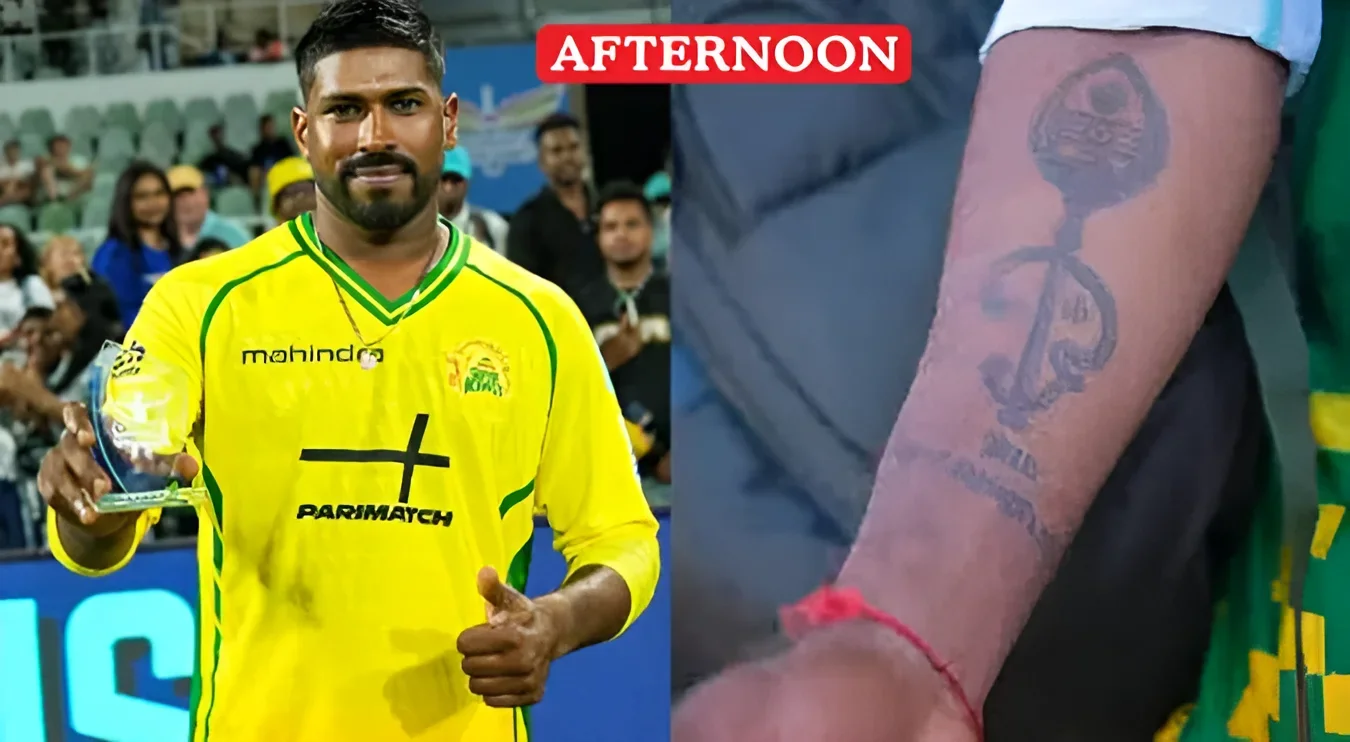
The world of professional sports and the art of tattooing have always gone hand in hand, becoming a way for athletes to express themselves and manifest their inner beliefs. The recent case of South African cricketer Brandon Subramaniam, whose image with a tattoo of the god Murugan and the sacred mantra “Om Saravanabhava” instantly went viral on social media, has become a prime example of how body art unites cultural codes, religious devotion, and personal history. For many fans and tattoo culture enthusiasts, this is not just a drawing on the skin, but a powerful spiritual amulet embodied in the aesthetics of modern graphic art.
Sacred Meaning and Visual Embodiment: Who is God Murugan
To understand the significance of Brandon Subramaniam’s tattoo, one must delve into the deep layers of Indian mythology and Tamil culture. God Murugan, also known as Kartikeya, Skanda, or Kumara, is a supreme deity, revered primarily by the Tamil people. He is the son of Lord Shiva and Goddess Parvati, the divine commander of the gods’ army, embodying wisdom, strength, purity, and victory over the forces of evil.
In tattoo art, the image of Murugan is often accompanied by his characteristic attributes, which carry their own symbolic weight:
- Vel (Sacred Spear): This is not just a weapon, but a symbol of spiritual insight and discernment. In tattoos, the Vel is often depicted as a central element, symbolizing a person’s ability to cut through ignorance and attain truth.
- Peacock: Murugan’s vahana (mount). The peacock symbolizes victory over pride and egoism, as well as beauty and eternal renewal.
- Rooster: Depicted on Murugan’s banner, it signifies the arrival of dawn and the awakening of consciousness.
For Subramaniam, whose roots trace back to Tamil Nadu, the choice of this image is a direct connection to his origins. In the context of professional sports, the image of the warrior god Murugan becomes an ideal metaphorical companion, bestowing the will to win and resilience in the face of on-field challenges.
The Mantra “Om Saravanabhava”: Linguistic and Spiritual Analysis
Particular attention in the cricketer’s tattoo is drawn to the calligraphic inscription in Tamil – “Om Saravanabhava.” This is one of the most powerful mantras dedicated to Murugan. Experts in Eastern philosophy and sacred texts emphasize that each syllable of this mantra has its own vibration and unique meaning:
- SA (Са): Grants the ability to attract luck and the favor of others.
- RA (Ра): Symbolizes the accumulation of spiritual energy and knowledge.
- VA (Ва): Helps overcome material difficulties and obstacles.
- NA (На): Provides protection from enemies and negative influences.
- BHA (Бха): Brings happiness and satisfaction with life.
- VA (Ва): Signifies infinity and unity with the divine principle.
From the perspective of tattoo copywriting and design, using such inscriptions requires the artist not only to have lettering skills but also a deep understanding of font anatomy. Tamil script is characterized by its roundness and graceful lines, making it ideal for application on the forearm or bicep, where muscles create a natural volume that emphasizes the dynamism of the letters.
The Tamil Diaspora in South Africa: Tattoo as a Bridge Between Generations
Brandon Subramaniam’s story is not just the story of one athlete, but a reflection of a large-scale cultural phenomenon. South Africa is home to one of the largest Indian diasporas in the world, a significant portion of which are ethnic Tamils. Despite the change of generations and geographical distance from their historical homeland, traditions, religion, and art remain the foundation of their identity.
The Joburg Super Kings team, which is the South African franchise of the famous Indian franchise Chennai Super Kings, includes players with Tamil roots, such as Keshav Maharaj and Senuran Muthusamy, highlighting this connection. In this context, a tattoo serves as a visual marker, declaring belonging to a great culture. It’s a way of saying to the world: “I remember my roots, and they give me strength.”
Technical Aspects of Execution: Tips for Those Planning Such a Tattoo
If you are inspired by Brandon Subramaniam’s example and plan to get a tattoo of a Hindu deity or mantra, consider a few professional recommendations. Working with religious symbols requires special tact and a high level of execution.
1. Choice of Style:
The image of Murugan can be rendered in several techniques. Black & Grey Realism will allow for conveying the depth and volume of the divine image, creating the effect of a living statue. Traditional Indian Art (a style reminiscent of temple paintings) will emphasize authenticity and cultural context. For mantras, artistic lettering using fine needles (3RL or 1RL) is best for achieving maximum clarity of the small elements of Tamil script.
2. Placement:
In Hindu tradition, images of gods are treated with reverence. Professional tattoo artists recommend placing such symbols on the upper part of the body (shoulders, chest, back, arms). Applying sacred images below the waist may be perceived as disrespectful to the tradition.
3. Care and Color Preservation:
Athletes like Subramaniam often spend a lot of time in the sun. Ultraviolet radiation is the main enemy of a tattoo. To prevent the fine details of the mantra from blurring and the deity’s face from fading, it is essential to use sunscreens with a high SPF factor and to get pigment touch-ups in a timely manner.
The Psychology of Tattoos in Sports: Why Does It Work?
Many wonder why professional athletes so often adorn their bodies with religious symbols. Psychologists claim that a tattoo for an athlete is a kind of “anchor.” In moments of immense pressure on the field, looking at the “Om Saravanabhava” mantra on his arm can help Brandon focus, calm his mind, and gain confidence. It is a visual prayer that is always with him.
The video posted by Joburg Super Kings with the caption “Muthu Murugan Dhuan” went viral for a reason. It struck a chord with the audience, combining a passion for sports with a deep respect for spiritual values. In today’s world, where boundaries are blurring, such tattoos become an important tool for preserving individuality.
Aesthetics and Detail: An Expert Look at the Work
Examining Subramaniam’s tattoo in detail, one can note the high quality of the line work. In Tamil fonts, it is crucial to maintain the proportions of loops and connecting lines, as the slightest distortion can alter the meaning of the word. The artist who worked on the cricketer’s arm clearly paid attention to the anatomical placement of the text – the inscription smoothly follows the muscle, without deforming when the arm moves, which is extremely important for a cricketer whose activity involves active limb movement.
The use of high-density black pigment ensures that the tattoo will look contrasting even on darker skin, which is an important technical nuance for artists working with clients of Indian descent. This highlights the professionalism of the artist and Brandon’s serious approach to modifying his body.
Tattoo as a Personal Manifesto
Brandon Subramaniam’s tattoo story is an inspiring example of how ancient symbols find new interpretations in modern culture. God Murugan and the mantra “Om Saravanabhava” on the arm of the South African athlete remind us that the art of tattooing is not just decoration, but a profound way of communication, energy transfer, and preservation of ancestral heritage. For tatufoto.com readers, this case serves as confirmation: when choosing a tattoo, imbue it with meaning that will support you throughout your life, just as faith and tradition support champions on their path to triumph.