
A tattoo featuring Salvador Dalí or his legendary surrealist scenes is not just body art, but a manifesto of intellectual freedom and creative rebellion. By choosing such a sketch, you declare to the world your unwillingness to tolerate the mundane and the boring rules of reality. The image of the Spanish genius has become synonymous with eccentricity, deep psychoanalysis, and the ability to see hidden meanings where others see only chaos in tattoo culture. In this article, we will thoroughly analyze what lies behind melting clocks, long-legged elephants, and the master’s famous mustache, so that your future tattoo becomes a true artistic masterpiece with a deep philosophical subtext.
Dali Tattoos: A Glimpse into the World of Surrealism and Unconventional Thinking

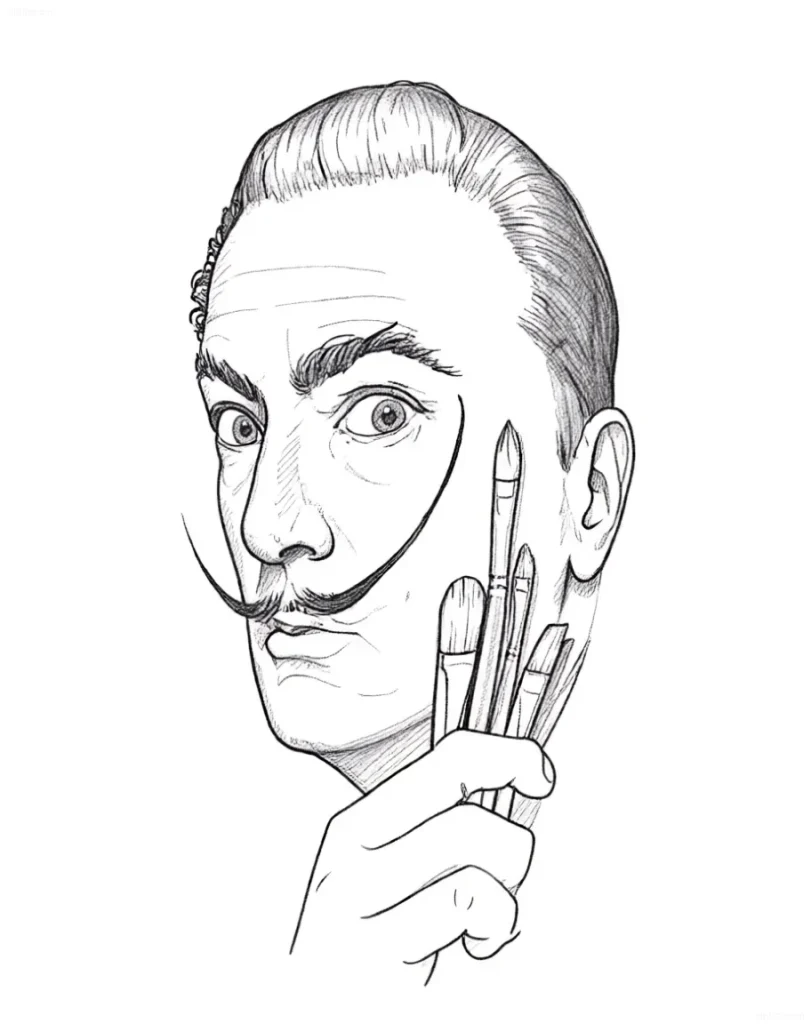
When we talk about Dalí-style tattoos, we mean an immersion into the subconscious. Salvador Dalí was not just an artist; he was a philosopher who used his brush to dissect human fears, desires, and dreams. In the context of modern tattooing, a portrait of Dalí himself is a symbol of recognizing genius bordering on madness. By choosing the master’s face with his characteristically upturned mustache, the tattoo wearer emphasizes their commitment to the idea that imagination is more important than reality.

Such tattoos are often chosen by people in creative professions: artists, designers, musicians, and writers. For them, Dalí is an icon of self-expression. However, the symbolism of these images is much broader. It is a mark of a person who is not afraid to be “different,” who values paradoxes, and is ready for a constant search for truth within themselves. Surrealism in tattooing is a way to visualize what cannot be expressed in words: the fluidity of time, the fragility of existence, and the infinity of imagination.
The History of Dalí’s Surreal Imagery: From Avant-Garde to Eternity

To understand the true meaning of a Dalí tattoo, one must turn to the origins of his work. Dalí developed the so-called “paranoiac-critical method,” which allowed him to extract images from the depths of his “self” and transfer them to canvas. In tattoo art, this method has transformed into the creation of multi-layered sketches where one object smoothly flows into another, creating optical illusions.
Dalí’s subjects began to actively penetrate tattoo culture in the late 20th century, when the technical capabilities of equipment allowed artists to convey the finest details and complex color transitions characteristic of the master’s paintings. Since then, the popularity of these motifs has only grown. Today, a tattoo with a Dalí theme is considered a sign of high aesthetic taste. It is the choice of those who want their body to be not just covered with drawings, but to become a mobile gallery of high art.
Deep Meanings of Tattoos with Dalí’s Surreal Motifs

Each element in Dalí’s works has a strictly defined meaning, based on Freud’s psychoanalysis and the artist’s personal experiences. Let’s consider the most popular motifs and their interpretation in tattoos:
- Soft (melting) clocks: This is perhaps the most recognizable symbol. In tattoos, it signifies the relativity of time and the transience of existence. The wearer of such a tattoo realizes that time is not a linear scale, but a subjective sensation. It is a symbol of rejecting rigid schedules and acknowledging that moments of happiness or pain can stretch into infinity.
- Elephants on spider legs: Huge animals on thin, almost invisible legs symbolize the contrast between a heavy past (or power) and the fragility of the present. In tattoos, this is often interpreted as the resilience of the spirit despite external vulnerability, as well as the pursuit of the sublime despite earthly burdens.
- Ants: For Dalí, ants were always a symbol of decay, disintegration, and all-consuming anxiety. In tattoos, this image can signify an awareness of mortality, the cyclical nature of life, or a reminder that even the smallest details can destroy something great.
- Egg: A symbol of hope, rebirth, and purity. Tattoos with an egg are often chosen as a sign of a new beginning or protection of one’s inner self.
- Drawers: The image of a human body with open drawers symbolizes the secrets of the subconscious. Such a tattoo indicates that the person is inclined to self-knowledge, holds many secrets, and constantly explores their soul.
- Burning giraffe: A symbol of premonition of disaster or a “cosmic male apocalyptic monster.” In tattoos, it is a powerful sign of inner turmoil or protest against social upheaval.
Styles of Dalí-Inspired Tattoos: From Realism to Abstraction

The choice of style for a Dalí tattoo is critically important, as it determines how accurately the atmosphere of surrealism will be conveyed. Here are the main directions that are ideal for this theme:
- Realism: Ideal for portraits of Salvador Dalí himself. The artist must possess the highest level of skill to convey the artist’s mad gaze and the texture of his famous mustache. Photorealistic depictions of Dalí’s paintings also look incredibly impressive.
- Surrealism (as a tattoo style): This is a direct continuation of the master’s ideas. Distortions, play with perspective, and the combination of incompatible objects are welcomed here.

- Trash Polka: This style perfectly complements Dalí’s chaotic energy. The combination of realistic elements with rough strokes of black and red paint emphasizes the eccentricity and drama of the subjects.
- Watercolor: Suitable for conveying the “dreamlike” atmosphere of Dalí’s paintings. Blurred contours and soft color transitions create the impression that the tattoo is a dream come to life.
- Graphics and Linework: A modern interpretation of the classics. Thin lines allow for detailed yet concise images, such as Dalí’s famous silhouette or the outline of an elephant.
Ideal Placement for a Dalí Tattoo on the Body: Emphasize Your Individuality

The location for a surrealist-style tattoo should be chosen based on the scale and detail of the sketch. Since Dalí’s works often contain many small elements, they require space.
| Placement Area | Recommended Subject | Perception Features |
|---|---|---|
| Back | Full-scale reproductions of paintings (e.g., “The Temptation of St. Anthony”) | Allows for conveying the full depth and detail of the subject, looks like a real canvas. |
| Forearm | Dalí’s portrait or melting clocks | High visibility, a constant reminder of one’s principles and philosophy. |
| Thigh | Elephants on spider legs | The vertical orientation of the area is ideal for the long legs of the elephants, creating a dynamic effect when moving. |
| Chest | Symbols of the subconscious (drawers, butterflies) | An intimate location, symbolizing what is hidden deep in the heart. |
Tips for Choosing and Creating a Unique Dalí-Style Tattoo

To ensure your tattoo is not just a copy of a famous painting but gains individuality, follow these tips:
- Combine images: Ask the artist to combine several Dalí symbols in one sketch. For example, a portrait of the artist from which melting clocks “flow.”
- Add personal elements: Surrealism allows you to weave details that are important specifically to you into classic subjects. This could be an object from your life, rendered in Dalí’s “melting” technique.
- Pay attention to the background: In Dalí’s paintings, the sky and desert landscapes play a huge role. Do not leave the main object “hanging in the air”; create an atmospheric environment for it.
- Choose an experienced artist: Surrealism does not forgive mistakes in composition and color. Look for a tattoo artist who specializes in artistic reproductions or has experience working in the surrealist style.
Frequently Asked Questions About Tattoos with Salvador Dalí’s Imagery

Question: Doesn’t a portrait of Dalí look too extravagant?
Answer: It all depends on the execution. In a minimalist or graphic style, it can look very stylish and restrained. But Dalí himself was the embodiment of extravagance, so such a tattoo is always a bold statement.
Question: What do Dalí tattoos mean for women and men?
Answer: In the modern world, there is no strict gender division. Men are more likely to choose large-scale subjects with elements of power and destruction (elephants, giraffes), while women prefer more elegant and metaphorical images (butterflies, flower-eyes, melting clocks).
Question: Is it difficult to care for such a detailed tattoo?
Answer: The care is standard, but due to the abundance of small details and gradients, it is extremely important to protect the tattoo from the sun (use SPF) so that the colors do not fade and the lines do not “run” over time.
Interesting Facts About Salvador Dalí and His Influence on Tattoo Art

- Salvador Dalí himself designed jewelry and logos (e.g., the Chupa Chups logo), which inspires tattoo artists to create decorative elements in his style.
- Dalí’s famous mustache has become a brand in itself. There are thousands of minimalist tattoos consisting only of the silhouette of these mustaches – this is the most concise way to express love for surrealism.
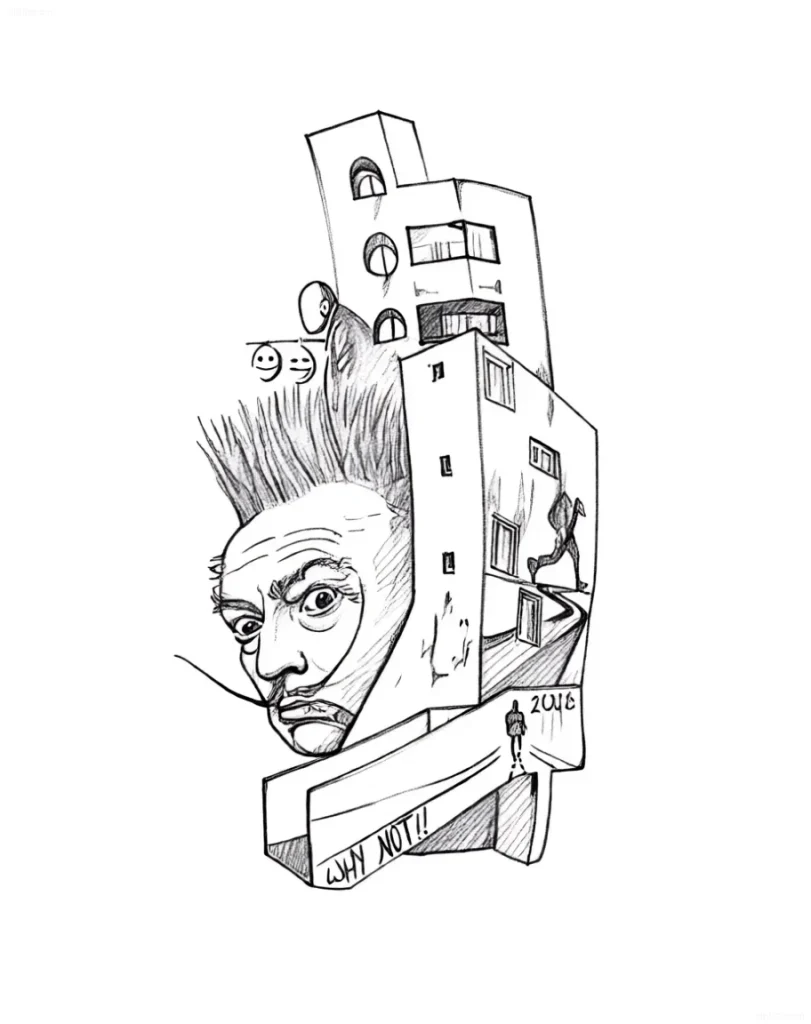
- Dalí was obsessed with science and mathematics (e.g., the fourth dimension). This is reflected in tattoos using geometric shapes and hypercubes combined with organic forms.
- Many Dalí fans get tattoos of his muse and wife, Gala, symbolizing all-consuming passion and devotion.
A Salvador Dalí-style tattoo is an eternal dialogue between reality and fantasy. It doesn’t just adorn the skin; it makes those around you think, search for hidden meanings, and admire the complexity of the human mind. If you feel a spark of madness and boundless creative potential within you, the images of the great surrealist will be the perfect choice for you, one that will never go out of fashion, because true art is eternal.