
A tattoo with a paisley pattern, more commonly known in Russian-speaking circles as the “Indian cucumber,” is not just a decorative element, but an ancient symbol carrying a powerful energetic charge. This ornament, resembling a droplet with a curved upper end, has adorned the clothing of kings, cult structures, and household items for millennia. In modern tattoo culture, paisley is chosen by those who appreciate the aesthetics of Eastern motifs and want to imprint a symbol of continuous development, life force, and harmony with the universe on their bodies. By choosing such a sketch, you touch upon the heritage of great civilizations, turning your skin into a canvas for a philosophical statement about eternity.
Paisley Tattoo: The Meaning and Symbolism of the “Indian Cucumber” Pattern

When you first see a paisley-style tattoo, your attention is involuntarily drawn to the complexity and elegance of its lines. But behind the external beauty lies a complex hierarchy of meanings. The primary meaning of a paisley tattoo is centered around the idea of the life cycle and spiritual growth. This pattern is often called the “seed of life,” the “tear of Allah,” or the “flame of Zoroastrianism,” and each of these names reveals a facet of its symbolism.
In tattoos, the “Indian cucumber” is most often interpreted as a symbol of:
- Fertility and abundance: The shape of a seed or a sprouting grain directly links the pattern to the idea of new life and material well-being.
- Energy and dynamism: The curved tip of the pattern creates a sense of movement, indicating that life is a constant flow that never stops.

- Divine protection: In many Eastern cultures, paisley was considered an amulet, protecting the wearer from the evil eye and evil spirits.
- Inner strength: Since the pattern is often compared to a flame, it symbolizes a person’s inner fire, their passion, and will to live.
For each person, a paisley tattoo can have its own, deeply personal meaning. Some see it as a symbol of rebirth after a difficult life stage, while others see it as a sign of a deep connection to their roots and ancestors.
The History of the Paisley Pattern: From Ancient Civilizations to Modern Tattoos

The history of this ornament is a fascinating journey through centuries and countries. The pattern is believed to have originated in ancient Persia (modern-day Iran), where it was called “buta” (or “boteh”). Translated from Persian, this word means “bush” or “bunch of leaves.” For ancient Persians, buta was a symbol of fire – a sacred element in Zoroastrianism, embodying life and immortality.
The pattern’s path into the global tattoo culture was long:
- Persian origins: Buta adorned the regalia of shahs and high nobility, emphasizing their status and divine origin.
- Indian influence: In India, the pattern transformed, acquired softer forms, and became associated with mango tree seeds. Here it was named “kalka” and became a symbol of fertility, love, and the feminine principle. It was from India that British colonizers brought fabrics with this ornament to Europe.

- Scottish trace: The pattern got its modern name “paisley” in honor of the small Scottish town of Paisley, which in the 19th century became the largest center for the production of fabrics with the “Indian cucumber.”
- Psychedelic revolution: In the 1960s, thanks to the hippie movement and the band The Beatles, paisley experienced a new peak in popularity. It became a symbol of freedom, expanded consciousness, and fascination with Eastern philosophy.
Paisley entered modern tattooing as an element of the “Mehndi” (henna painting imitation) and “Ornamental” styles. Today, artists use this pattern not only as a standalone element but also as part of complex sleeves, mandalas, and geometric compositions.
The Symbolism of Paisley Tattoos: Energy, Life, Fertility, and Eternity in Every Curve

If we break down the paisley tattoo into its components, we see how the form dictates the content. Every line in this ornament is not accidental. Let’s take a closer look at the key aspects of symbolism that you can incorporate into your future tattoo.
1. Energy and flame. One of the oldest interpretations of paisley is the image of a cypress tree – a tree that was considered a symbol of eternity in ancient cultures. The curved top of the cypress, bent by the wind, represents humility before divine power and, at the same time, incredible flexibility and resilience. In a tattoo, this can signify your ability to adapt to any life difficulties while maintaining your inner core.
2. Life and fertility. The resemblance of the pattern to a sprouting seed makes it an ideal choice for women who wish to emphasize their femininity, motherhood, or desire for creation. However, this symbol is also relevant for men as a sign of creative energy and the ability to bring ideas into reality.
3. Eternity and cyclicality. Paisley has no sharp angles. Its flowing forms remind us that everything in the world is cyclical: the end is always followed by a beginning. Tattoos with this pattern are often applied as a reminder that the soul is immortal, and the experiences we gain are invaluable.
| Pattern Element | Traditional Meaning | Meaning in Tattoo |
|---|---|---|
| Curved tip | Humility, flexibility | Adaptability, moving forward |
| Internal filling | Richness of nature | Complexity of the inner world |
| Droplet shape | Seed, embryo | Beginning of a new path, potential |
The Multifaceted Meanings of Paisley Tattoos: Personal Interpretations and Cultural References

When choosing a paisley tattoo, you are free to determine which meaning will prevail. Depending on the context and additional elements, the meaning can change. Let’s consider a few popular interpretations:
- Paisley as a symbol of love: In Indian tradition, two paisley droplets facing each other symbolize the union of two souls, marital harmony, and fidelity.
- Spiritual quest: If a lotus flower or an eye (symbol of the all-seeing eye) is depicted inside the “cucumber,” such a tattoo signifies a striving for enlightenment and the pursuit of truth.

- Freedom and rebellion: A nod to the 60s era makes paisley a symbol of unconventional thinking, love for art, and unwillingness to follow rigid social norms.
- Protective talisman: The dense filling of the pattern with small details (dots, lines) turns the tattoo into a kind of “chainmail” that, according to beliefs, repels negative energy.
Interestingly, in some cultures, paisley is associated with a dewdrop – a symbol of purity and renewal. If you feel that your life needs a “reboot,” a tattoo with this pattern can be an excellent visual anchor for positive changes.
Styles of Paisley Tattoos: From Minimalism to Detailed Compositions

The beauty of paisley tattoos lies in the versatility of this pattern, which can be adapted to any stylistic direction. When choosing a style, consider the effect you want to achieve: graphic and strict, or soft and decorative.
- Dotwork: Perhaps the most popular style for paisley. Creating the pattern with thousands of tiny dots gives the tattoo volume and makes it resemble an old engraving or exquisite lace.
- Linework: Ideal for those who prefer minimalism. Clean, sharp lines emphasize the elegant shape of the “Indian cucumber” without overloading the image with unnecessary details.
- Ornamental: In this style, paisley becomes part of a large symmetrical canvas. It is often combined with mandalas, geometric shapes, and sacred symbols.
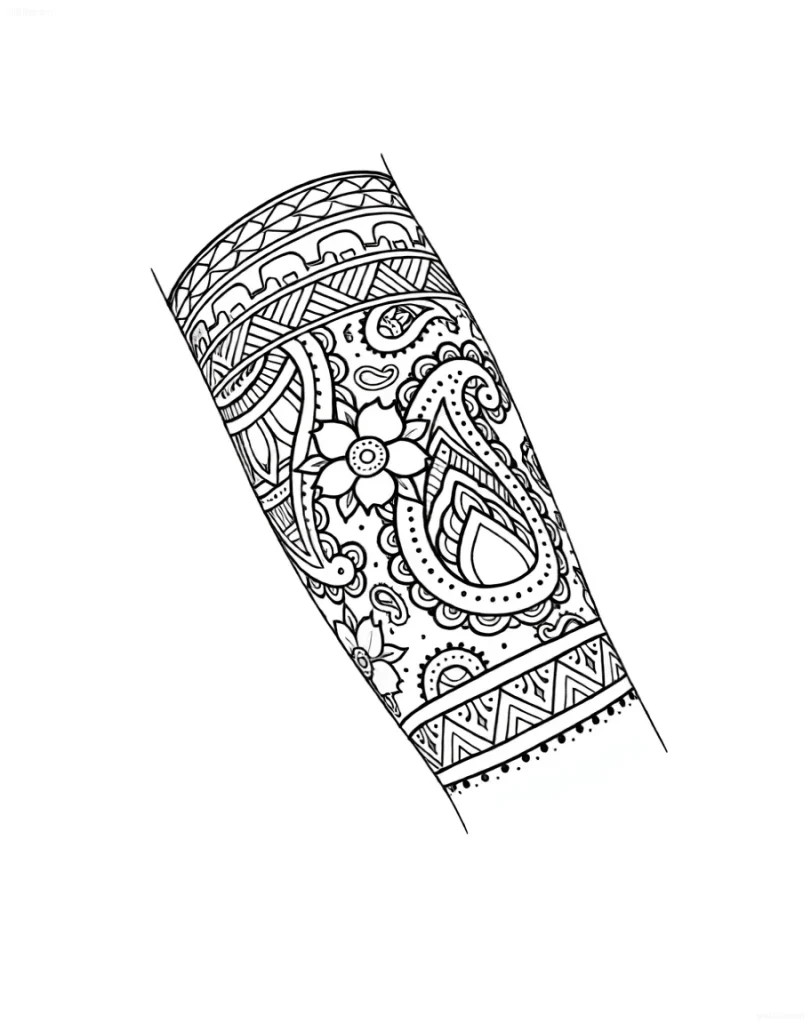
- Blackwork: The contrasting combination of dense black fill and “negative space” (skin without ink) creates very striking and bold paisley tattoos that are noticeable from afar.
- Watercolor: For lovers of bright colors. Paisley done in watercolor style looks airy and modern, like a painting on a silk scarf.
- Mehndi: A direct imitation of traditional henna painting. Such tattoos are usually very detailed, including many small curls, flowers, and dots.
You can also consider the Neo-Traditional option, where paisley can serve as a background for larger elements, such as animals or portraits, adding an Eastern flair to them.
Best Placements for Paisley Tattoos: Ideas for Harmonious Arrangement

Thanks to its curved, flowing shape, a paisley tattoo perfectly “fits” the anatomical curves of the human body. Proper placement will help emphasize the figure’s advantages and make the tattoo an organic part of your image.
Here are some proven placement ideas:
- Shoulder and forearm: Here, paisley can be placed as a single element or wrap around the arm like a bracelet. The “droplet” shape perfectly accentuates the contour of the deltoid muscle.
- Back (shoulder blade or along the spine): Large compositions of several paisley elements, resembling wings or a tree of life, look truly majestic.
- Thigh: This is an ideal place for large-scale ornamental works. The curved tip of the paisley can smoothly extend towards the knee or hip, creating a dynamic design.
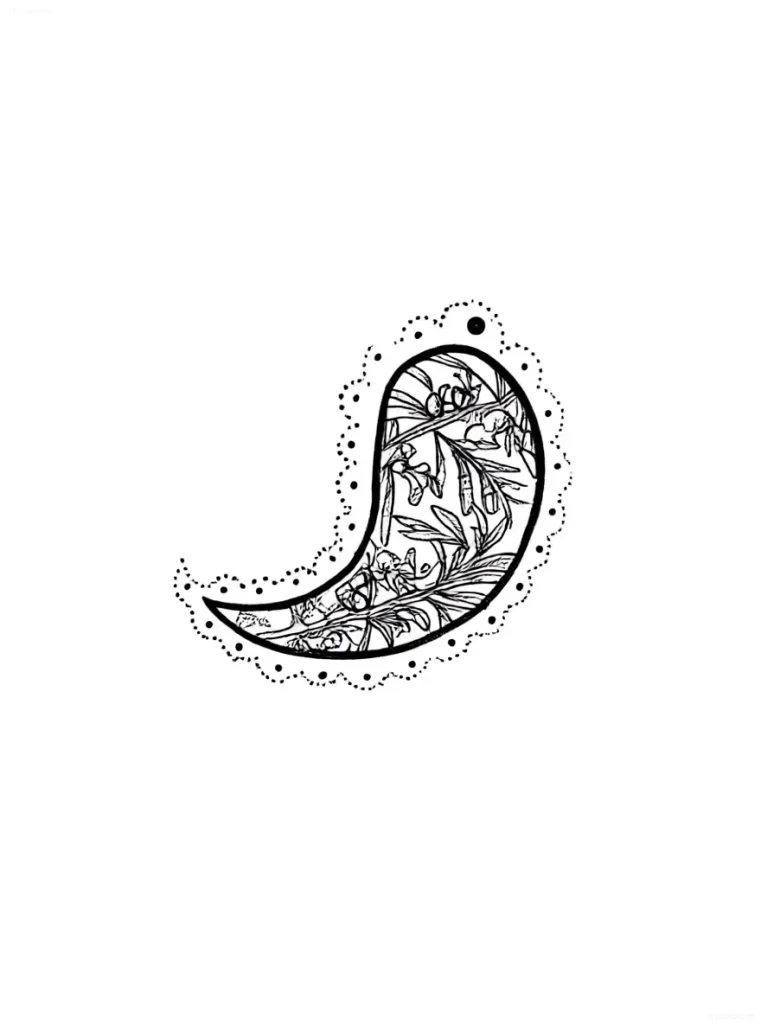
- Foot and instep: Here, paisley tattoos often imitate traditional Eastern jewelry. This looks very feminine and elegant.
- Neck (behind the ear or on the side): A miniature “Indian cucumber” in this location will be a piquant accent that can be easily hidden by hair if necessary.
- Ribs: Paisley that follows the curve of the ribs looks very aesthetic and emphasizes the slenderness of the figure.
Remember that paisley is a pattern that loves movement. If you are planning a large piece, ask the artist to “integrate” the sketch into the dynamics of your muscles so that the tattoo seems to come alive with movement.
Tips for Choosing a Design and Artist for Your Paisley Tattoo

To ensure your paisley tattoo brings you joy for years to come, approach the preparation process responsibly. This is not a situation where you should rush to choose the first sketch you find online.
- Sketch individuality: Paisley is a constructor. You can ask the artist to fill the “droplet” shape with elements that are important to you: initials, flowers, zodiac signs, or even microscopic landscapes.
- Attention to detail: The “Indian cucumber” requires meticulous precision. If the sketch has many small elements, make sure the tattoo’s scale will allow them to remain clear over time. The smaller the tattoo, the simpler the internal pattern should be.
- Choosing an artist: Look for a professional who specializes in ornamental tattooing, dotwork, or graphics. Review their portfolio: lines should be straight, dots crisp, and symmetry impeccable.
- Color palette: Black is the classic choice. It best conveys the graphic nature of the ornament. However, golden, turquoise, or deep burgundy shades can add true Eastern luxury to the tattoo.
- Trial run: If you are unsure about the placement, ask the artist to create a temporary transfer or draw the outline directly on your skin with a marker. This will help you “feel” the tattoo.
Don’t be afraid to experiment! Paisley can be both strict and monochrome, or explosive and multicolored, combining elements from different cultures.
Frequently Asked Questions About Paisley Tattoos (FAQ)

Is it painful to get a paisley tattoo?
The pain depends not on the pattern itself, but on the placement. However, it’s worth considering that paisley often requires detailed work and multiple passes of the needle (especially in dotwork), which can increase session time and, consequently, discomfort.
Does a paisley tattoo have a negative meaning?
In traditional cultures, this pattern does not carry a negative meaning. On the contrary, it is considered a benevolent symbol. In the criminal world or marginal structures, this pattern also has no specific interpretations, so you can wear it without fear.
Is a paisley tattoo suitable for men?
Absolutely! Despite the fact that the pattern seems decorative and “floral,” in Persian history, it was a symbol of royal power and male strength. In men’s tattoos, paisley is often done in stricter, geometric styles or in blackwork technique.
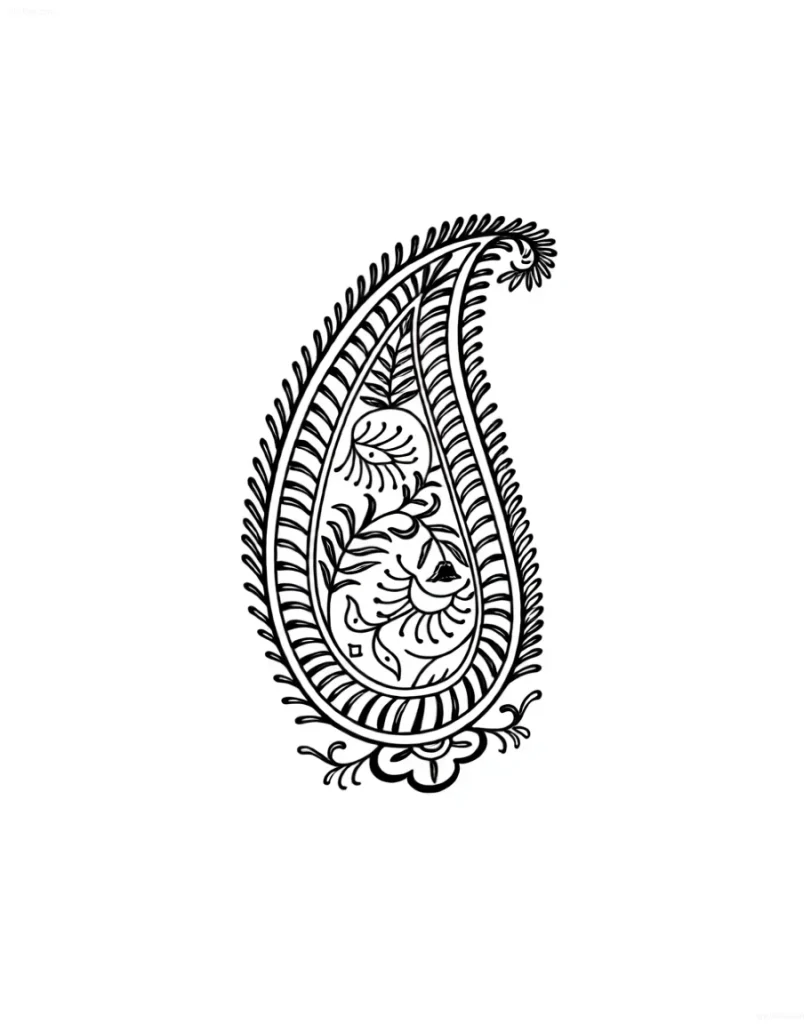
How to care for a detailed paisley tattoo?
Care is standard: cleanliness, moisturizing, and sun protection. For ornamental tattoos with fine lines, UV protection (SPF cream) is crucial to keep the details sharp and prevent them from blurring.
Can an old tattoo be covered with a paisley pattern?
Yes, due to the possibility of dense filling with details, paisley is excellent for cover-ups. The artist can use dark elements of the pattern to hide the old pigment while maintaining the overall aesthetic and lightness of the design.
Interesting Facts About the “Indian Cucumber”

- In Azerbaijan, the “buta” pattern is a national symbol and appears on the coats of arms of some cities.
- The famous paisley bandana became a cult accessory thanks to American cowboys, and later, representatives of various subcultures.
- Botanists still debate what exactly served as the prototype for the pattern: a mango seed, a palm leaf, a date palm sprout, or even a pine cone.
- Paisley was Queen Victoria’s favorite pattern, which contributed to its incredible popularity in 19th-century Europe.
A tattoo with a paisley pattern is your personal talisman, combining the wisdom of ages with modern art. Regardless of whether you choose a tiny symbol on your wrist or a luxurious ornamental sleeve, this pattern will always remind you of the endless flow of life, inner energy, and the beauty that lies in the details. By choosing paisley, you choose eternity.