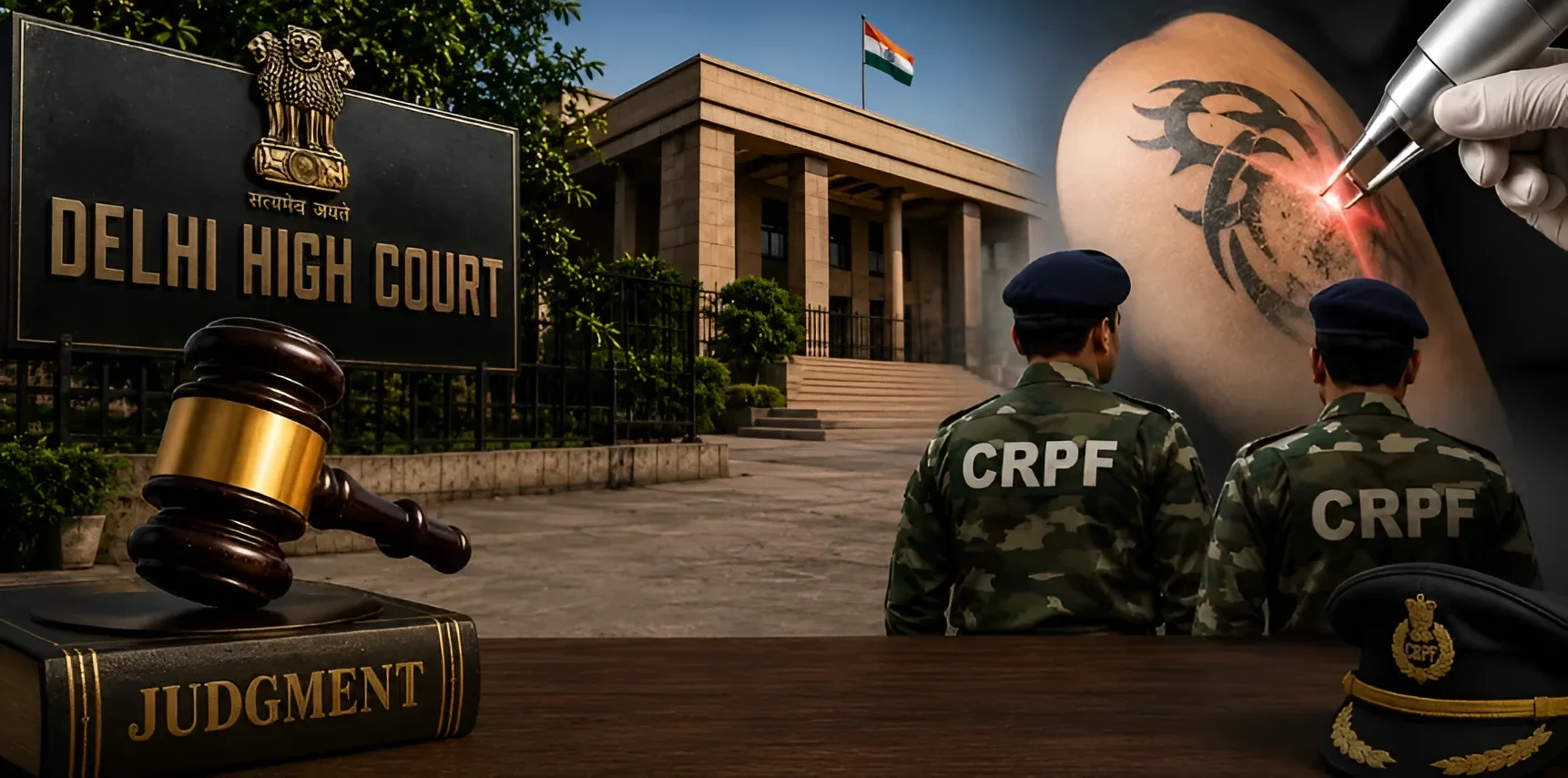
In the world of tattoo culture, where every mark on the body can be a symbol of a personal story or group affiliation, strict rules exist for those serving in government structures. In India, as in many other countries, the presence of tattoos among law enforcement officers is strictly regulated. A recent decision by the Delhi High Court has set an important precedent for understanding the seriousness with which these rules are treated.
The essence of the case: why did a tattoo become a career obstacle?
Two officers of the Central Reserve Police Force (CRPF) of India, Ankit Mann and Pradhan Chaudhary, filed an appeal with the Delhi High Court after being deemed ineligible for promotion to the post of Assistant Commander (General Duty) in the Limited Departmental Competitive Examination (LDCE-2023). The reason for the rejection was the presence of a tattoo on their right forearm – the hand used for saluting.
After being declared ineligible, both officers immediately underwent tattoo removal surgery. However, the court, presided over by Justices Amit Mahajan and Anil Khetarpal on July 1, 2026, ruled that this action could not rectify the situation that arose at the time of the medical examination.
MHA Rules: Where are tattoos allowed and where are they not?
The Ministry of Home Affairs (MHA) of India has established clear rules regarding tattoos for personnel of the CAPFs (Central Armed Police Forces) and Assam Rifles. According to these rules:
- Tattoos are permitted only on traditional body parts such as the inner forearm, but only on the left (non-saluting) arm.
- Tattoos on the back of the hands are allowed, but their size should not exceed one-fourth of the respective body part (elbow or hand).
- The right forearm, used for saluting, is completely excluded from the list of permitted tattoo locations.
These rules were developed to maintain a strict appearance and discipline in law enforcement agencies. Tattoos on visible body parts can violate this standard, especially if they are on the hands used for official salutes.
The Court’s Position: Why did tattoo removal not help?
Justices Amit Mahajan and Anil Khetarpal, in their judgment, pointed out several key aspects:
- Ineligibility was established at the time of the examination. The presence of a tattoo on a prohibited body part was confirmed during the medical examination, rendering the officers ineligible for promotion at that time.
- Tattoo removal after the examination is irrelevant. The court ruled that rectifying a tattoo after a violation was identified cannot fix the situation. Eligibility must be assessed on the date of application, not after.
- Officers cannot claim ignorance of the rules. As both applicants were already serving in disciplinary forces, they could not claim ignorance of the updated MHA medical guidelines, especially when seeking promotion to a higher rank.
The court also emphasized that in judicial review, it is not obligated to provide an additional opportunity to applicants. Removing a tattoo after ineligibility has been established cannot undo the disqualification that has already occurred.
Context of Tattoo Culture and Public Service
In today’s world, tattoos have become an integral part of self-expression culture. However, for those serving in government structures, especially law enforcement, strict limitations exist. This is due to the need to maintain a strict appearance and discipline, as well as the potential for tattoos to be associated with certain groups or ideologies that do not align with service requirements.
In India, as in many other countries, tattoos on visible body parts, particularly on the arms, can be perceived as a violation of appearance standards. This is especially important for officers who often act as representatives of the state and must maintain a high level of professionalism.
Conclusions and Prospects
The Delhi High Court’s decision underscores the importance of adhering to established rules and standards in government structures. For those aspiring for promotion in law enforcement, having tattoos on prohibited body parts can become a significant obstacle. Removing a tattoo after a violation has been identified cannot rectify the situation, and this is important to consider when planning one’s career.
For tattoo culture, this decision also serves as a reminder that certain limitations exist for those serving in government structures. It is important to understand that tattoos can have not only personal meaning but also affect one’s professional career.
In conclusion, the Delhi High Court’s decision has set an important precedent for understanding the seriousness with which tattoo regulations are treated in government structures. For those serving in law enforcement, it is crucial to consider these rules when planning their careers and choosing tattoo locations.