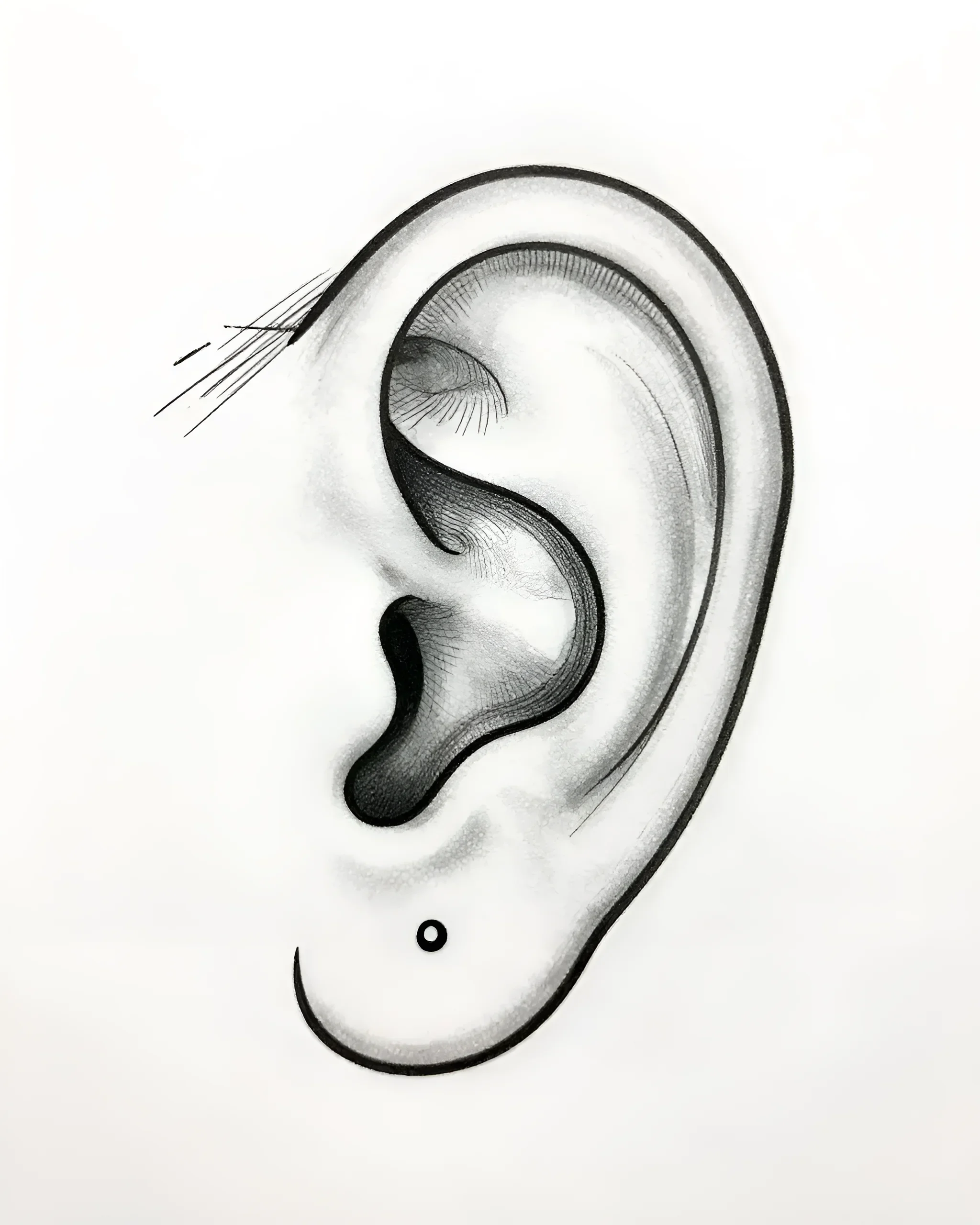
If you’ve ever browsed through piercing artists’ portfolios and your gaze lingered on an ear with several crossed barbells, you’ve most likely seen an industrial piercing. It’s not just ‘another piercing’ – it’s an entire engineering construction where two or more holes in the cartilage are connected by one long bar, creating the effect of a metal frame. At tatufoto.com, we’re accustomed to dissecting the symbolism and meanings of tattoos, but the industrial deserves special attention: it stands at the intersection of body art, industrial aesthetics, and pure technical mastery. In this article, we’ll cover all facets of this piercing – from why it’s called the most difficult to specific aftercare tips that will save you weeks of pain and nerves.
Industrial: What is this Piercing and Why is it the Most Difficult
An industrial piercing involves creating two holes in the ear cartilage, and then passing one straight or curved bar through them. Unlike regular piercings where each hole heals independently, here both ends are fixed on a single implant, and the load is distributed along the entire length of the cartilage. This is precisely what makes the industrial technically the most difficult ear cartilage piercing.
Why exactly ‘the most difficult’? There are several reasons, and they are all practical:
- Double Cartilage Trauma. Cartilage is a tissue with extremely limited blood supply. A single cartilage piercing heals in 3–6 months. Two piercings connected by one bar create an inflammatory zone that can extend up to 6–12 months. The tissue literally ‘doesn’t have time’ to regenerate in two areas simultaneously.
- Risk of Migration and Rejection. The bar presses on the cartilage from both sides. If the piercer makes even a millimeter error in depth or angle, the bar starts to ‘drift,’ and the cartilage begins to reject the implant. In classic piercings, there’s nowhere for the piercing to migrate – it simply heals. In an industrial, the migration of one end pulls the entire bar along.
- Dependence on Individual Ear Anatomy. Each person’s ear cartilage has a different thickness, density, and curvature. What fits perfectly on one ear will press or, conversely, be loose on another. The piercer must ‘read’ the ear like a blueprint.
- Impossibility of ‘Moving’ After Healing. If after a month you realize the bar is crooked or pressing, you can’t simply move it. You’ll have to remove it, wait for it to heal, and get it done again. Unlike a tattoo, which can be covered up, an industrial is ‘perfect the first time or start from scratch.’
This is precisely why, in professional piercing, the industrial is considered an ‘adult’ piercing. Many piercers won’t take on clients who haven’t had at least one healed cartilage piercing – simply because the client needs to understand what six months of aching ear pain feels like and how to properly care for a wound.
An important nuance: the industrial is not a tattoo in the classic sense, but in the context of body art and subcultural aesthetics, it is closely intertwined with tattoo culture. People who get industrials most often already have tattoos or plan to get them, and the piercing is perceived as part of the overall ‘picture’ on the body. On our portal, we examine the industrial precisely in this broad context – as an element of the body’s visual language, carrying specific meanings.
History of the Industrial Piercing in Culture
There is no exact date for the ‘invention’ of the industrial – it’s not a patent or an author’s technique. The piercing evolved organically from the needs and experiments of the piercing community in the 1980s–1990s.
Its roots lie in the punk and hardcore scene of Los Angeles and New York. In the mid-80s, when ear cartilage piercing (helix, conch) was just emerging from underground, people were looking for increasingly radical ways to ‘reformat’ their ears. Passing one bar through two piercings was a logical yet bold solution: it visually transformed the ear into an object resembling industrial hardware, a structural element. Hence the name – industrial.
Piercing studios in San Francisco and Los Angeles in the late 80s and early 90s played a key role in its popularization. Piercers like Michael Gregory and other pioneers of modern piercing experimented with bar shapes, piercing angles, and combinations. The industrial quickly became a ‘calling card’ of alternative aesthetics: it was worn by musicians, artists, and activists. Within the tattoo community, the piercing was perceived as a ‘basic level’ of body modification – if you had an industrial, you were ‘one of us’.
In the 2000s, the industrial moved from the underground to the mainstream. Variations with curved bars, additional piercings, and combinations with ear tattoos appeared. In Russia and CIS countries, the piercing became massively popular around 2010–2015, when piercing studios opened in major cities and ceased to be associated exclusively with subculture.
Today, the industrial is no longer just a ‘punk’ symbol. People from various subcultures get it, and even those who simply like minimalist geometry on their bodies. But the cultural code remains: the industrial is still read as a gesture, a statement that the person is not afraid of pain and not afraid to stand out.
Meanings and Symbolism Carried by Industrial Piercings
At tatufoto.com, we always emphasize that any body modification is not just adornment but a carrier of meaning. The industrial is no exception in this regard, and perhaps one of the most ‘eloquent’ piercings. Let’s break down the main layers of meaning.
1. Industrial Aesthetics and Rebellion. The very name and visual image – a metal bar, crossed lines, ‘fasteners’ – refer to industrial culture, the aesthetics of factories, cinemas, and punk rock. A person with an industrial literally ‘wears’ a reference to a culture that has always been about protest, about rejecting smoothness and conformity. This meaning is not necessarily conscious: sometimes a person simply chooses the form, but the cultural code is read by others.
2. Strength and Endurance. The industrial is one of the most painful piercings. The pain during the piercing is described as a sharp, ‘piercing’ sting, and during the healing period, the ear aches, swells, and may itch for weeks. The very fact that a person went through this and survived to heal is perceived in a subcultural context as a demonstration of resilience. In the tattoo community, this parallels how a large tattoo is perceived: ‘they could handle it, so they are tough’.
3. Geometry and Order in Chaos. Unlike, say, a lobe piercing, which looks ‘soft,’ the industrial is a clear line, symmetry, and engineering precision. Symbolically, it can be interpreted as a striving for order, structure, and self-construction. For people who get an industrial in combination with geometric tattoos (arrows, circles, lines on the neck or wrist), the piercing becomes part of a larger visual metaphor: the body as a construction, as a project.
4. Individuality and ‘Markedness’. An industrial cannot be hidden. It’s visible with any hairstyle, any clothing. In a world where people strive for ‘normality’ and invisibility, an industrial is a conscious choice to be visible, to be ‘marked.’ In tattoo culture, this echoes the idea of a tattoo as an ‘autograph’ on the body: I am here, this is who I am, I don’t conform.
5. Connection to Music and Art. Historically, the industrial is closely linked to industrial music (quintessential bands include Ministry, Front 242, Die Krupps) and industrial aesthetics in visual art. For fans of this genre, the piercing is not just an adornment but a ‘node’ in their personal symbol system, as conscious a choice as a tattoo of their favorite band’s logo or abstract industrial art.
It’s important to understand: meanings are not rigidly fixed. If you get an industrial simply because ‘it looks beautiful,’ that’s a valid choice. Symbolism is a layer that everyone adds themselves. But if you want the piercing to ‘communicate’ a specific message to others, it’s useful to consciously choose the form, placement, and accompanying tattoos.
Types and Variations of Industrial Piercings: From Classics to Complex Constructions
This is where things get interesting for those choosing ‘their’ industrial. There are a huge number of options, and each carries a slightly different visual and symbolic emphasis.
Classic Industrial (straight industrial). Two cartilage piercings connected by a straight bar. The upper piercing is usually in the helix (upper edge of the cartilage), and the lower one is in the anti-tragus or lower part of the cartilage. The bar runs diagonally or vertically. This is the ‘base’ from which everything started. Visually – a clear, minimalist line. Symbolically – ‘pure’ protest, without unnecessary decorations.
Curved Industrial. The bar is not straight but slightly curved, following the contour of the cartilage. This is both more aesthetic (the bar doesn’t ‘stick out’ but lies on the ear) and technically more complex – the piercer must accurately calculate the radius of the curve for the specific ear. Visually, it looks softer, more ‘organic.’ Symbolically – flexibility, adaptability, ‘I build myself for myself, not according to a template’.
Double Industrial. Two bars, four piercings. The constructions can vary: two parallel bars, two crossed (forming an ‘X’ or ‘#’), two bars forming a triangle or trapezoid. This is already a serious construction, with longer healing and higher risk. Visually – a dense, ‘architectural’ pattern. Symbolically – complexity, layering, ‘I’m not afraid of depth’.
Industrial with Additional Piercings. Single piercings are added to the main bar: helix, conch, tragus, anti-tragus. This creates a ‘composition’ where the bar is the supporting structure, and the single piercings are ‘decorative elements.’ This is the most popular option for those who want to ‘fill’ their ear without overloading it. Combined with an ear tattoo (e.g., a small geometric tattoo in the conch area), it creates a cohesive art object.
Industrial with Beads, Nuts, Decorative Elements. Instead of standard beads, nuts, hexagons, stars, or engraved beads are placed at the ends of the bar. This is purely an aesthetic choice, but it enhances the ‘industrial’ code: nuts and hexagons literally refer to fasteners and mechanics.
Industrial with Tattoo. A separate topic. Increasingly, people get tattoos around or under the industrial: lines mimicking the bar’s trajectory, dots at the piercing sites, abstract patterns ‘enveloping’ the ear. This is a full-fledged body art where the piercing and tattoo are a single entity. On our portal, we recommend considering such combinations as separate projects: first the tattoo (or first the piercing, depending on which takes longer to heal), then the completion.
When choosing a variation, consider not only ‘what looks good’ but also your anatomy. An ear with thin cartilage cannot withstand a double industrial with four piercings – the cartilage may deform. An ear with dense, ‘fleshy’ cartilage, on the other hand, might ‘swallow’ a thin bar, making it unnoticeable. A good piercer will examine your ear during a consultation and tell you which options are realistically possible for you.
Industrial Piercing Placement: Anatomy and Aesthetics
For an industrial piercing to ‘sit’ beautifully and heal without complications, understanding the anatomy of the auricle is critically important. Let’s break down the key areas.
Helix. The upper edge of the cartilage, the ‘arc’ of the ear. This is the most popular spot for the upper industrial piercing. The cartilage here is thin but quite dense. A helix piercing heals in 3–4 months. Aesthetically, the helix is the ‘frame’ of the ear, and a piercing here emphasizes its shape.
Anti-tragus. The protrusion opposite the tragus, at the lower part of the auricle. Often used as the lower point of an industrial. The cartilage here is thicker, and the piercing takes longer to heal – 4–6 months. Aesthetically, the anti-tragus ‘closes’ the composition from below, creating a visual ‘anchor’.
Tragus. The small cartilage ‘flap’ in front of the ear canal. Rarely used in industrials due to its small surface area, but can be a connection point in complex constructions.
Conch. The deep ‘bowl’ inside the ear. Not used in classic industrials (the bar doesn’t pass through the conch), but in combination with single piercings, the conch becomes a ‘background’ for the composition.
Inflection and Anti-inflection. The inner folds of the cartilage. In complex industrial constructions, the bar can pass through these areas, but this requires the highest precision from the piercer – the cartilage here is thin and curved.
The aesthetics of placement are based on principles of geometry:
- Symmetry. Classic industrials are often made symmetrical relative to the ear’s vertical axis. This looks ‘strict’ and ‘engineered’.
- Asymmetry. The bar runs at an angle, piercings at different heights. This looks more ‘alive’ and ‘dynamic.’ Popular among those who want to move away from ‘templates.’
- Proportion. The length of the bar should be such that it doesn’t press on the cartilage or be too loose. Ideally, there should be a 1–2 mm gap at each end. If the bar is too long, it rotates, presses, and causes inflammation. If it’s too short, the cartilage ‘pushes’ the bar in, and it migrates.
- Angle. The bar should run parallel to the cartilage surface, not ‘dig into’ it. If the angle is incorrect, one end will press harder, and the cartilage will begin to reject the implant.
Practical advice: try on the bar before getting pierced. Many studios allow you to take a bar of the correct length and hold it against your ear to see how the construction will look. This isn’t a ‘trial piercing’ but simply a visual fitting. You’ll see if you like the angle, length, and symmetry. This saves you stress and the risk of ‘I don’t like it’.
Tips for Choosing a Piercer and Aftercare for an Industrial Piercing

Here we move from theory to practice, and this is perhaps the most important section of the article. The choice of piercer and the quality of aftercare determine whether your industrial will be a beautiful adornment or a source of chronic inflammation.
How to Choose a Piercer:
- Look at portfolios specifically for industrials. Not ‘piercings in general,’ but industrials. See how the bars are positioned, if the piercings are symmetrical, if there are any signs of migration on healed ears. If 90% of the portfolio is lobes and helixes, and there are only a couple of industrials, that’s a red flag.
- Ask about sterilization. Needles must be disposable, in factory packaging, opened in front of you. Bars should be implant-grade titanium (ASTM F136) or niobium. No ‘stainless steel,’ no ‘gold-plated silver.’ Titanium is hypoallergenic, doesn’t oxidize, and doesn’t tarnish.
- Evaluate the consultation. A good piercer will not rush you. They will look at your ear, ask what you want, explain what’s realistic and what’s not, and talk about healing, pain, and aftercare. If the piercer says ‘Oh, it’s quick and painless’ – that’s a bad sign. An industrial is not ‘quick and painless’.
- Check studio conditions. Cleanliness, a separate workspace, disposable gloves, antiseptics. Piercing is a medical procedure in a practical sense, and the conditions should reflect that.
- Ask about guarantees. If the bar migrates or the ear becomes inflamed during healing, a good piercer will take responsibility for correction: they will select a different bar, treat it, and provide recommendations. Clarify this before getting pierced.
Industrial Aftercare During Healing (3–12 months):
- Cleaning. Twice a day, clean the ear with a saline solution (0.9% sodium chloride, available at pharmacies as ‘saline solution’ or can be prepared: 1 tsp sea salt without iodine per 1 liter of boiled water). Clean both ends gently, without pressure. Do not use peroxide, alcohol, brilliant green, or iodine – they kill young cells and slow down healing.
- Do not touch the bar with your hands. Do not twist, move, or ‘check if it’s in place.’ The bar must remain stationary until the cartilage fuses. Any movement is a micro-trauma.
- Sleep. Sleep on the side opposite the piercing or on your back. If you sleep on the pierced ear, the bar presses on the cartilage, and healing takes significantly longer. Buy a special pillow with a cutout for the ear or simply get used to sleeping on your back.
- Avoid excessive moisture. Showers are fine, but avoid steam rooms, swimming pools, the sea, or lakes until fully healed. Chlorine, salt, and bacteria are all enemies of your wound.
- Do not change the bar until fully healed. Even if it ‘doesn’t hurt anymore.’ Cartilage heals slowly, and the fact that it doesn’t hurt doesn’t mean it has fused. A minimum of 6 months – do not touch it. Better 9–12.
- Monitor for symptoms. Mild swelling, redness, and slight soreness in the first 2–3 weeks are normal. If swelling increases, pus appears, the ear is hot to the touch, and your body temperature rises – it’s an infection. See your piercer or a doctor; don’t wait for it to ‘go away on its own.’
The positive aspect: an industrial is an investment in yourself. Yes, healing is long, and yes, there’s discomfort. But the result is a construction that will delight you for years, doesn’t fade, doesn’t ‘blur’ (unlike a tattoo that can fade over time), and always looks sharp and neat. It’s essentially a ‘forever adornment’ that requires no updates.
Frequently Asked Questions About Industrial Piercings

We’ve compiled the questions most frequently asked during consultations at piercing studios and in comments under body art articles.
How much does an industrial piercing hurt? The piercing itself is a sharp pain, described as a ‘piercing stab,’ 7–9 on a ten-point scale. The pain subsides in a few seconds. For the first 2–3 days, the ear aches, swells, and may be uncomfortable to the touch. By the end of the first week, the sharp pain subsides, leaving mild discomfort that gradually disappears within 2–4 weeks.
Can I get an industrial on both ears? Technically, yes, but not simultaneously. It’s recommended to get it on one ear, wait for complete healing (6–12 months), and only then get it on the other. Getting both ears pierced at once is a huge stress on the body and carries a high risk of complications. Furthermore, if something goes wrong on the first ear (migration, rejection), you’ll know what needs correction and can account for it on the second.
Is an industrial compatible with an ear tattoo? Yes, and it’s a very popular combination. However, the order is important: if the tattoo is in the area where the bar will be, get the tattoo first, wait for it to heal (4–6 weeks), then get the piercing. If the tattoo is in an area where the bar won’t be (e.g., in the conch, while the bar is in the helix and anti-tragus), the order isn’t critical. The main thing is not to get a tattoo on the site of a future piercing and not to get a piercing on a fresh tattoo.
What to do if the bar starts ‘drifting’ (migrating)? Don’t panic and don’t try to ‘move’ it yourself. Go to your piercer. They will assess the situation: if migration is in the early stages, a bar of a different length or angle can be chosen. If the cartilage has already started rejecting it, the bar is removed, the ear is treated, and the piercing is redone after complete healing. The sooner you seek help, the higher the chance of saving the piercing.
Can I wear an industrial on a plane, in a pool, or in a sauna? On a plane – yes, but pressure changes might cause slight discomfort in the first few weeks of healing. In a pool and sauna – no, until fully healed. Chlorine, steam, and bacteria all provoke inflammation. After complete healing (6–12 months), there are no restrictions.
How much does an industrial cost? It depends on the city, studio, piercer, and complexity of the construction. A classic industrial typically costs more than a single cartilage piercing because it involves two piercings and more complex work. Refer to the specific studio’s price list, but don’t choose the ‘cheapest’ option. Saving money on a piercer is a risk of migration, infection, and re-piercing, which will ultimately cost more.
Age restrictions? Most studios perform industrial piercings from the age of 18. Some do it from 16 with parental consent. However, this is not just a formality: cartilage at 16 is still developing, and a piercing during growth might ‘drift’ as the ear shape changes. The optimal age is 18+.
Interesting Facts About Industrial Piercings
We conclude the article with a collection of facts that aren’t always mentioned during consultations but make the industrial even more interesting as a cultural and technical phenomenon.
- The Industrial is a ‘rite of passage’ for piercers. In the professional community, the industrial is considered one of the most challenging piercings. A piercer who confidently and beautifully performs industrials automatically gains client trust for simpler work as well. It’s a kind of ‘exam’ for a piercing artist.
- Titanium vs. Niobium. Titanium (ASTM F136) is most often used for industrials because it’s lighter and stronger. But niobium is also an excellent option: it’s hypoallergenic and can be anodized in various colors (gold, rose gold, black PVD coating). If you have a titanium allergy (rare, but it happens), niobium is an alternative.
- Industrial in Film and Music. The piercing has become a ‘trademark’ for many musicians and actors. In the 90s, it was worn by members of industrial and metal bands, and in the 2000s, by rock and pop artists. In films, the industrial is often used as a visual marker for an ‘alternative’ character: a rebel, an artist, an anti-hero.
- Industrial and Tattoo – a Single Art Object. In modern body art, industrials and ear tattoos are increasingly done as a single project: the tattoo artist and piercer coordinate the design so that the tattoo lines ‘flow’ into the bar, and the piercings become ‘dots’ in the composition. This is no longer just an ‘adornment’ but a full-fledged sculpture on the body.
- Industrials don’t ‘fall out.’ Unlike some piercings (e.g., in the lobe, which can ‘close’ with improper care), an industrial, if healed, remains forever. Cartilage doesn’t ‘seal’ the channel like skin in the lobe. If you remove the bar, the piercings will remain as two small scars, but the channel won’t close completely. This is important to consider if you’re thinking ‘what if I change my mind’.
- Industrial in Korean and Japanese Culture. In South Korea and Japan, the industrial became popular in the 2010s as part of the ‘body art’ trend. In Japan, the piercing is often combined with traditional tattoos (irezumi) on the neck or shoulder, creating a contrast between the ‘industrial’ bar and the ‘classic’ tattoo. In Korea, the industrial is popular among young people as an element of a ‘minimalist’ style.
An industrial is not just a piercing. It’s a small project you launch on your body: with planning, selection, healing, aftercare, and a result that lasts for years. If you approach it consciously – with an understanding of anatomy, a choice of piercer, and patience during the healing period – it will become one of the most expressive elements of your ‘picture’ on your body. And at tatufoto.com, we always advocate for every modification – whether it’s a tattoo or a piercing – to be done with self-love and an understanding of what it represents. Good luck with your choice, and may your industrial heal beautifully and become the ‘anchor’ you’ve been looking for.