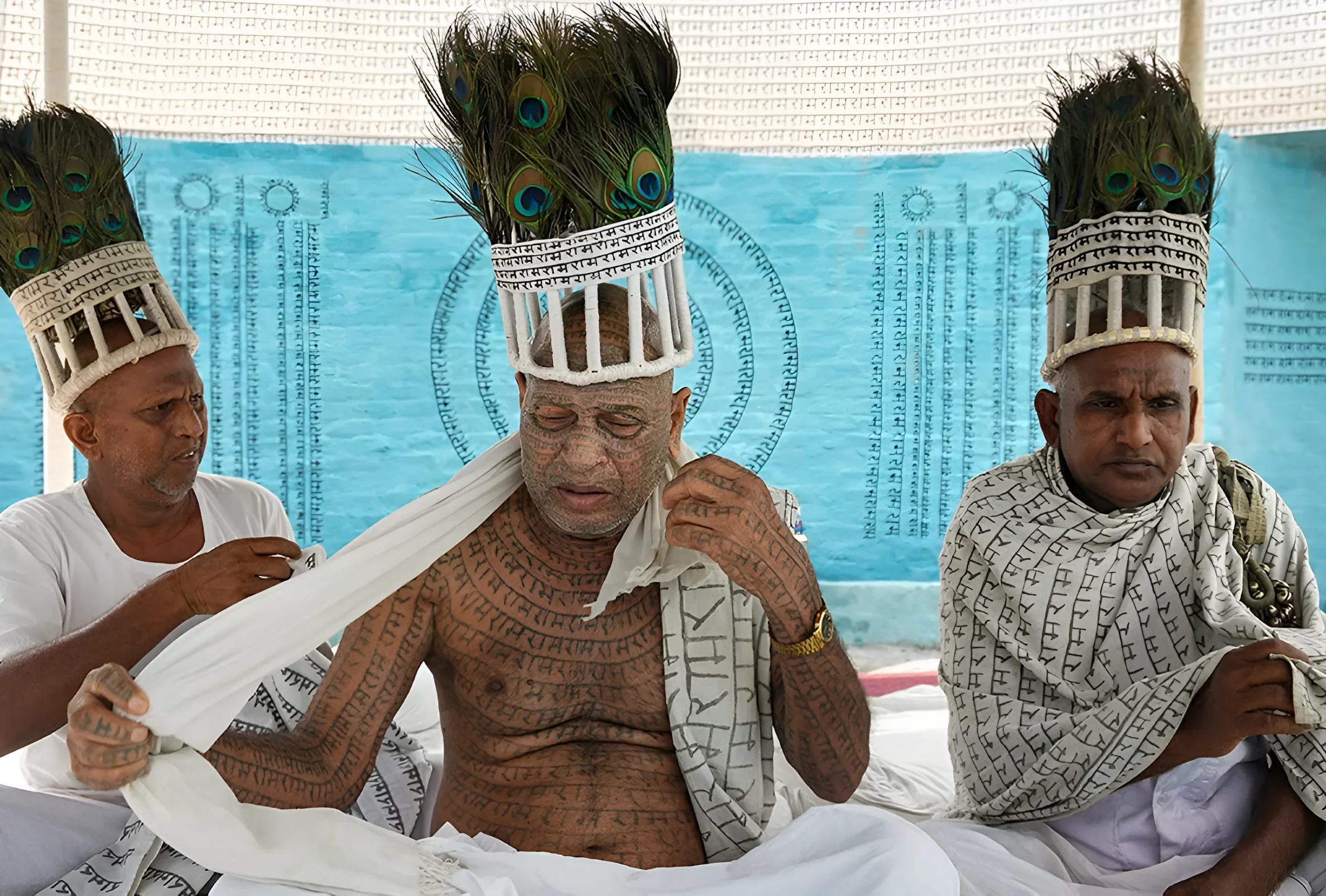
In the midst of Durga Puja, one of India’s largest street festivals, Kolkata hosted a scene for a few days that bore little resemblance to the usual Bengali pandals. On Saturday, October 17, 2026, representatives of the Ramnami community – a Hindu Bhakti sect from the state of Chhattisgarh – arrived at the festive tents of West Bengal. Their visit was not just a cultural exchange; it was a living lesson in how tattoos can transform into a language of faith and a form of social resistance.
The first thing that strikes you when you see members of the community is their skin. Their faces, necks, shoulders, arms, and torsos are covered in a dense pattern of repeating inscriptions. This is not an ornament for beauty, nor a personal motto: the sacred name “Ram” is tattooed on their bodies, stretching across the skin in an unbroken ribbon, turning the person into a kind of walking scroll. Combined with tall white headdresses adorned with peacock feathers and clothing painted with the same text, the image is cohesive: the body here is perceived not as a shell, but as a temple to be filled with mantra.
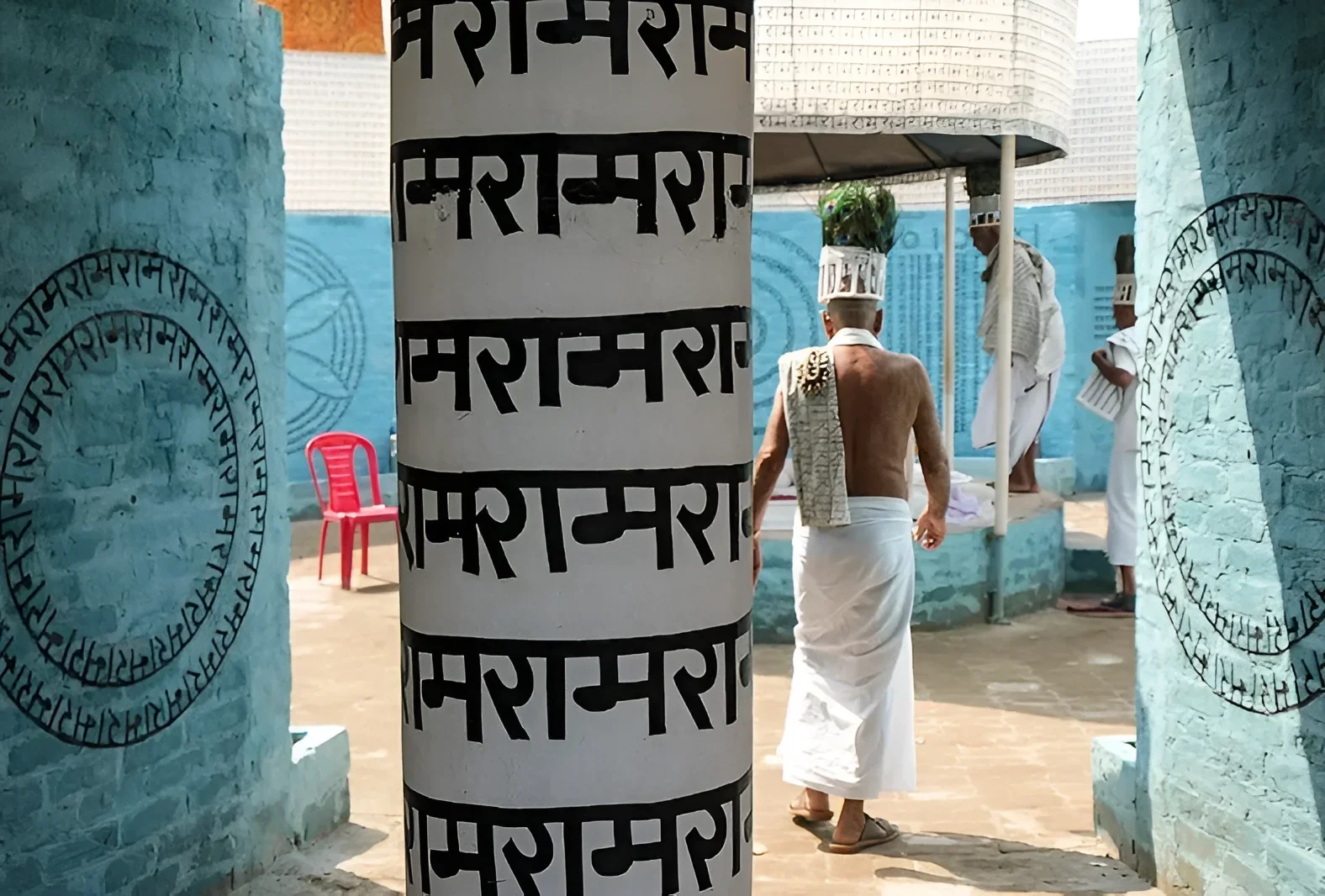
For tattoo culture, this is a fundamentally different logic than what the Western viewer is accustomed to. In the European and American tradition, tattoos are most often read as personal narratives, aesthetic statements, or markers of subculture. For the Ramnami, however, body art serves as both ritual and identification. Here, a tattoo is a “living text,” a bodily mantra that can be “read” with the eyes and “recited” with the voice. The skin becomes the same as a monk’s mala beads: a carrier of the word that must always be present and always visible.
It is important to understand the social subtext as well. The Ramnami community is historically linked to the Bhakti movement and the practice of Nirgun Bhakti – devotion without reliance on a specific image of the deity. The name itself can be translated as “We are Ram” or “We belong to Ram,” and this statement was bold in itself within a rigid caste hierarchy. Tattooing the name of Ram all over their bodies became a way for the community to assert their spiritual legitimacy and, simultaneously, an act of rebellion against discrimination by higher castes. A body covered in sacred text cannot be “read” by caste: it becomes a public manifesto.
At the festive pandal in Kolkata, this tradition was showcased in its entirety. Participants recited religious texts, unfurled painted cloths with mantras, and showed their tattoos to visitors. A separate element was a wall of portraits – photographs of community members, which guests took pictures of as souvenirs. This format turned a religious procession into a true exhibition of bodily heritage, where each person was both a carrier of tradition and its exhibit.
Key elements of the tradition visible in Kolkata:
- Dense tattooing of the name “Ram” all over the body, including the face and neck.
- Tall headdresses with peacock feathers as part of the ritual image.
- Clothing and cloths painted with the same sacred text.
- Public recitation of mantras and display of bodily “scrolls” as a form of preaching.
For tattoo culture as a whole, this example is a vivid reminder that tattoos have never been neutral adornments. In different societies, they have served as initiations, protection, prayers, and political gestures. The Ramnami in Kolkata demonstrated how body art can unite spiritual practice and social resistance, turning the skin into the most honest carrier of meaning possible.