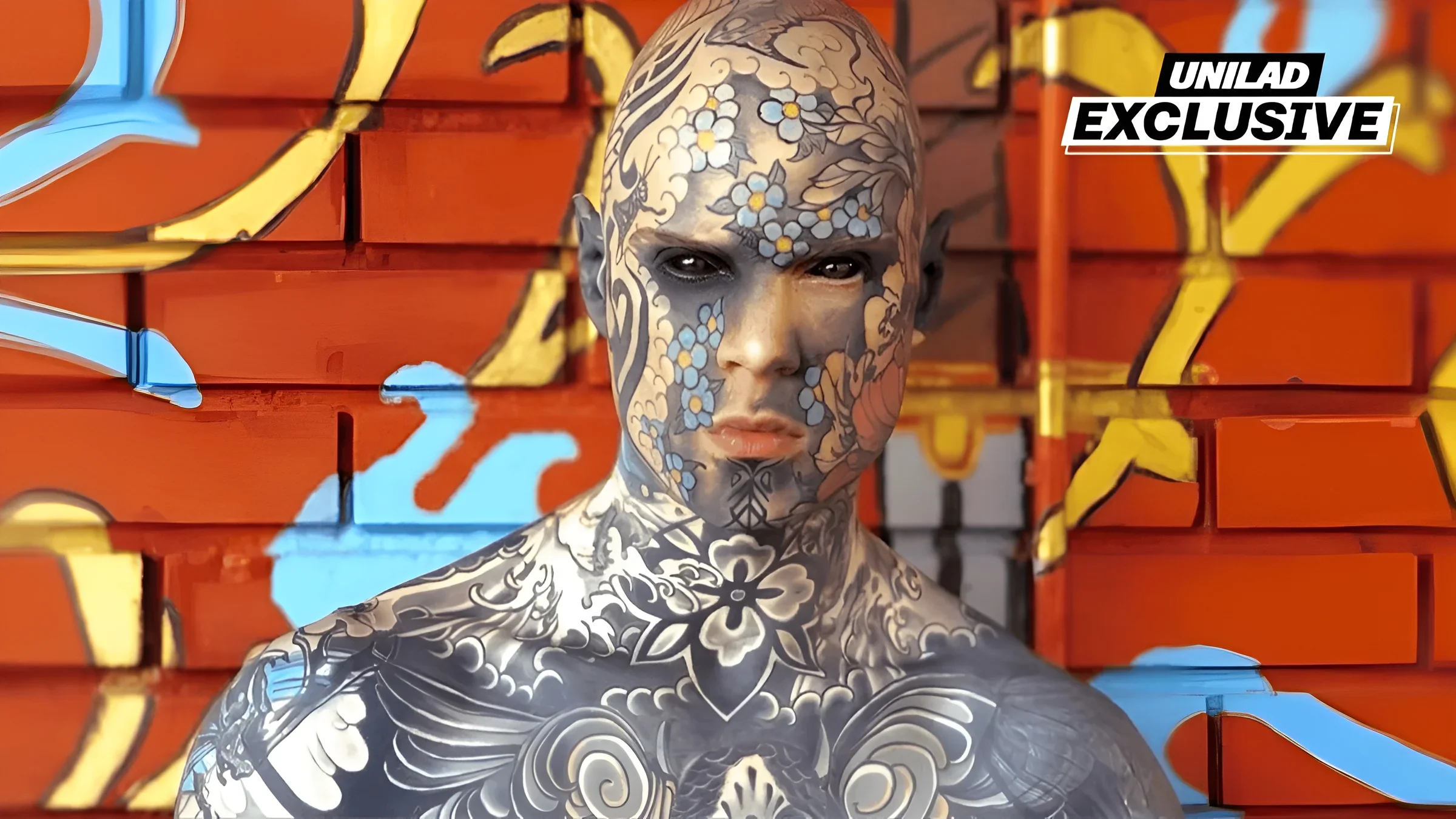
Sylvain Helaine, who at forty-one is no stranger to strange looks, long ago stopped hiding behind a hood — even though that is exactly what gave him his online pseudonym, Freaky Hoody. This French educator, a substitute primary school teacher in Paris, has covered his body in ink from head to toe, and then went further: tattooing his eyes, tongue, fingernails, and toenails, and removing his nipples and navel to make room for new designs. In total, he has spent about 660 hours in the chair and invested over $109,000 in his transformation, and according to him, he has no intention of stopping.
How the journey began

The story began in London, where Helaine moved at 25 after a personal crisis. Already having experience as a school teacher, he participated in the French educational program Jules Verne and taught in the British capital from 2012 to 2014. He succumbed to tattoo culture almost instantly: on his first day in Brixton, his attention was caught by a bank worker with a fully tattooed neck. From January 2013, he began getting covered at the Into You studio in Farringdon, which, by the way, closed in 2016. Returning to his mother in Paris, Helaine brought with him a debt of $5,491, and he only finished his first full layer three and a half years later.
Today he is working on a second layer — this is retouching, cover-ups, and new compositions over the original design. In the context of modern tattoo culture, this approach is called “second skin” or “full-body second layer”: when the body is perceived not as a canvas, but as a surface that can be “repainted” and deepened, adding volume and contrast. It is this logic that turns a tattoo from a single pattern into a cohesive visual system.
What was the hardest part
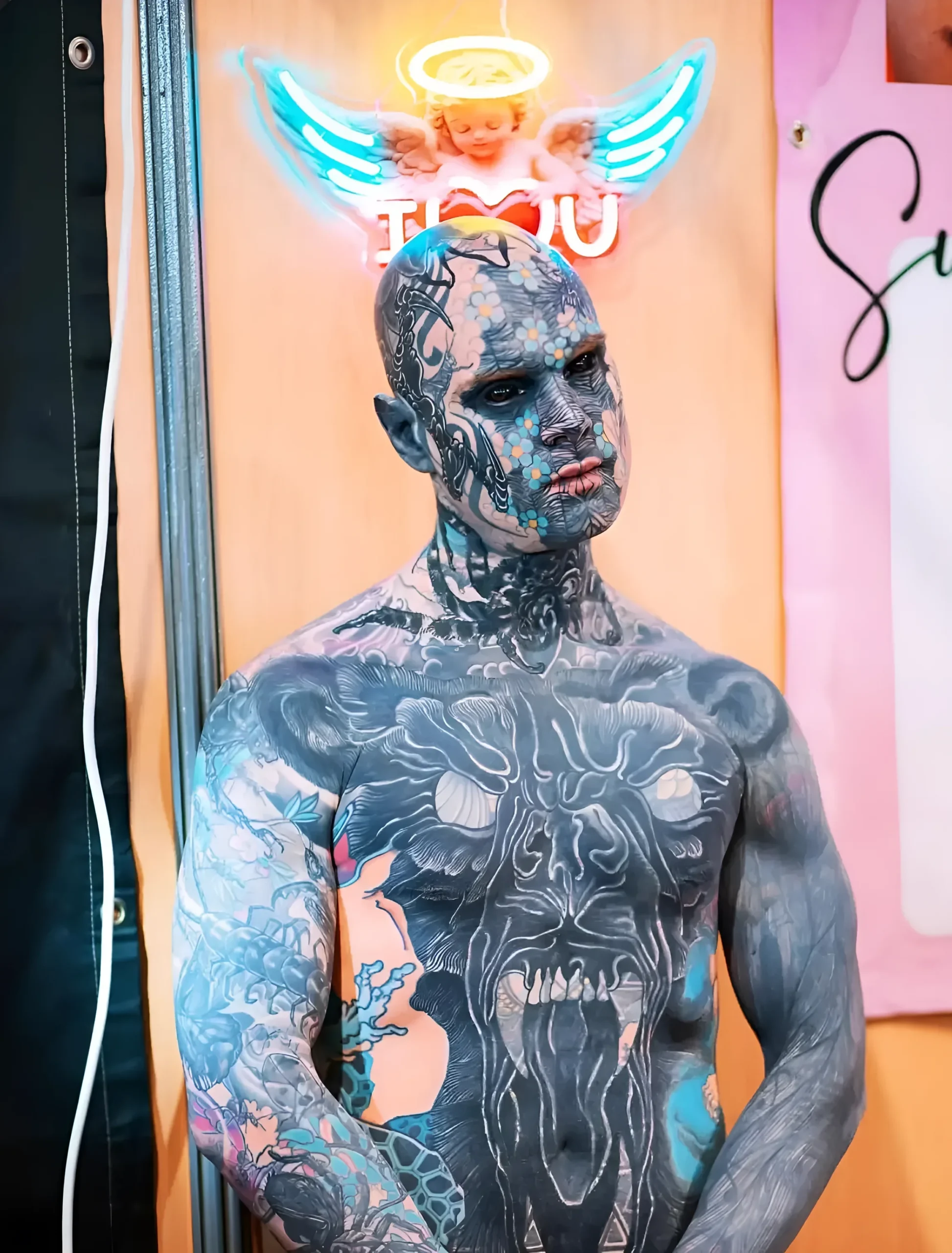
Helaine calls the eye procedure the most agonizing. It could not be done under anesthesia because the eye had to be held open, and he saw the needle approaching and entering. It took about 15 minutes, but the sensations, in his words, are comparable to finishing a 42-kilometer marathon. He remembers the amount vaguely — “maybe $3,000.” At the same time, he was lucky with his eyes: there were no complications, although, as he emphasizes, problems occur in nine out of ten cases. He knows people who have lost part or all of their vision, a model friend who can no longer work because direct light has become unbearable, and a woman whose black ink spread to her cheeks.
The nails required nerve anesthesia for each finger: ink was injected under the plate, each nail was treated twice, totaling four procedures. Healing took six months, and the pain in his fingers returns about twice a day. One finger became “hard as wood” for several months, and on his left hand, the needle went too deep and broke the nail root — that will remain forever. The tongue was tattooed with a syringe, as there is no skin there: the swelling was such that the tongue was sticking out of his mouth after just two minutes; he couldn’t drink for a day, didn’t eat for several days, and could only eat without tears after three weeks. A year later, two more syringes of ink were added, which caused lymph node swelling and lumps in his throat.
Life beyond the chair
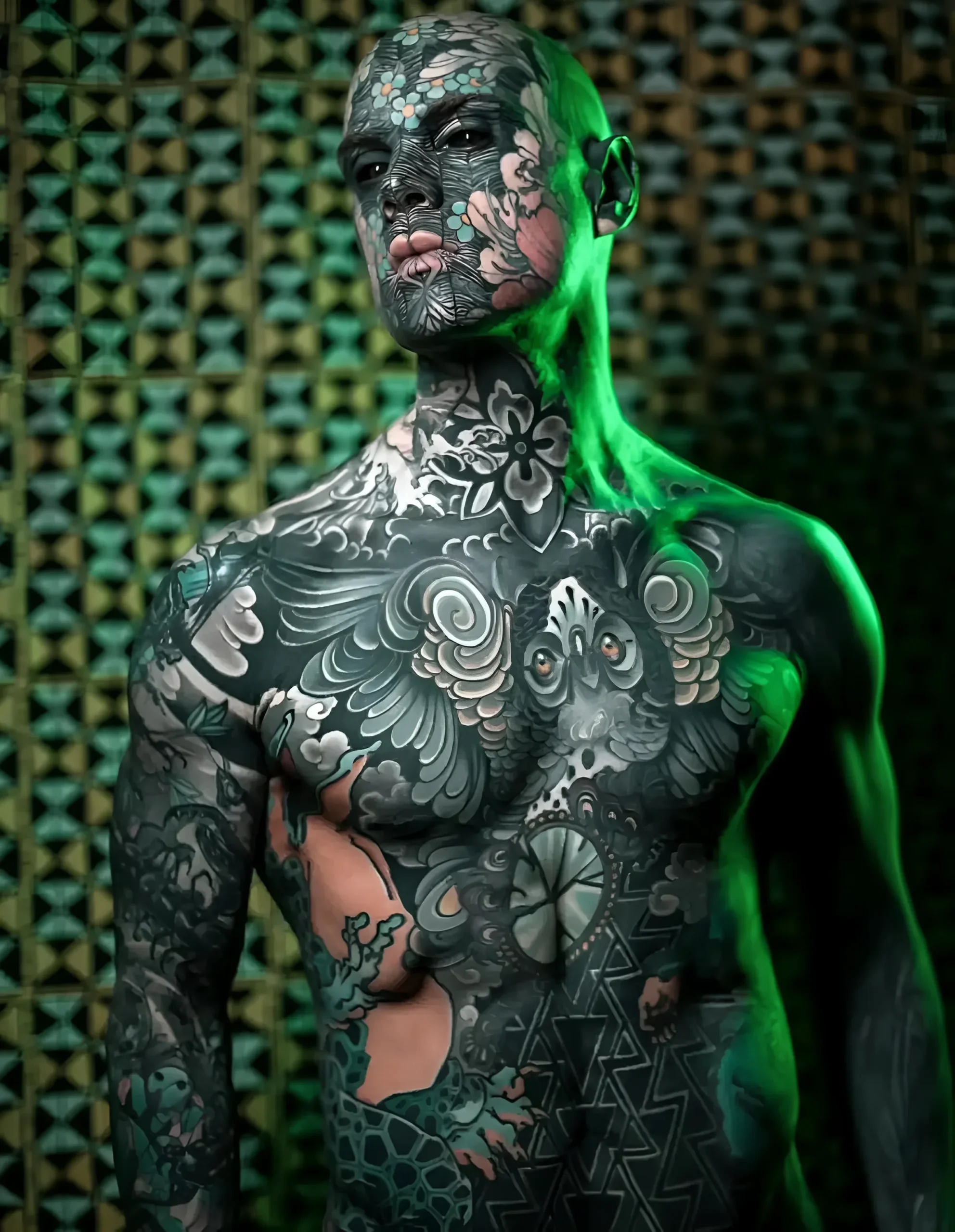
Helaine has been in the profession since 2009, and this is his eighteenth year in the same district of Paris. For the last ten years, he has been working as a substitute teacher, moving between 15–20 schools to maintain his connection to art. Principals, according to him, announce him as “here comes Mr. Helaine, that very tattooed teacher,” and students aged seven to ten don’t ask questions — all their parents have tattoos too. Parents, upon learning about him, search for him online. Outside of school, he is a guest at tattoo conventions across France and French-speaking Europe, hosts about every second one, did go-go dancing and fire shows in clubs before the pandemic, and periodically appears in movies, series, and music videos. At one of the Swiss events, he worked alongside actor Danny Trejo, known for the movie “Machete,” who told him how he got a tattoo on his chest in three different prisons, hiding from cellmates and guards.
His family eventually accepted his appearance: his mother was worried at first, but now attends nearby events. The harshest reactions remain comments from religious people, mostly Christians, who consider body modification unacceptable. Helaine has no regrets and says that even if they appear, he will simply cover them up.
For those who are just thinking about such a path, his advice is simple: start small, first the body, and only then the neck, face, and hands, and bet on tattoos rather than body modifications. In the professional environment, this sounds like a basic rule: body modification heals for months versus five to six days for a tattoo, and the irreversibility here works much harder.