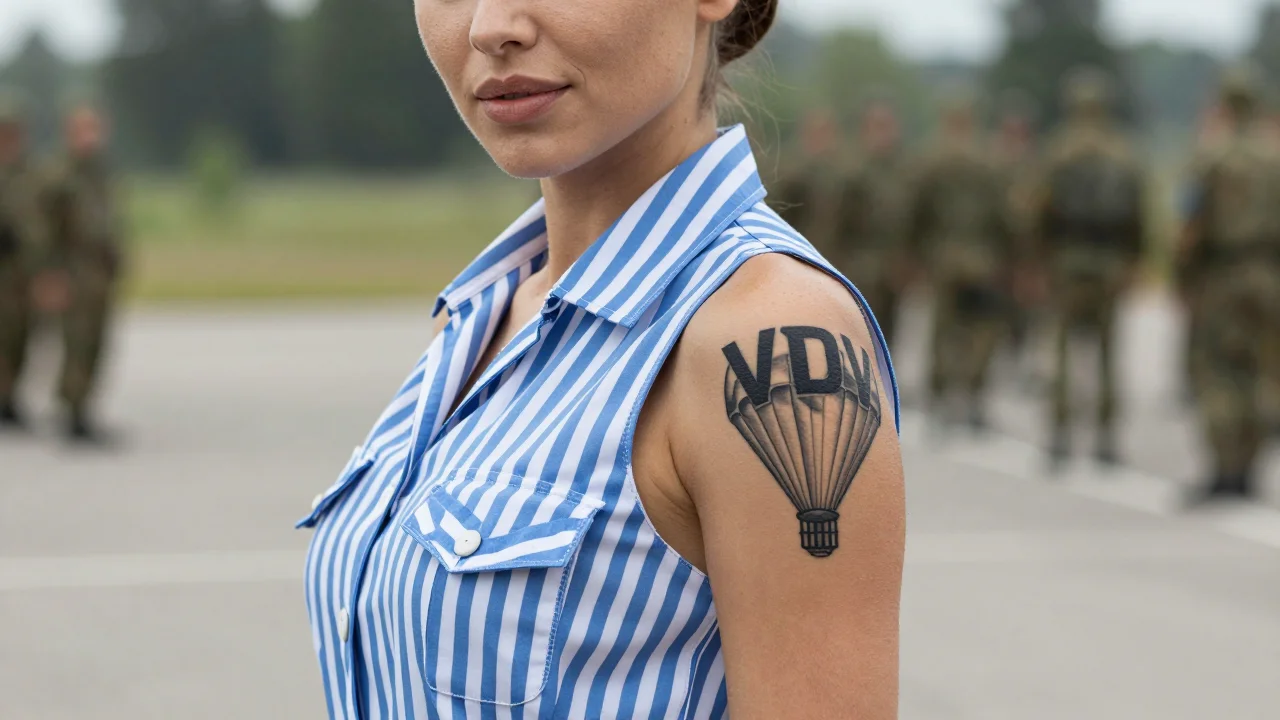
The history of army tattoos is a chronicle of male camaraderie, harsh trials, and the evolution of society’s attitude towards body art. Today, as tattoo culture has become mainstream, many countries’ armed forces maintain a conservative approach to body art, especially during the recruitment selection phase.
In today’s legal landscape, qualified defense of conscripts’ rights becomes the only reliable way to avoid subjective interpretations of tattoos by psychiatrists at the military medical commission. In this article, we will delve into how the meaning of “army tattoo” has changed and why your sketch today might lead to a referral to a psychiatric clinic.
1. Antiquity and the Middle Ages: Tattoos as Brands and Amulets
The first mentions of marking warriors are found in the chronicles of Ancient Rome and Greece. It’s important to understand that tattoos (stigma) at that time were more punitive or functional in nature.
Roman Legionaries
Roman soldiers tattooed marks of their unit on their bodies. This was not for aesthetic reasons: in case of desertion or death in battle, the “stigma” could identify which legion the person belonged to. These were usually abbreviations of unit names or the legion’s zodiac signs.
Crusaders and Pilgrims
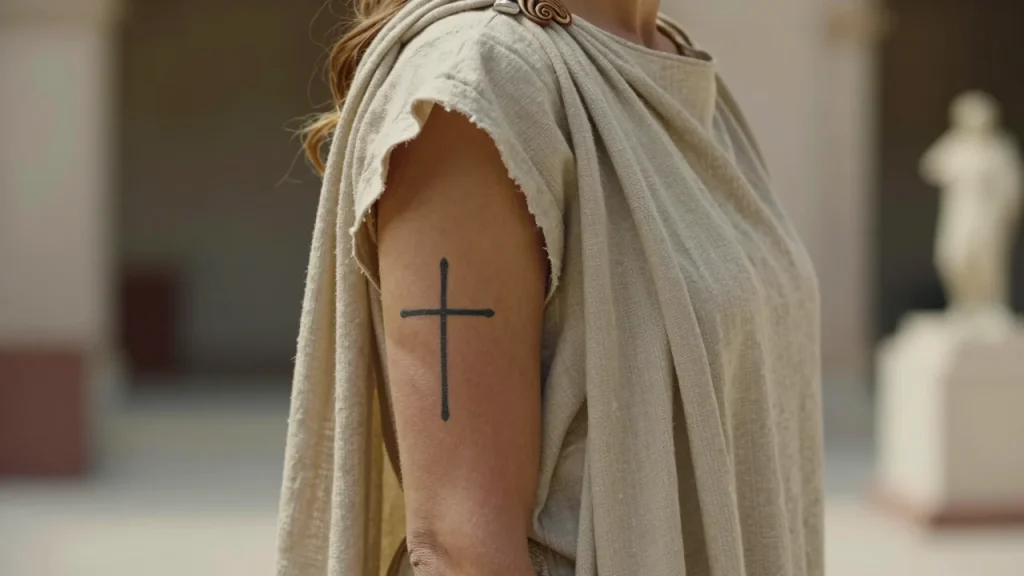
In the Middle Ages, tattoos acquired a sacred meaning. Crusaders often tattooed a cross on their chest or arms. This was a guarantee that if they died in a foreign land, they would be buried according to Christian rites, not as “infidels.”
2. The Era of Peter I: The Birth of Systematic Record-Keeping
In the Russian Empire, a systematic approach to army tattoos emerged thanks to Peter I’s reforms. The Tsar, striving for perfect order, introduced mandatory marking of recruits.
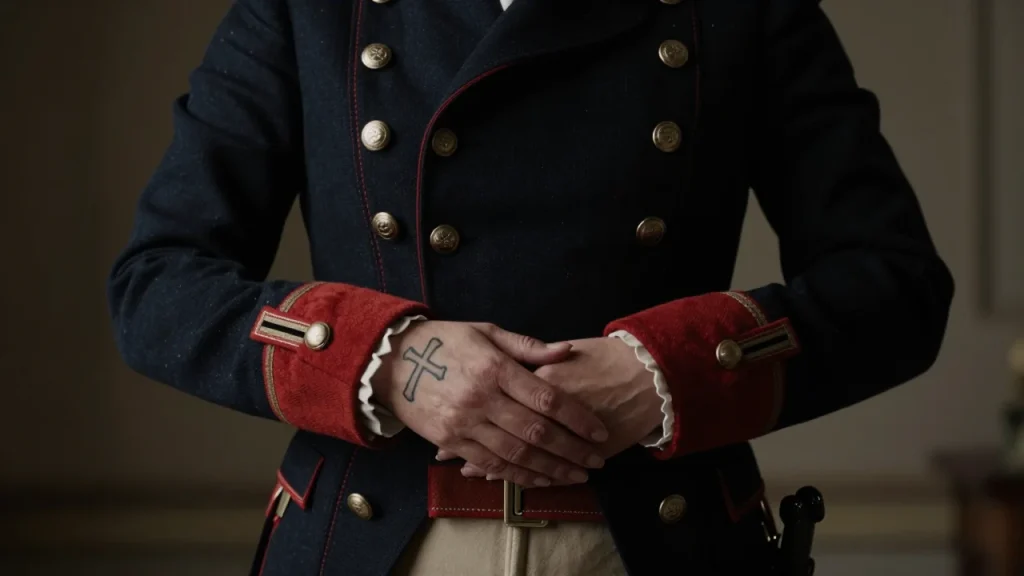
- Technology: A cross was carved into the soldier’s wrist, into which gunpowder or ink was rubbed. A personal number was applied nearby.
- Purpose: To combat desertion. With such a “passport” on their arm, a soldier could not simply go to a village and pretend to be a peasant.
Later, in the 19th century, sailors brought back the fashion for decorative tattoos from their world travels, borrowed from the Polynesians. Thus began the division between “mandatory” state marking and “voluntary” personal mementos of service.
3. Tattoos in the World Wars of the 20th Century
The First and Second World Wars turned tattoos into a means of survival and identification.
Blood Type Under the Armpit
The most famous example is the tattoos of SS soldiers (SS-Blutgruppentätowierung). A letter indicating the blood type was tattooed under the left armpit. After the war, this tattoo became a “black mark” used to identify former SS members.
However, allied troops also used similar markings (though less frequently), understanding that in field conditions, this could save lives during blood transfusions.
Sailors and “Old School”
It was during this period that the “old school” style flourished. Anchors, swallows, portraits of girls – all had specific meanings:
- Anchor: Crossing the Atlantic.
- Swallow: Returning home (after 5000 nautical miles).
- Turtle: Crossing the equator.

4. Soviet Army Subculture
In the USSR, tattoos were officially prohibited by regulations but flourished in “barracks.” Unlike the criminal world, where one had to “explain” a tattoo, army tattoos were a sign of pride in one’s branch of service.
Symbolism by Branch of Service: Detailed Table
| Branch of Service | Main Elements | Meaning and Context |
| VDV (Airborne Forces) | Parachute, winged sword, IL-76 aircraft, “For VDV” inscription | Affiliation with the elite, “sky brotherhood.” |
| Navy | Anchor, Neptune, sailing ship, polar bear | Long service in autonomous voyages, northern latitudes. |
| Intelligence/GRU | Bat, owl against a globe | Secrecy, “we see everything while remaining in the shadows.” |
| Naval Infantry | Scorpion (with tail raised or lowered), skull in a beret | A scorpion with its tail raised often signified participation in combat operations. |
| Border Guards | Border post, German Shepherd, shield and sword | Border protection, loyalty to duty. |
5. Modern Prohibitions: Why the Military Commissariat Fears Tattoos?
In 2026, the attitude towards tattoos in the army remains ambivalent. On one hand, contract soldiers can get “sleeves,” but on the other hand, a tattoo can become a serious obstacle for a conscript.
Tattoo as a Psychiatric Diagnosis
The main problem lies in the “Schedule of Diseases.” Psychiatrists at the medical commission often use tattoos as an indirect sign of mental disorders.
What doctors look for:
- Body Coverage Percentage: If tattoos cover more than 70% of the skin, the conscript will almost certainly be sent for further examination at a psychiatric clinic.
- Theme: Aggressive imagery (weapons, blood, scenes of violence), occult symbols, or profanity.
- Location: Tattoos on the face, eyeballs, or hands are often considered signs of “demonstrative behavior” or “personality immaturity.”
Important: A tattoo itself does not exempt you from military service. It merely gives a doctor a reason to look for a “diagnosis” in your psyche. If you disagree with the commission’s findings, you will need legal support.
6. Global Practice: Where Tattoos Are the Norm, and Where They Are Taboo?
| Country | Policy on Tattoos | Specifics |
| USA (US Army) | Liberal | Tattoos are allowed on arms and legs. Prohibited on the face and neck (except for small ones behind the ear). |
| United Kingdom | Moderate | Tattoos must not be visible in dress uniform. Offensive imagery is prohibited. |
| Israel (IDF) | Very liberal | Tattoos are a personal matter for the soldier, as long as they do not interfere with service. |
| Japan | Extremely strict | Due to associations with the Yakuza, tattooed soldiers are rare and often ostracized. |
7. Practical Advice for Conscripts with Tattoos
If you are going to the military enlistment office and have noticeable body art, prepare for the following:
- Neutral Explanations: When asked “Why did you get it?” don’t answer “Because I hate the system.” It’s better to say: “It’s a tribute to art” or “Just an aesthetic preference.”
- No Aggression: Do not argue with the psychiatrist. Remember that every word you say is recorded in your file.
- Know Your Rights: If they try to declare you unfit for service due to psychiatry solely because of a tattoo (and you are healthy), it is a violation.

8. The Future of Military Tattoos
The world is moving towards individualism. It is likely that in 5-10 years, army regulations will finally distinguish between “aesthetic tattoos” and “medical pathology.” But until this happens, every conscript with a “sleeve” or a tattoo on their neck remains at risk.
Army tattoos have come a long way from a deserter’s brand to a complex social code. Today, they represent memory, risk, and art. The main thing is to remember that your individuality should not become a reason for violating your civil rights.
FAQ: Everything a Conscript and Servicemember Needs to Know About Tattoos in 2026
In this section, we have gathered answers to the most pressing questions received by the editorial office from future defenders of the fatherland and lovers of tattoo art.
1. Can I be denied military service solely due to having tattoos?
There is no direct prohibition on serving with tattoos in the legislation. However, tattoos are considered by the military medical commission (MMC) doctors as one of the markers of psychological state. If there are too many tattoos (more than 70% of body surface) or they have specific content, the conscript may be sent for examination at a psychiatric clinic. Based on the results of this examination, a diagnosis may be made that will be grounds for being declared unfit, but the person is not rejected for the tattoo itself, but for the diagnosed personality disorder.
2. What tattoos are considered “suspicious” by a psychiatrist at the military enlistment office?
Psychiatrists pay attention to three main criteria:
- Aggression and Violence: Depictions of torture, detailed weapons, blood, predator’s snarls in visible areas.
- Protest and Deviant Themes: Profanity, anti-government slogans, anarchic symbols.
- Occultism and Suicidal Tendencies: Depictions of methods of suicide, specific sect symbols, demonic attributes covering a large area.
3. Is it true that you can’t join special forces with tattoos on your face or neck?
Yes, that’s close to the truth. For elite units, reconnaissance, and special forces, the “inconspicuousness” of a soldier is important. Bright markings on exposed areas of the body (face, hands, neck) make a person recognizable, which is unacceptable when performing specific tasks. Furthermore, in such units, strict discipline and uniformity of appearance are still valued.
4. What should I do if a doctor at the military enlistment office is rude or threatens me with a psychiatric referral due to a tattoo?
Unfortunately, the subjectivity of old-school doctors still occurs. It’s important to remember that defense of conscripts’ rights is a legal process. If you encounter pressure, do not get into an argument. Calmly clarify on what grounds of the “Schedule of Diseases” they are forcing you into additional examination. If you find the commission’s decision biased, you have the right to appeal it to a higher military enlistment office or court.
5. Can I get tattoos while serving active duty?
Officially, no. The regulations require a servicemember to maintain hygiene and health. Getting a tattoo in barracks conditions carries the risk of infection and blood poisoning (sepsis). A commander may consider this “intentional self-harm,” which can lead to disciplinary action, up to and including confinement. Nevertheless, the tradition of “demobilization tattoos” is alive, but experienced soldiers advise waiting until you are discharged and getting quality work done in a sterile studio.
6. Is a blood type tattoo considered mandatory?
In the modern army, no. Despite the popularity of this motif, doctors (both civilian and military) will never rely on a drawing on the skin for blood transfusions. An error in a tattoo could be fatal, so medical personnel always perform a rapid test for blood type and Rh factor before the procedure. Such a tattoo today is merely a tribute to tradition and a symbol of military style.
7. What symbols in army tattoos are considered “uncool” or prohibited?
In the army environment, the following are not welcomed:
- Tattoos of branches of service in which a person did not serve (older comrades might “question” you about this).
- Symbols with double meanings (e.g., some runes that can be interpreted as Nazi symbols).
- Caricatured depictions of service that demean fellow soldiers.
8. Does a tattoo affect a future career in government agencies?
If you plan to join the police, FSB, or prosecutor’s office after the army, visible tattoos can be a serious obstacle during the polygraph and medical examination. Most law enforcement agencies adhere to a conservative dress code where “clean skin” is a sign of trustworthiness.
Table: Quick Checklist for a Conscript with Tattoos
| Situation | Risk | Recommendation |
| Tattoo on face/eyes | High risk of psychiatric referral | Prepare in advance for psychological tests. |
| “Sleeve” tattoo (neutral theme) | Minimal risk | Behave calmly, state that it’s aesthetic. |
| Tattoo with aggressive text | High risk | Consider cover-up or removal. |
| Tattoo on intimate areas | Medium risk | Raises unnecessary questions from the dermatologist and psychiatrist. |