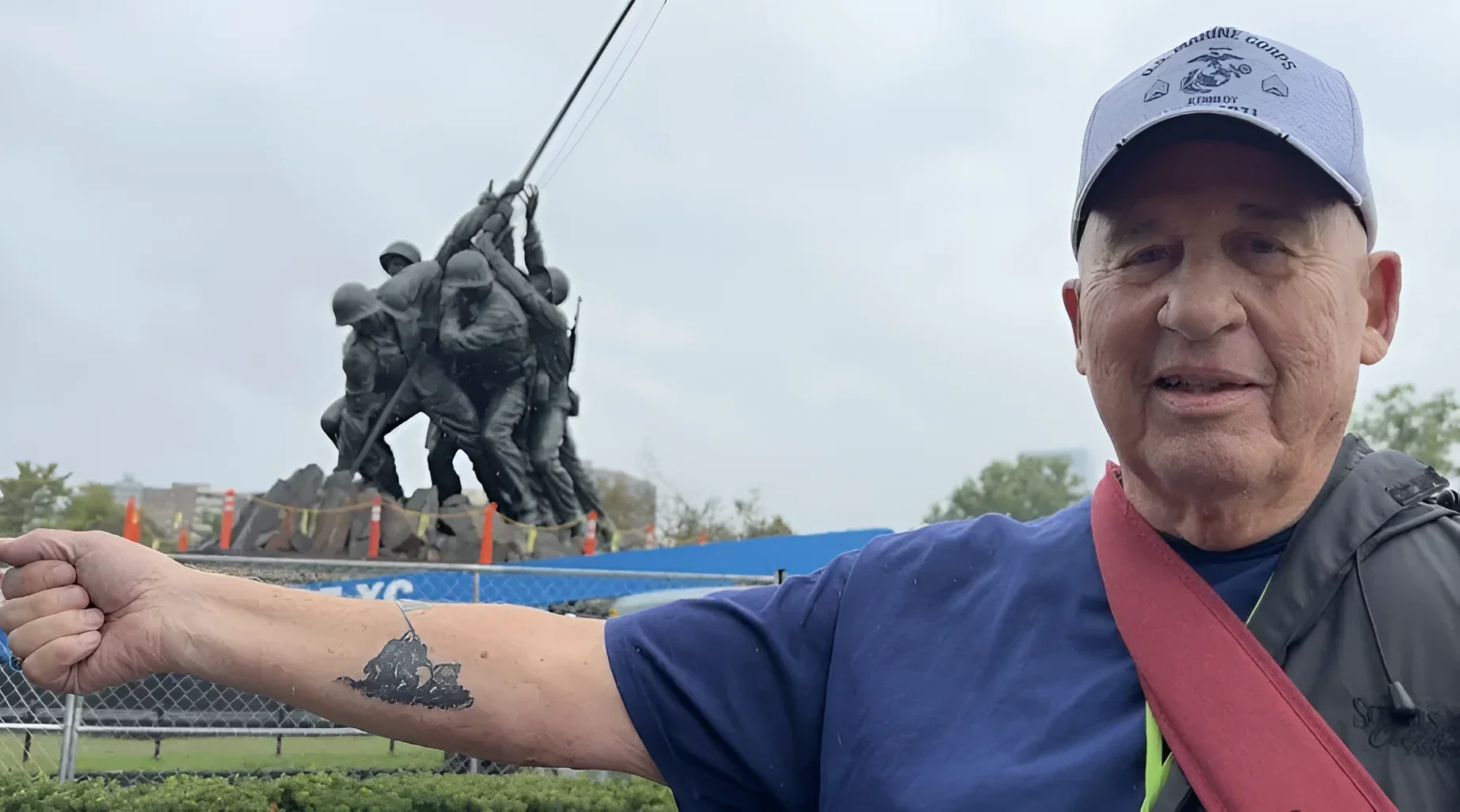
On Sunday, at the Marine Corps Memorial in Washington, one of the arriving veterans, Tom Kennedy from Bismarck, raised his hand and pointed to a tattoo on his forearm that almost perfectly replicated the famous sculpture of the raised flag. Next to it, on his other arm, he has long had the Marine Corps emblem. For Kennedy, this visit was not just a stop on his itinerary: this very monument became the prototype for his tattoo, and he had waited for years to see it in person, next to his own forearm.
Tom Kennedy served in the U.S. Marine Corps for two years, from 1969 to 1971. Before the army, he had already been teaching for three years, and according to his own words, he was immediately nicknamed “Pop” by the troops due to his age and experience. After being discharged, he returned to teaching and coaching, but he never erased his service from himself. The two tattoos – the memorial and the emblem – became his way of carrying his past on his body, not just in his memory.
Why Military Tattoos Are a Separate Layer of Culture
The connection between tattoos and the military environment is one of the oldest in global practice. Even in the age of sail, sailors would ink symbols of their ship, zodiac, and patron onto their skin to “seal” themselves in their profession. By the era of World War II, tattooing had become a mass phenomenon specifically among soldiers and Marines: emblems of units, dates, silhouettes of equipment and monuments. Since then, military tattoos have lived by their own rules and are little dependent on fashion trends in studios.
Tattoo culture experts identify three functions in such works, which are clearly visible in Kennedy’s example:
- Anchor of Memory. A tattoo fixes a specific place and moment – here its role is closer to a photograph than to an adornment. The memorial on his forearm acts as a “portable plaque” with the inscription “I was there.”
- Marker of Belonging. The corps emblem on his other arm signifies group identity – a connection with those who served alongside him. This is not a personal story, but a shared symbol.
- Ritual of Return. Showing the tattoo at the monument itself turns the trip into a personal dedication: the body and the place coincide, and memory gains a physical anchor.
It is important that such works are almost never done “on impulse” and are rarely changed. They are designed to last for decades, which is why veterans usually choose minimalist, readable silhouettes – this is exactly what Kennedy’s tattoo looks like: a compact silhouette of the memorial that won’t get lost against everyday clothing.
What’s Next for the Veteran
After visiting the memorial, Kennedy and his fellow veterans had several more stops on their program, and then the journey home. The plane is scheduled to land at Bismarck Airport at 7:15 PM, and locals are invited to meet them there. For many veterans, such a “circle” – from the monument to their home airport – closes not just a trip, but an entire chapter of life that is now, in essence, inked onto their skin.