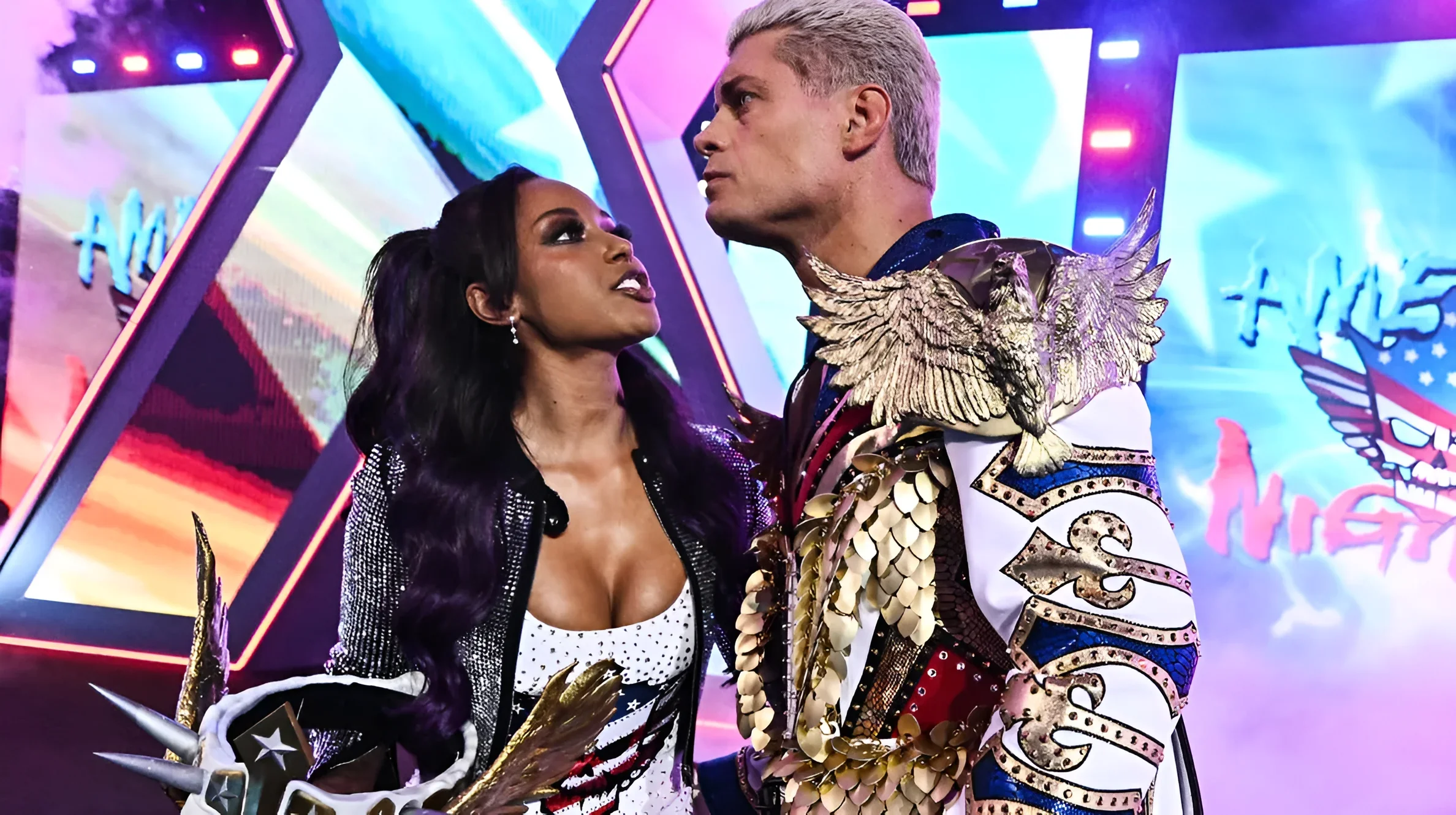
Brandi Rhodes, wife of one of the most recognizable wrestlers of our time, openly admitted in a conversation that she had mixed feelings about her husband’s famous neck tattoo. On her show, she didn’t hide the fact that she would have preferred a more modest design initially, while emphasizing that the body is personal space, and only the wearer can decide what to do with it.
A Conversation She Didn’t Hide
The words were spoken on the podcast A Shot of Brandi with Carmelo Hayes, where Brandi usually discusses not only the behind-the-scenes of wrestling but also personal topics that most WWE stars keep to themselves. Speaking about the tattoo, she immediately set a boundary: she wouldn’t impose her taste on her husband, but she also wouldn’t share her opinion unless asked.
“Here’s what I told Cody about the neck tattoo: ‘It’s your body. You can do whatever you want with it. However, if it were me, I wouldn’t have made it so big,'” the episode recording quotes her as saying.
How the Design Came About and What’s Special About It
Cody Rhodes himself first showed the tattoo at the entrance to his match against MJF at the AEW Revolution tournament in February 2020. More than six years have passed since then, and the design has become part of his visual image. It’s a large red, white, and blue block with a skull in wings logo – the signature mark of his “American Nightmare” persona – which occupies a significant portion of the right side of his neck.
Importantly, Brandi doesn’t deny the idea itself. She’s not bothered by the subject or the placement, but by the scale. “I’m not saying I don’t like it. I think it’s his character. He did it because he’s that kind of person. He always represents what he represents,” she explained.
What Tattoo Culture Says About Such a Choice
From a tattoo culture perspective, Cody’s case is a classic example of how a design ceases to be just an adornment and becomes a tool for self-presentation. The neck has historically been considered a “taboo” area: it was chosen either by people with a rebellious background or by those who needed a maximally visible, almost public gesture. Today, in pop culture, this barrier has practically been removed – large tattoos on the neck and face have become brand markers, not just personal expressions.
Tattoo psychologists note another point: size often indicates the degree of “investment” in an image. The larger and closer to the face the design, the more strongly the wearer associates their identity with it. For a wrestler whose persona is built on visual codes, this is a logical step – the tattoo becomes part of a costume that cannot be removed.
At the same time, Brandi’s position reflects a typical conflict within couples: one partner sees the tattoo as self-expression, the other as an irreversible change in appearance to which they are not privy. In the tattoo community, this is called a “breakdown of aesthetic consensus,” and it occurs more often than one might think, especially when it comes to areas that are visible every day.
- Tattoo Debut: AEW Revolution, February 2020, match against MJF.
- Design: Skull in wings, red-white-blue color scheme, right side of the neck.
- Brandi’s Position: Design is fine, size is debatable.
- Context: Neck as a zone for a public gesture, not a hidden pattern.
Ultimately, the Rhodes couple’s story is not so much an argument about a tattoo as a clear snapshot of how tattoo culture has integrated into the lives of media personalities. Cody’s neck tattoo has long ceased to be “just a tattoo”: it is part of the narrative he builds in the ring and part of the family dialogue that Brandi has with him outside of it.