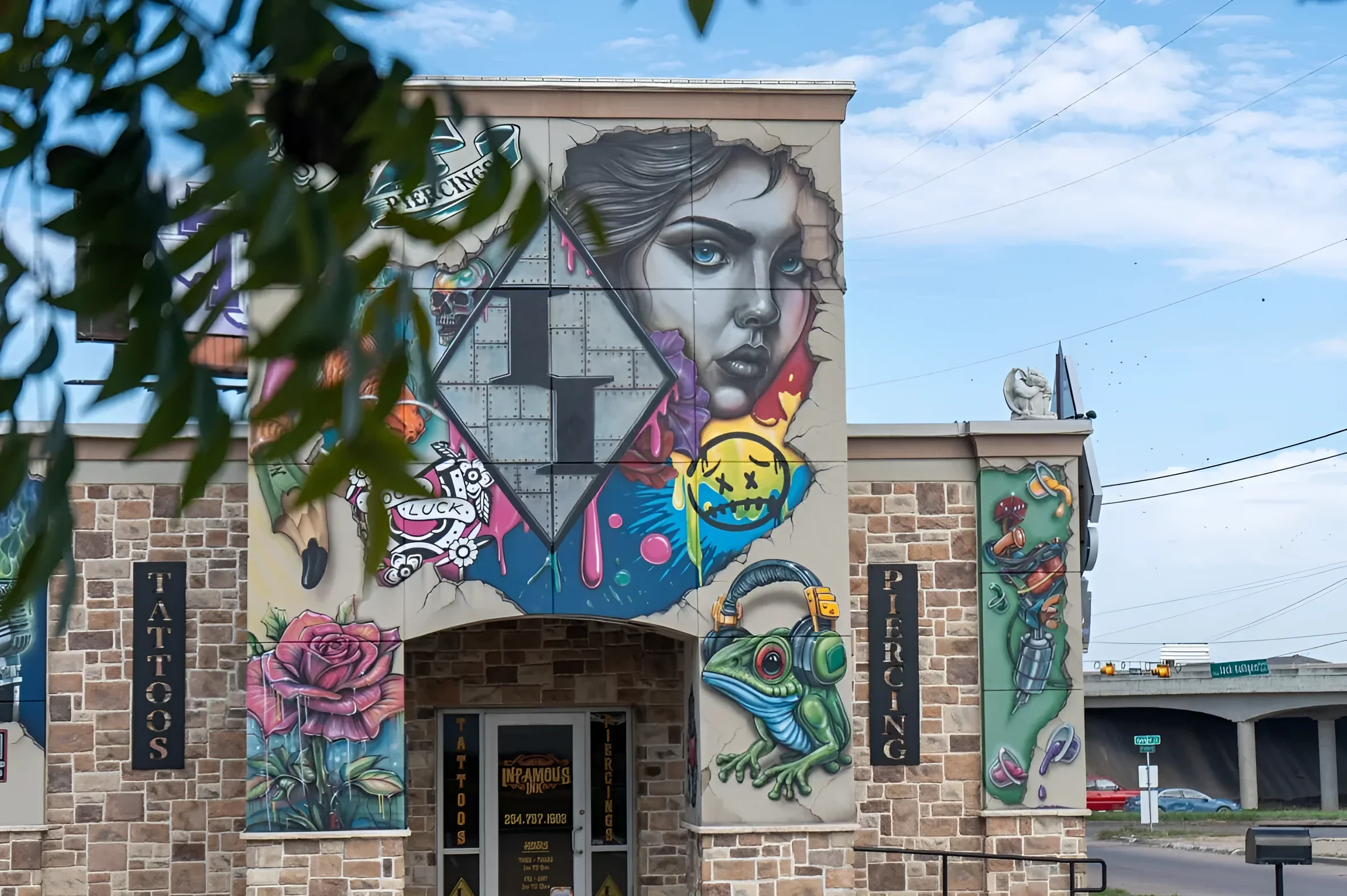
What was considered a sign of rebellion or marginality just a couple of decades ago now easily coexists with business suits and student uniforms. Tattoos are no longer exceptional; they have become part of everyday visual culture, especially among young people. A clear example of this shift is Waco, Texas, where over twenty tattoo parlors are clustered around the Baylor University campus, with Infamous Ink at 1813 South 11th Street being one of the most prominent.
Numbers That Change the Picture
Statistics confirm what is visible to the naked eye. According to Pew Research Center data published in 2023, 41% of Americans under thirty now have at least one tattoo. Among women aged 18 to 29, this figure is even higher at 56%. For comparison, in the early 2000s, tattooed individuals were perceived as a niche group—military personnel, bikers, and pop artists. Today, according to Zach “Lefty” Colbert, owner and artist at Infamous Ink, the trend has reached a point where “all parents have tattoos,” which in itself has broken the old stereotype.
| Group | Percentage with Tattoos |
|---|---|
| Americans under 30 | 41% |
| Women 18–29 | 56% |
Why Now?
Experts attribute this surge not only to fashion but also to a broader cultural shift. Zander Tracy, a sophomore student from Austin, describes it as a movement towards greater personal autonomy: “The US in general seems to have adopted a libertarian bent. People are becoming more independent, and the ‘my body, my choice’ movement is a prime example of the pursuit of personal freedom.” In this context, tattoos transform from a marker of subcultural affiliation into a tool for self-expression and asserting personal boundaries.
What Are People Getting Today?
Stylistic preferences, according to Lefty’s observations, are updated approximately every three years—techniques, popular subjects, and even specific words and phrases change. For the student audience, a set of consistent requests is currently characteristic:
- fine line—thin, delicate lines emphasizing stroke purity;
- patchwork—”patchwork” compositions of small technical elements assembled into a single image;
- small meaningful symbols and personal signs, rather than large arched compositions.
Large elaborate works and extensive arches, once the hallmark of the genre, have taken a backseat for young people. This is an important signal: tattoo culture is shifting from decorative pomp to intimacy and precision.
More Than Just Fashion
It’s important not to reduce everything to trends. For many, tattoos carry personal stories. Tracy, for example, has one piece that replicates his father’s tattoo—”When I went to college, I felt like it would be fun for us to do it together”—and another became a symbol of a trip to Hawaii. It is this duality—public trend and private meaning—that makes tattoo culture resilient: it endures stylistic changes because it is underpinned by specific people and their memories.
Ultimately, Waco with its Infamous Ink and neighboring studios is just a point on the map of a larger process. Tattoos have definitively entered the mainstream, and their future is determined not so much by aesthetics as by how the new generation learns to speak about themselves through their skin.