Permanent tattoos have long ceased to be solely a marker of a rebellious past or a hobby. Today, they are part of everyday aesthetics, a means of self-expression, and even a form of personal diary. But classic tattoos have one vulnerability – they don’t offer an “undo” option. Laser removal, as tattoo artists themselves note, is often more painful than the tattooing procedure itself. It is this pain and irreversibility that engineers from the University of Colorado Boulder are trying to mitigate with their development of inks that change visibility depending on lighting. The team’s work, described in the journal Matter & Light, became known on October 19, 2026.
The key figure in the project is nanoscientist Carson Bruns, who, according to his own words in an interview with Nature, continues an unspoken tradition: testing his own developments on his own body. Bruns is already known in the tattoo community for his product “Magic Ink,” which glows magenta under ultraviolet light. To visually demonstrate how the ink reacts to sunlight, he created so-called “sun freckles” – essentially, UV exposure indicators. The new work goes further: this time, it’s about inks that become transparent when exposed to UV rays and reappear under normal light.
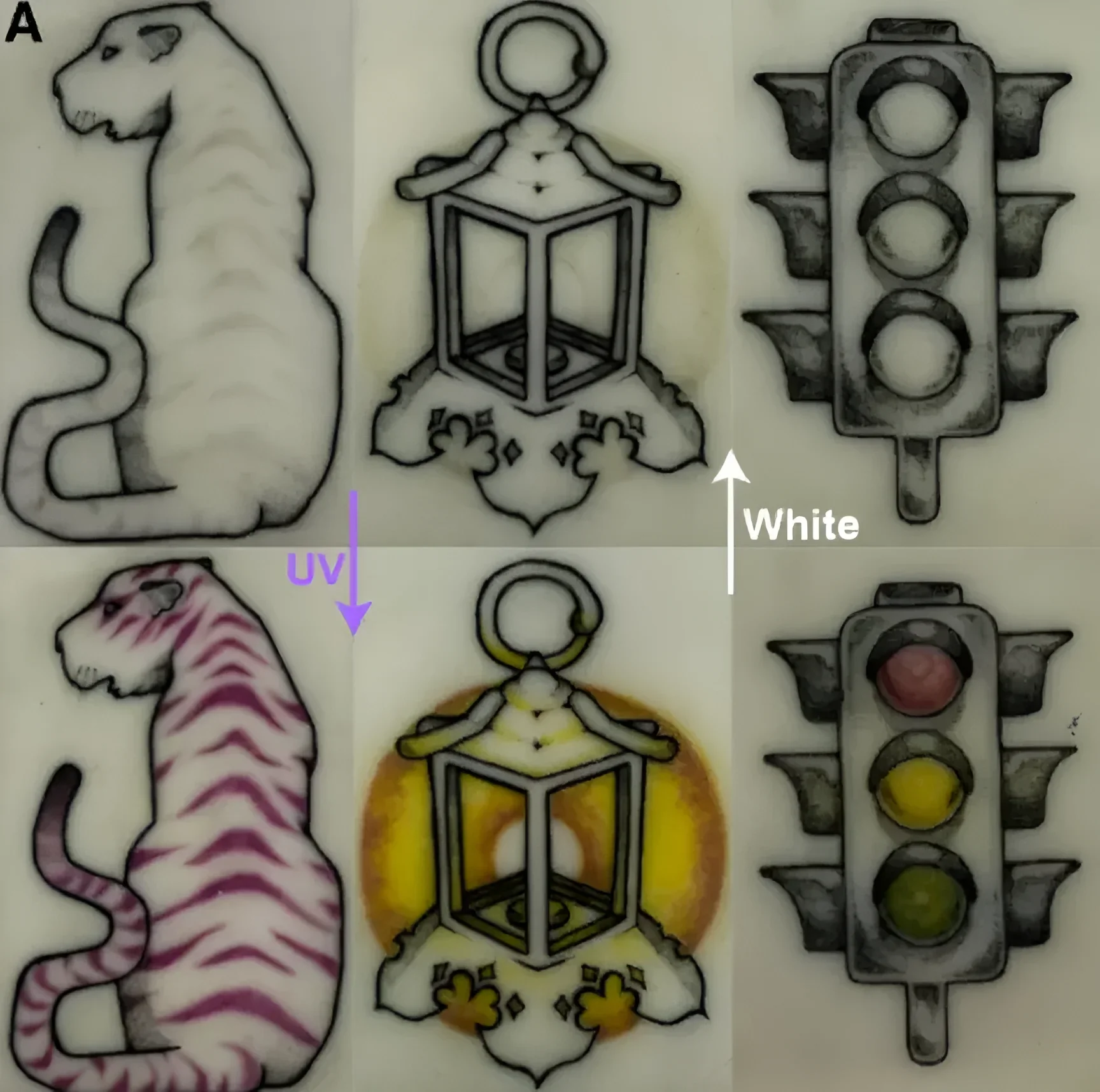
The most interesting aspect for tattoo culture is not laboratory slides, but live examples. The collage from the study shows three designs: a tiger, a hanging lantern, and a traffic light. Before UV exposure, they appear as clean outline sketches, and afterward, they reveal their colors: the tiger’s magenta stripes emerge, the lantern fills with a warm yellow glow, and the traffic light sections light up red, yellow, and green. Bruns applied these compositions to his own leg over approximately 12 months, combining different shades, and they all behaved exactly as intended.
How the “Disappearing” Ink Works
The formula is currently available in three colors – yellow, blue, and magenta – and relies on the same principle as transition lenses in glasses or some smart fabrics. Inside the ink are microscopic spheres made of acrylic glass, filled with photochromes. These are chemical compounds that absorb photons of a specific wavelength. At rest, the spheres maintain their original color, but under UV radiation, they “flatten” and become transparent. As soon as visible light falls on them, the chemical bond breaks, the spheres return to their shape, and the design becomes visible again. The effect, according to the team, has lasted for over two years.
This is important for the tattoo industry for several reasons. Firstly, a category of “situational” tattoos emerges – designs that can be shown at a party under black light and hidden in everyday life. Secondly, the main psychological barrier is removed: a person can try a complex design without fear that it will be visible at work or in formal settings. Thirdly, it’s a new layer of aesthetics that artists are already embracing: interactivity, play with light, hidden layers – all of this resonates with the trend towards customization and “living” tattoos.
The team emphasizes that the goal goes far beyond a salon trick. Promising versions of the ink could be useful in medicine – for example, as temporary markers for precise positioning during direct radiotherapy sessions. For now, photochromic tattoo inks remain in the status of a laboratory tool and Bruns’ personal project: a full safety evaluation cycle must be completed before widespread application.
For tattoo culture, the emergence of such technology is a signal that the line between art, chemistry, and medicine is blurring. A tattoo ceases to be a static mark on the skin and transforms into a dynamic object that reacts to its surroundings. Whether it remains a niche novelty or becomes the new standard for “smart” tattoos, time will tell. But one fact is already clear: the future of tattooing lies in its ability not only to be worn but also to be switched on.