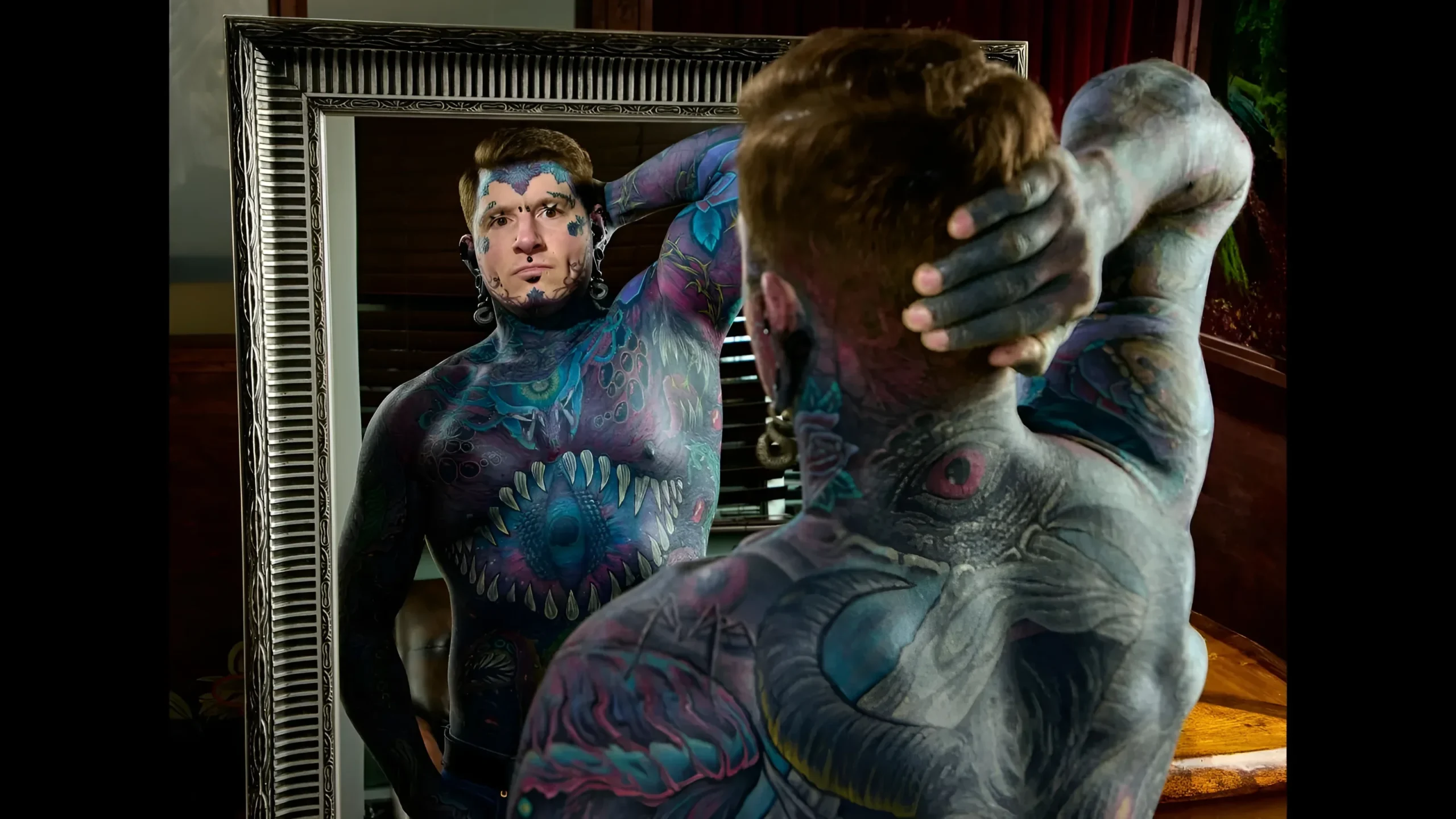
Tattoo culture has once again reached a new world milestone that shatters conventional ideas of how far a person with a needle and pigment can go. Jeremy “Remay” Shulfield from Lethbridge, Canada, has been officially entered into the Guinness World Records 2027 edition as the most tattooed living man in the “multiple layers” category. This is not just another entry in the record book—it is confirmation that tattooing has ceased to be a static drawing and has turned into a living, constantly changing process.
How the record was secured
The path to recognition was not as straightforward as it seems. According to Shulfield himself, he had approached Guinness before but was rejected: he did not have his face fully covered. The breakthrough happened in early 2025, when the previous record holder, Lucky Diamond Rich, personally connected him with editor-in-chief Chris Glenday. After a video call involving all three, the matter was settled in Shulfield’s favor. At the same time, Rich retained his title for maximum body coverage—100 percent of the skin under ink—while Shulfield received the award specifically for the number of layers applied on top of each other. This is an important distinction: two different records describe two different philosophies of tattooing.
Five thousand hours in the chair
The figures Shulfield cites impress even those who spend several hours in the chair at a time. He has over 5,000 hours of work with an artist under his belt, and he has been visiting studios two to three times a week for about 15 years. His first tattoo appeared around 2005—it was his son’s name on his inner forearm. Then came regular new works every couple of months, and then came the moment when his interest shifted from the result to the process itself: experiments with pigments, the interaction of layers, and “mapping” new skin territory.
| Parameter | Value |
|---|---|
| Full name | Jeremy “Remay” Shulfield |
| City | Lethbridge, Canada |
| Record category | Most tattooed living man (multiple layers) |
| Edition | Guinness World Records 2027 |
| Hours in the chair | over 5000 |
| Frequency | 2–3 times a week |
| Experience | about 15 years |
| First tattoo | about 2005, son’s name |
Territory after “blackout”
The most interesting moment from the perspective of tattoo culture is what happens after the so-called “blackout suit,” when large areas of skin are completely covered in black pigment over several sessions. Shulfield calls this phase “completely uncharted”: over the black, he now works with full color, constantly adjusting and enhancing the design. He compares himself to a “mad scientist” in a lab, where every session is a test of how new ink will settle on existing layers. It is this multi-layered nature that distinguishes his record from Rich’s: it is not about surface area, but about depth and the number of overlays.
Studio management and cultural openness
Beyond using his own body as a “canvas,” Shulfield manages the Rocky Mountain Tattoo studio in Lethbridge, which is owned by his friend—the very artist who tattooed him. Shulfield himself is not a tattoo artist, but he handles piercing and laser removal at the studio. After the Guinness recognition, people far removed from the tattoo scene began approaching him, and he sees this as a chance to make the culture more accessible and less insular. His position is simple: a tattoo is no longer the taboo thing it was decades ago, and a small drawing on a forearm shouldn’t be intimidating.
Expert view
From the perspective of tattoo culture development, Shulfield’s case is important for several reasons. First, it marks a shift from the aesthetics of “coverage” to the aesthetics of “process”: the body becomes not a painting, but a document of a continuous experiment. Second, the separation of records into “coverage” and “layers” shows that the industry has realized that extreme tattooing is not one direction, but several. Third, the very fact that the record holder is not an artist, but manages a studio and runs a YouTube channel with session recordings, suggests that the tattoo culture audience increasingly values transparency and personal narrative, not just the result on the skin. Shulfield himself says he will stop when he stops enjoying it, and that he is currently “closer to the middle than the end”—which is perhaps the most honest criterion in a world where the body turns into an endless project.