
The question of the compatibility of tattoos and the Orthodox faith is one of the most acute and frequently discussed in the Christian environment. For many believers interested in the art of tattooing, this topic becomes a stumbling block. As professional encyclopedists and symbolism analysts, we approach this issue as objectively as possible, considering both historical prohibitions and modern interpretations by clergy. Our goal is to provide you with comprehensive, expert information to make an informed and balanced decision while remaining true to your spiritual principles.

Important Disclaimer: This material is for informational and analytical purposes only and is based on the study of biblical texts, church interpretations, and cultural context. We are not spiritual mentors and cannot give direct instructions that replace a conversation with your personal confessor or priest. The final decision regarding getting a tattoo, based on your personal faith and conscience, should be made by you after prayer and consultation with a representative of the Church.

Tattoos and Orthodoxy: Is Combination Possible? A Review for Believers
Secular culture perceives tattoos as a form of self-expression, art, and body adornment. However, in the context of Orthodoxy, the body is seen not just as a biological shell, but as the “temple of the Holy Spirit” (1 Cor. 6:19). It is this fundamental difference in attitude towards the body that generates conflict.
Traditional theology, relying on the Old Testament, often views tattoos as a violation of bodily integrity, as well as a remnant of pagan cults. At the same time, modern pastoral practice demonstrates a much more flexible approach, focusing not so much on the mere fact of the drawing, but on the motivation and symbolism of that drawing.
Key aspects determining permissibility:
- Historical basis of the prohibition: Was the prohibition universal or contextual?
- Motivation: Is the tattoo applied out of vanity, rebellion, or does it carry a deep personal meaning that does not contradict faith (e.g., a memory of an important event)?
- Symbolism: Does the image contain occult, pagan, or overtly anti-Christian signs?
For a believing person contemplating a tattoo, the first step should be an honest analysis of their motivation before God. If a tattoo becomes an idol or a way to display pride, it undoubtedly contradicts Orthodox ethics, regardless of the subject matter.
Historical Context: Tattoos in Ancient Rus’ and Byzantine Tradition

It is often overlooked in discussions that the attitude towards body markings in the Christian world was not absolutely monolithic throughout history. Analyzing ancient texts and archaeological findings allows us to see nuances.
Tattoos in Byzantium and Early Christianity
The initial Old Testament prohibition (Lev. 19:28: “You shall not make any cuttings in your flesh for the dead, nor tattoo any marks on yourselves”) was directed against rituals associated with the worship of the dead and pagan deities. In the early Roman Empire, where Christianity originated, tattoos were associated with slaves, criminals, or soldiers.
However, there is evidence that some early Christians, especially in Egypt and the Middle East, marked themselves with religious signs:
- Copts: The tradition of applying a small cross on the wrist or hand, symbolizing adherence to the faith and readiness to accept martyrdom. This tradition is alive today.
- Pilgrims: In the Middle Ages, pilgrims visiting the Holy Land (especially Jerusalem) sometimes applied commemorative marks – crosses or images of holy sites – as evidence of their journey.
Ancient Rus’ and Slavic Traditions
In Ancient Rus’, before the adoption of Christianity, tattoos (or ritual patterns) may have existed as part of pagan culture. With the arrival of Orthodoxy, the Church actively fought against any manifestation of paganism, including body markings. Thus, for many centuries, the tattoo in the Russian cultural sphere was perceived as something alien to the Christian tradition and associated with the world that had fallen away from God.
Conclusion: Historically, the Church opposed tattoos associated with paganism and occultism. However, religious marks applied with pious intent (such as pilgrim crosses), while not universally approved, were not always condemned as strongly as pagan signs.
What Does the Church Say? Official Position and Interpretations of Clergy
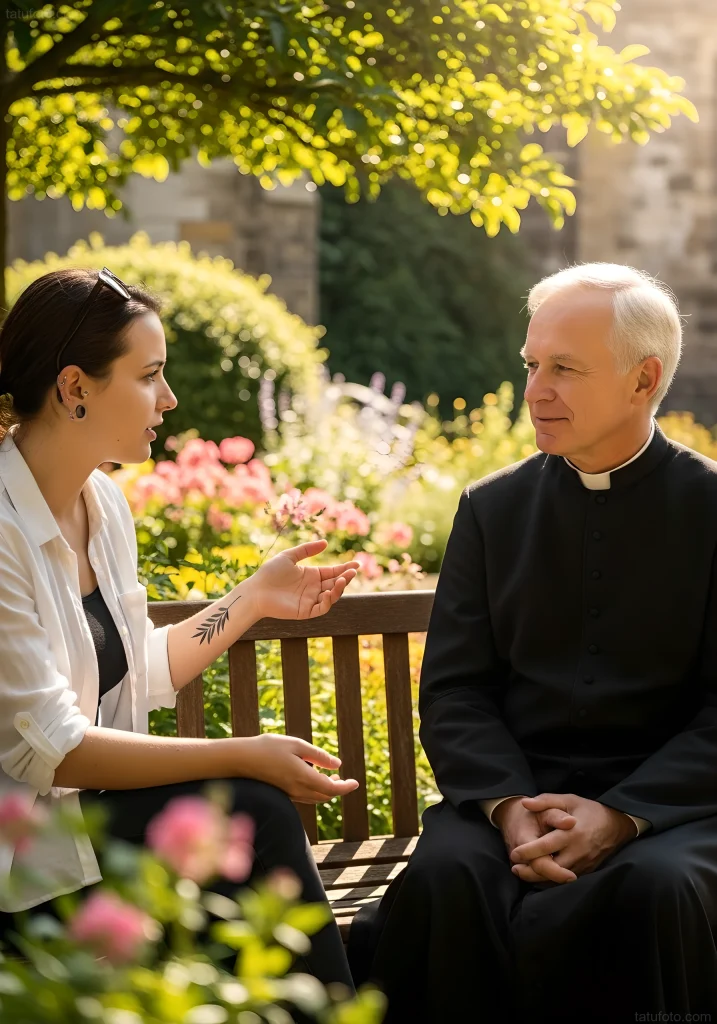
The Orthodox Church, particularly the Russian Orthodox Church (ROC), does not have a unified, dogmatically fixed decree declaring tattooing an absolute sin leading to excommunication. However, there is a consistent pastoral opinion based on Holy Scripture and Tradition.
Basis of the Prohibition: The Book of Leviticus (Lev. 19:28)
The central text used against tattoos is the verse from Leviticus mentioned above. Modern theologians offer two main interpretations:
- Literal Interpretation: Any marking on the body is forbidden because it is a change not intended by God. The body must remain untouched.
- Contextual Interpretation: The prohibition specifically refers to pagan rituals (e.g., mourning rites for dead gods or idols). If the tattoo does not carry a pagan or occult meaning, then formally it does not violate the spirit of this particular Old Testament law.
Most clergy lean towards the view that a tattoo, if not associated with sin (such as vanity, rebellion, or indecency), is more a matter of piety than salvation. Nevertheless, the general position of the Church remains reserved and cautionary.
The Opinion of Modern Pastors
Many priests emphasize that the main sin is not the drawing itself, but the motivation, which may be dictated by:
- Pride and Vanity: The desire to stand out, to draw attention to one’s body, which should be modest.
- Conformity to the World: Following fleeting fashion rather than eternal spiritual values.
- Disrespect for the Body: Applying images that may be regarded as defiling the temple of the Holy Spirit.
Summary of Position: The Church does not welcome tattoos, especially if they are applied impulsively, out of pride, or have questionable symbolism. If a believer insists on a tattoo, they should choose the most neutral or pious subjects possible and avoid hidden meanings.
Tattoo Symbolism and Its Correspondence with Orthodox Values: What is Permissible and What is Not

For an Orthodox Christian, symbolism is not just a drawing, but a manifestation of faith or worldview. It is the symbolic meaning of the tattoo that is the most critical point when evaluating it from the Church’s perspective.
Categorically Unacceptable Symbols
These symbols directly contradict Christian teaching and should be avoided by the believer:
- Occult signs: Pentagrams, symbols of pagan gods (except for historical or mythological images devoid of worship), satanic symbolism.
- Symbols of violence, hatred, or racial intolerance: Tattoos that promote evil or enmity.
- Indecent images: Subjects that violate the commandment of chastity and modesty.
- Symbols associated with the criminal world: Prison tattoos carrying hierarchical or criminal meanings.
Conditionally Permissible Symbols (Require Caution)
These images may be neutral or even pious, but their interpretation depends on context and execution:
| Symbol | Orthodox Interpretation | Risks and Limitations |
|---|---|---|
| Cross | The main symbol of salvation, faith, and Christ’s sacrifice. | Some priests believe that the cross should not be applied to the body, as its place is on the neck (pectoral cross) or in the church. Depicting a cross as an ornament can be perceived as profanation. |
| Angels / Archangels | Protection, heavenly host. | If the image is too stylized, aggressive, or eroticized, it loses its pious meaning. Traditional iconographic images are preferred. |
| Bible Quotes | Reminder of commandments, personal spiritual rule. | The quote must be deeply understood. Avoid quotes taken out of context or used to display pride. |
| Animals (Lion, Dove, Fish) | Dove (Holy Spirit), Fish (Ichthys – early Christian symbol), Lion (symbol of Christ/Mark). | It is necessary to ensure that the symbol does not carry a pagan or astrological meaning. For example, the Lion may be a symbol of strength, not Christ. |
Main Principle: A tattoo should not replace personal piety, prayer, or sacraments. It must be secondary to faith.
Tattoo Styles and Their Perception in the Orthodox Environment: From Traditional to Modern

The perception of a tattoo depends not only on the subject matter but also on the style in which it is executed. Different styles carry different cultural connotations that can either soften or exacerbate negative attitudes.
Styles That Cause Concern
- Chicano and Old School: These styles are often associated with criminal subculture, rebellion, or a world far removed from the church. Even if the subject is neutral, the style can provoke a negative reaction.
- Horror and Demonic Realism: Any images of skulls, dark entities, demons, or overly gloomy subjects. In Orthodoxy, dark images not related to spiritual struggle or martyrdom are perceived as glorifying evil.
- Ethnic/Tribal: If the patterns are directly related to specific pagan cults (e.g., Polynesian or African ritual signs), they may be regarded as a departure from monotheism.
Styles That May Be Neutral or Acceptable
- Graphics and Linework: Clear, minimalist lines. If the image is neutral (e.g., a geometric pattern without occult meaning, or a stylized tree), this style is the least provocative.
- Watercolor and Minimalism: These styles are often used to depict natural motifs, flowers, or abstract ideas that do not carry aggressive or controversial symbolism. They are perceived as purely artistic.
- Iconographic Realism (with strict limitation): Attempts to reproduce icons or faces of saints. One must be extremely cautious here. The Church categorically opposes applying the faces of saints or Christ to the body, as the body is subject to sin and defilement (including during intimacy or bathing). This is considered blasphemy.
Expert Advice: If you decide to get a tattoo, choose the most abstract, inconspicuous, and non-aggressive subjects. Avoid subjects that could be interpreted as cultic or idolatrous.
Where is the Best Place to Put a Tattoo if You Are an Orthodox Christian? Recommendations and Examples

The placement of a tattoo is of great importance in the context of Orthodoxy, as it is directly related to the concepts of modesty and chastity, and display.
The Principle of Modesty and Avoiding Vanity
Christian ethics call for modesty. Tattoos located in visible places (face, neck, hands) that inevitably attract attention may be regarded as a manifestation of vanity and pride. If the purpose of the tattoo is a personal reminder or memory, it should not be an object of public view.
Recommended Locations (Hidden):
- Ribs and Sides: Excellent for large, complex works that have personal meaning and are not intended for public view.
- Back: The largest canvas for personal symbols. A believer can wear a tattoo here knowing it is always covered by clothing.
- Upper thigh or shoulder (under clothing): Suitable for small, symbolic images.
Places to Avoid
There are parts of the body that are traditionally considered either sacred or inappropriate for tattooing:
- Face and Neck: Excessively provocative and contrary to the principle of modesty.
- Hands and Wrists: Although Copts traditionally place a cross on the wrist, in Slavic tradition this may be perceived as a challenge or imitation of the criminal world.
- Intimate Areas: Any image in these areas may be regarded as defiling the body, which should be the temple of the Holy Spirit.
Special Attention: If you plan to be baptized or married, a visible tattoo may raise questions from the priest. Hidden placement allows you to avoid potential conflicts and judgment.
Practical Advice: How to Decide on a Tattoo While Remaining True to Your Faith

Making the decision about a tattoo for an Orthodox person requires deep spiritual analysis. This is not just buying an item; it is altering the body that you will one day leave to God.
1. Spiritual Analysis of Motivation
Before going to the artist, ask yourself these questions:
- “Why do I need this?” If the answer is to look cooler, attract attention, or prove something to the world, the motivation is likely sinful.
- “Will this be a temptation?” Will your tattoo cause another person (especially one less involved in the church) to judge the Church or you?
- “What will it be like in 20 years?” Will this symbol still be relevant to your faith and life?
2. Consultation with a Confessor
This is the most important step. Share your desire and sketch with the priest to whom you confess. Tell him about the meaning of the drawing. The confessor will be able to assess your motivation and symbolism from the perspective of pastoral experience.
Important: Be prepared to accept the priest’s answer, even if it is negative. If you ask for a blessing, you must be prepared to follow it.
3. Choice of Symbolism and Style
If the decision is made, choose symbols that remind you of virtues or saints without evoking associations with idolatry or criminality. Examples:
- A text of a prayer or a short quote (e.g., “Lord, have mercy”).
- Geometric patterns devoid of pagan meaning.
- Symbols of nature that remind one of God’s creation (e.g., the Tree of Life, but without the occult context).
4. Prayer and Time
Wait. Make a decision, postpone it for a year. If your desire has not weakened after a year, and you have received a blessing, this may indicate the seriousness of your intention.
Frequently Asked Questions (FAQ) about Tattoos and Orthodoxy

1. Is a tattoo a mortal sin?
Answer: Orthodox theology does not classify tattooing as an absolutely mortal sin, unless it is associated with occultism, Satanism, or blasphemy against God. However, it can be a manifestation of other sins (vanity, neglect of the body) that require repentance.
2. What should I do if the tattoo was done before I became religious?
Answer: If the tattoo was done before you came to faith, you do not need to remove it immediately (especially if it is expensive and painful). It is important to repent for the sins of your past life, including the unwise treatment of your body. If the tattoo contains an overtly sinful or occult symbol, it is advisable to remove or cover it with a neutral design. If it is neutral, repentance is sufficient.
3. Is it permissible to apply faces of saints or icons?
Answer: This is strongly discouraged and often regarded as blasphemy. An icon is a sacred image intended for prayer and veneration, which should be kept in a clean place. A person’s body, even sanctified, is subject to defilement and decay. Applying the face of a saint to the skin is considered profanation.
4. Does the Bible prohibit tattoos directly?
Answer: The Old Testament (Lev. 19:28) contains a prohibition interpreted as a ban on pagan ritual markings. The New Testament does not contain a direct prohibition but calls for chastity, modesty, and reverence for the body as the temple of God.
Interesting Facts: Unexpected Cases and Historical Figures with Tattoos

Although the official position of the Church has traditionally been strict, history knows examples demonstrating the cultural complexity of this issue:
1. Pilgrims of Jerusalem
Starting from the Middle Ages, among pilgrims visiting Jerusalem (including Orthodox ones), there was a tradition of getting tattoos as “souvenirs.” These tattoos usually depicted crosses, Golgotha, or other Christian symbols. The Razzouk family of tattoo artists in Jerusalem is known for serving pilgrims for centuries. These marks served not as adornment, but as a testament to faith and spiritual struggle.
2. Tsar Nicholas II and the Dragon
Emperor Nicholas II, canonized by the Russian Orthodox Church, had a tattoo. During his journey to the East in 1891, while still Tsarevich, he had an image of an Eastern dragon tattooed on his right forearm. This fact does not diminish his faith or affect his sainthood, but it shows that in the 19th-century royal family, tattoos were perceived as an exotic, cultural symbol, rather than strictly a religious taboo.
3. Tattoos as a Sign of Loyalty
In some Christian communities in the Middle East, tattoos served as a sign of loyalty to the faith under persecution. Having a cross in a visible place meant that the person was ready to openly confess Christianity despite possible persecution, which is an act of courage, not vanity.
The issue of tattoos for an Orthodox person lies in the realm of pastoral practice and personal conscience, not dogma. If a tattoo carries a pagan, occult, or immoral meaning, it is sinful. If it is a work of art, carries a deep personal meaning, is not associated with pride, and does not become a temptation to others, its assessment is softened. In any case, we urge you to pray, conduct a sober analysis of your motives, and definitely discuss this step with your spiritual mentor.