Tattoos done in Sanskrit have long transcended narrow spiritual circles and become one of the most sought-after trends in global tattoo culture. Choosing this ancient, sacred language is not just an aesthetic decision, but a deep dive into the philosophy, ethics, and spiritual traditions of the East. Before immortalizing a phrase written in the Devanagari script on your skin, it is crucial to understand its true meaning of Sanskrit tattoo inscriptions, as this language does not tolerate superficial treatment or errors. Our expert guide will help you understand the symbolism, translation accuracy, and cultural context, so that your tattoo becomes a true reflection of your inner wisdom.
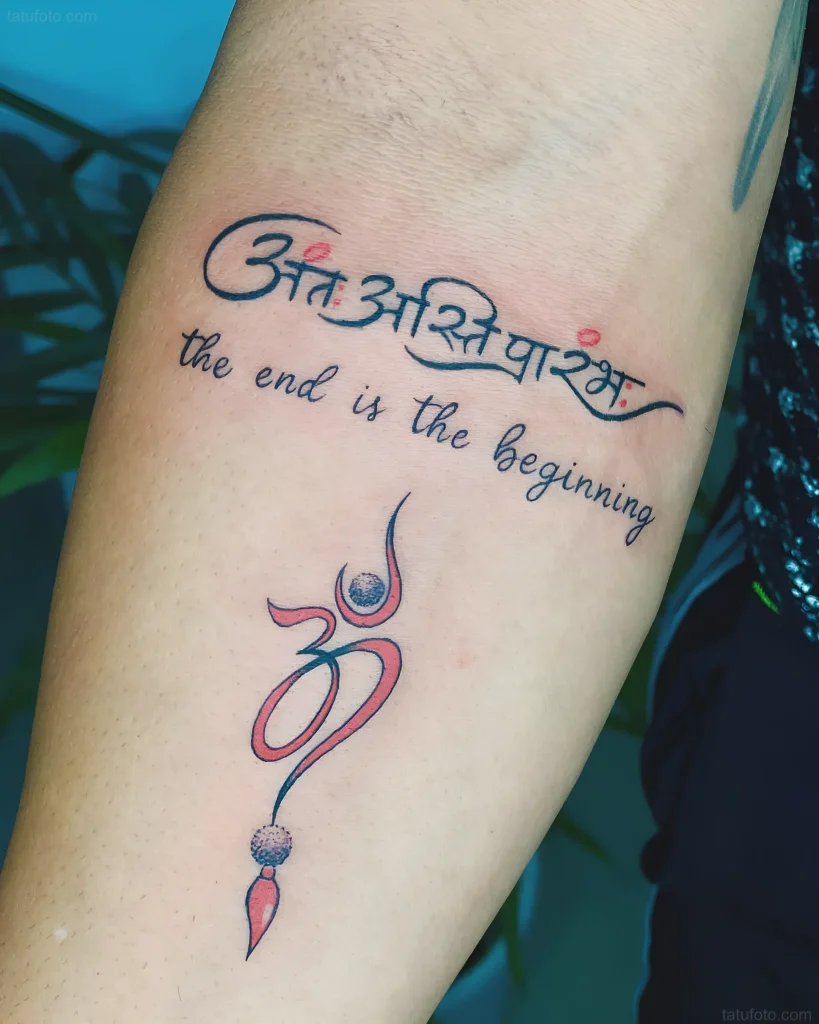
Sanskrit Tattoo Inscriptions: An Introduction to Ancient Wisdom
Sanskrit (Saṃskṛta) is not just one of the oldest languages in the world; it is the language of the Vedas, classical Indian literature, yoga, Buddhism, and Jainism. Its name literally means “perfected” or “refined.” In the context of tattoos, a Sanskrit inscription is perceived not as ordinary text, but as shabda – a sacred sound or vibration possessing power. This is precisely why the meaning of Sanskrit tattoo inscriptions always goes beyond literal translation.
By choosing Sanskrit, you are choosing:
- Depth of Symbolism: Each phrase, especially mantras, carries millennia of spiritual weight and energy.
- Aesthetic Perfection: The Devanāgarī script, with its characteristic horizontal line (shirorekha), possesses a unique visual harmony that looks beautiful in a tattoo.
- Personal Affirmation: The inscription serves as a constant reminder of your path, goals, or life philosophy.
However, this depth requires responsibility. An incorrectly applied or mistranslated phrase can not only look absurd but, according to beliefs, distort the spiritual meaning embedded within it.
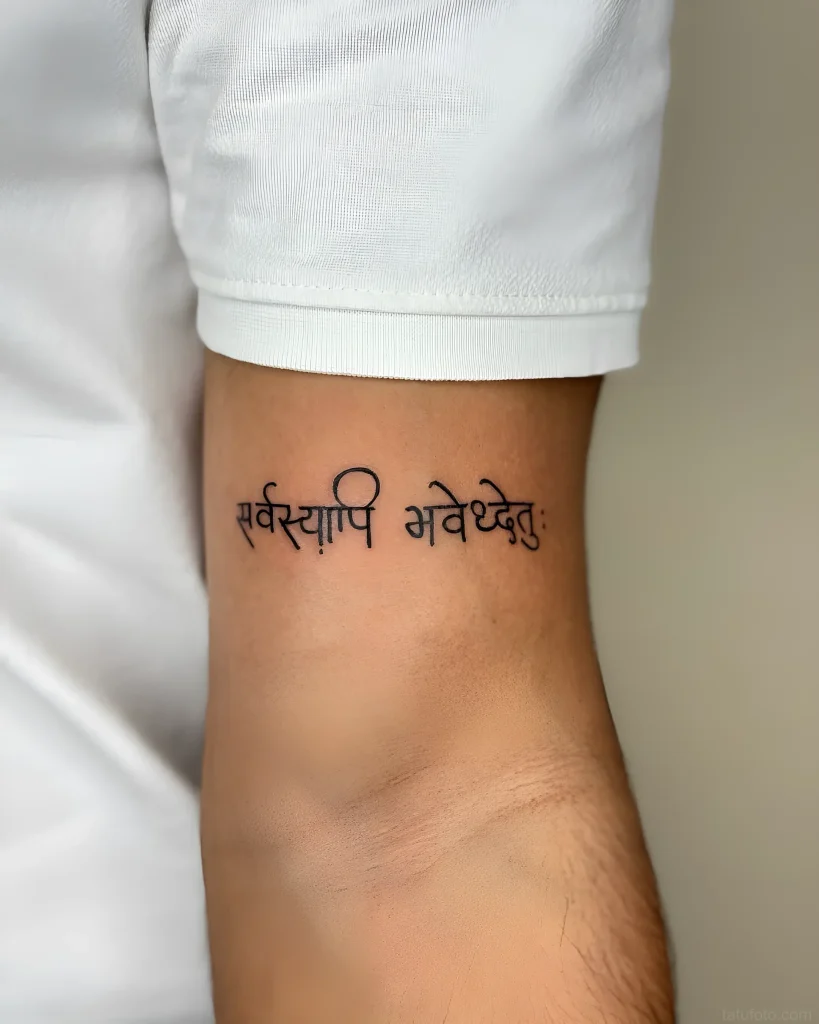
History and Origin of Sanskrit as a Tattoo Language
To understand why Sanskrit has conquered the world of tattoos, it’s necessary to look at its role in culture. Sanskrit is the key to understanding Indian philosophy. Although it is considered a “dead” language in terms of everyday communication (similar to Latin), its spiritual and academic influence remains unchanged.
- Cultural Context: For a long time, tattoos related to spirituality and Sanskrit were the prerogative of sadhus (holy men) and ascetics in India and Nepal. These tattoos, often depicting mantras or symbols like Om, served as initiation marks or talismans.
- Globalization of Yoga: In the late 20th and early 21st centuries, with the explosive growth in popularity of yoga, meditation, and Vedic philosophy in the West, interest in Sanskrit as a source of wisdom sharply increased. People began seeking ways to carry these principles with them constantly.
- Symbol of Authenticity: Unlike English or Latin quotes, Sanskrit offers a level of encryption and authenticity that gives the tattoo a special, personal meaning, not always obvious to an outsider.
Thus, a modern Sanskrit tattoo is a direct bridge connecting a person to ancient knowledge transmitted through a classic, immutable language.
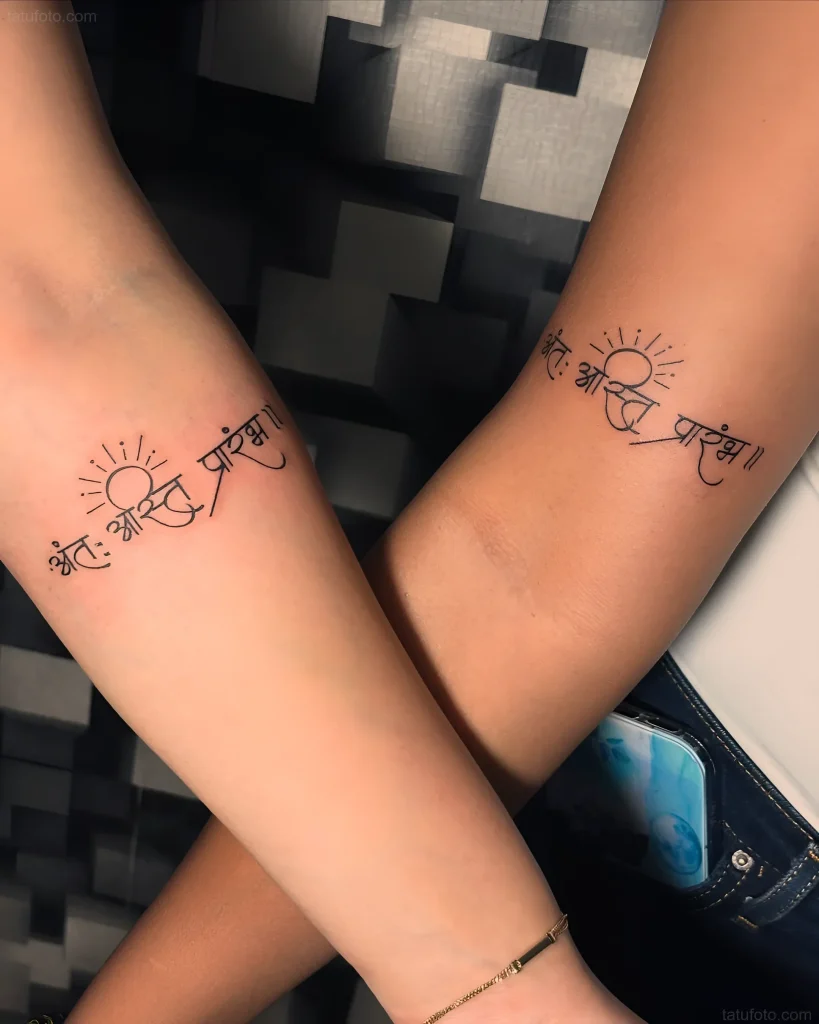
Key Meanings of Sanskrit Tattoo Inscriptions: From Mantras to Personal Affirmations
The meaning of Sanskrit tattoo inscriptions can be divided into several main categories, each reflecting a specific aspect of a spiritual or life path.
Mantras and Sacred Sounds
Mantras are not just words; they are phonetic formulas designed to alter states of consciousness. A mantra tattoo is a constant source of vibration and protection.
- Om (ॐ / Aum): The most famous and profound symbol. It represents the primordial sound of the universe, embodying the three states of consciousness (waking, dreaming sleep, deep sleep) and absolute reality (turiya). An Om tattoo is a symbol of unity, beginning, and end.
- Om Mani Padme Hum (Oṃ Maṇi Padme Hūṃ): Although this mantra comes from Tibetan Buddhism (and is often written in Tibetan script, its roots are in Sanskrit), it is incredibly popular. It means “The Jewel in the Lotus” and symbolizes the purity of body, speech, and mind, as well as compassion.
- Gayatri Mantra (partially): Complex mantras are rarely tattooed in full, but their parts or key words are used to attract light, wisdom, and enlightenment.
Philosophical Concepts and Life Principles
Many choose Sanskrit terms that serve as ethical or philosophical guidelines.
- Dharma (Dharma): Means “duty,” “right path,” “law of the universe.” A Dharma tattoo is often chosen by people striving to live in accordance with their destiny and moral principles.
- Karma (Karma): “Action” or “the law of cause and effect.” It is a reminder that every action has consequences and a call for awareness and responsibility.
- Moksha (Mokṣa): “Liberation,” “release from the cycle of rebirth.” Chosen by those seeking spiritual freedom and transcendence.
- Nirvana (Nirvāṇa): In Buddhism, a state of supreme bliss, transcending suffering and desires.
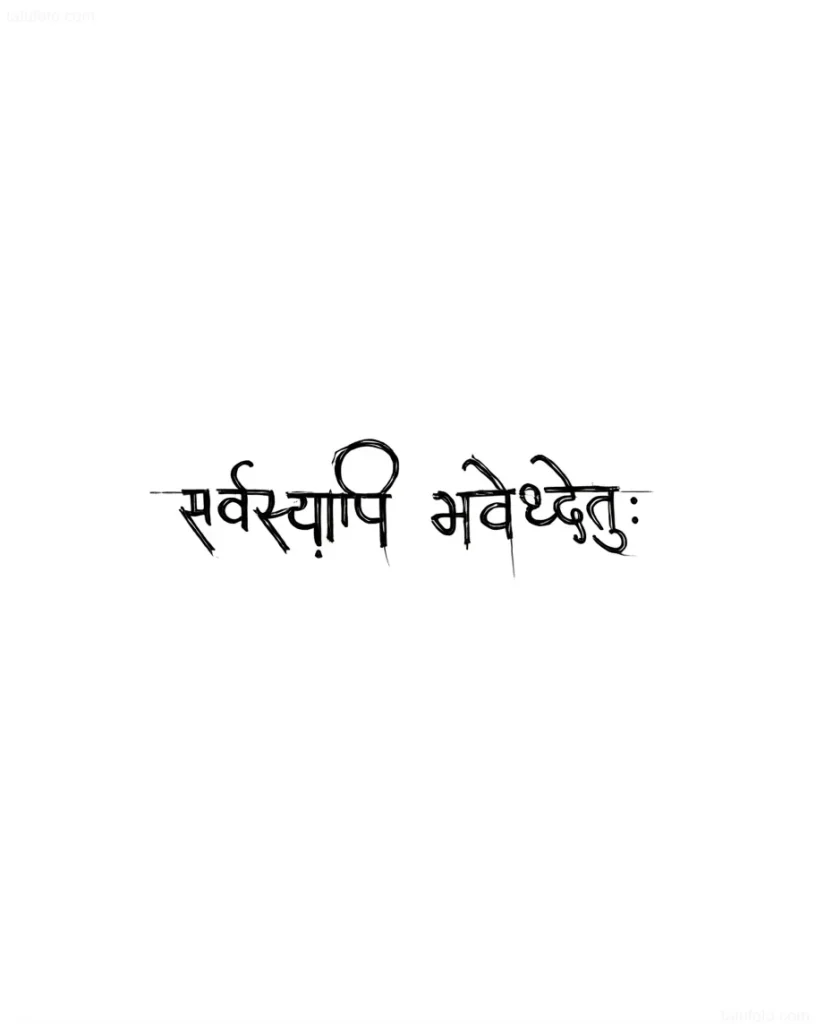
Personal Affirmations and Qualities
These inscriptions serve to reinforce desired inner qualities.
- Shanti (Śānti): “Peace,” “tranquility.” Often repeated three times (Om Shanti Shanti Shanti) to achieve peace on three levels (body, speech, mind). A Shanti tattoo is a call for inner harmony.
- Prema (Premā): “Unconditional divine love.” Chosen as a symbol of the highest form of love.
- Satya (Satyā): “Truth,” “truthfulness.” A reminder of the need to be honest with oneself and the world.
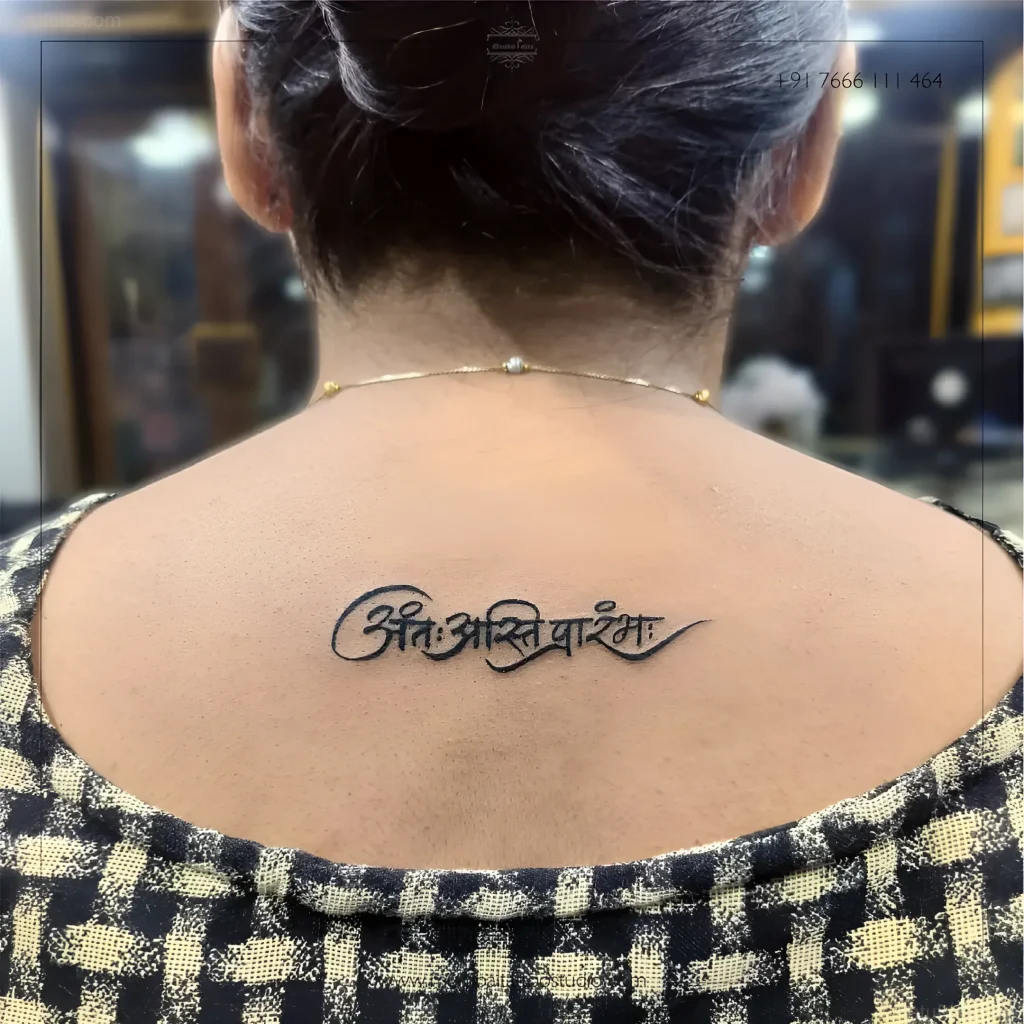
Popular Sanskrit Phrases and Their Accurate Translation for Tattoos
When choosing a phrase for a Sanskrit tattoo, it is important to pay attention not only to the beauty of its sound but also to its grammatical accuracy. Below are some of the most popular and profound options that clients often choose.
Phrases Reflecting Unity and Self-Discovery
Aham Brahmāsmi (अहं ब्रह्मास्मि)
Accurate Translation: “I am Brahman (the Absolute).”
Meaning: One of the great Mahavakyas (great sayings) of the Upanishads. It embodies the unity of the individual soul (Atman) with the universal soul (Brahman). This is the ultimate affirmation of non-duality.
Tat Tvam Asi (तत् त्वम् असि)
Accurate Translation: “Thou art That” (or “You are That”).
Meaning: Another Mahavakya. A reminder that your true essence is identical to the Supreme Reality. A phrase that calls for the realization of your divine nature.
Soham (सोऽहम्)
Accurate Translation: “I am He.”
Meaning: A mantra closely associated with breathing (inhalation – So, exhalation – Ham). Similar to Aham Brahmāsmi, but often used as a meditative practice, emphasizing constant unity with the Cosmos.
Phrases Carrying Blessings and Positive Energy
Loka Samasta Sukhino Bhavantu (लोकाः समस्ताः सुखिनो भवन्तु)
Accurate Translation: “May all beings in all worlds be happy.”
Meaning: A powerful expression of compassion and universal goodwill. An excellent choice for those who strive for peace and harmony not only for themselves but for all living beings.
Satyam Shivam Sundaram (सत्यं शिवं सुन्दरम्)
Accurate Translation: “Truth, Goodness, Beauty.”
Meaning: A threefold formula describing the ideal qualities of existence. Truth leads to goodness, and goodness manifests as beauty.
Phrases About Strength and Overcoming
Ahimsa Paramo Dharma (अहिंसा परमो धर्मः)
Accurate Translation: “Non-violence is the highest duty.”
Meaning: A central principle of yoga ethics. It is not just the absence of physical harm, but also the absence of hostility in thoughts and words.
Yogas Chitta Vritti Nirodhah (योगश्चित्तवृत्तिनिरोधः)
Accurate Translation: “Yoga is the cessation of the fluctuations of the mind.”
Meaning: The classic definition of yoga, given by Patanjali. Ideal for people who practice meditation or yoga, as a reminder of the goal of their practice.
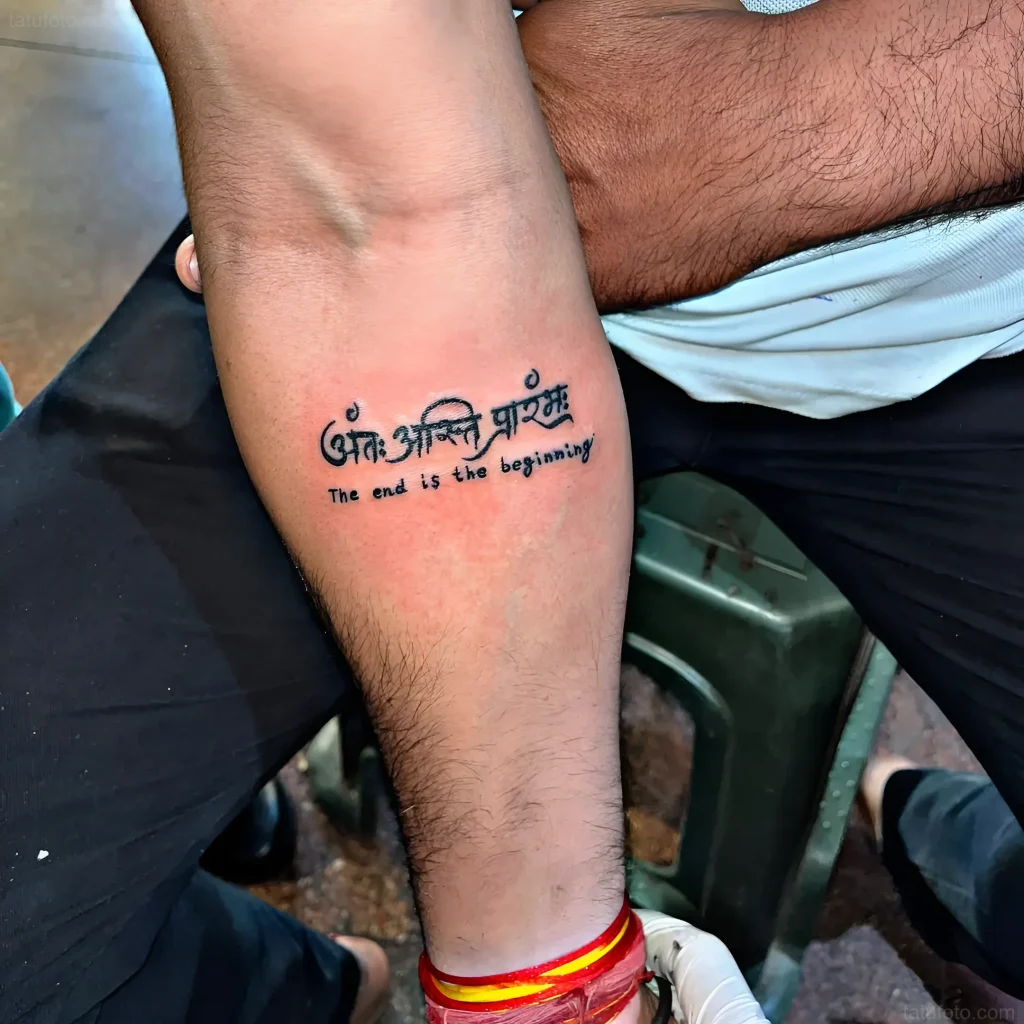
Styles and Fonts for Sanskrit Tattoos: How to Maintain Authenticity
The visual execution of a Sanskrit inscription is as critical as its translation. Sanskrit is traditionally written in the Devanagari script, which has strict calligraphic rules.
Traditional Devanagari
To preserve the meaning of Sanskrit tattoo inscriptions, most experts recommend adhering to the classic, clean Devanagari style. Its features:
- Shirorekha (Śirorekhā): A horizontal line connecting the upper parts of the letters. It should be continuous and straight. In tattoos, it is often emphasized, as it gives the inscription completeness and rigor.
- Symmetry: Devanagari letters are very graphic and symmetrical. Clean, fine line work is ideal for accurately reproducing all diacritical marks (special marks that change vowels and consonants).
- Size: Avoid overly small fonts, especially if the phrase is long. Small details, such as sub-scripts (marks written below the main letter), can merge over time, leading to distortion of meaning.
Modern Adaptations and Warnings
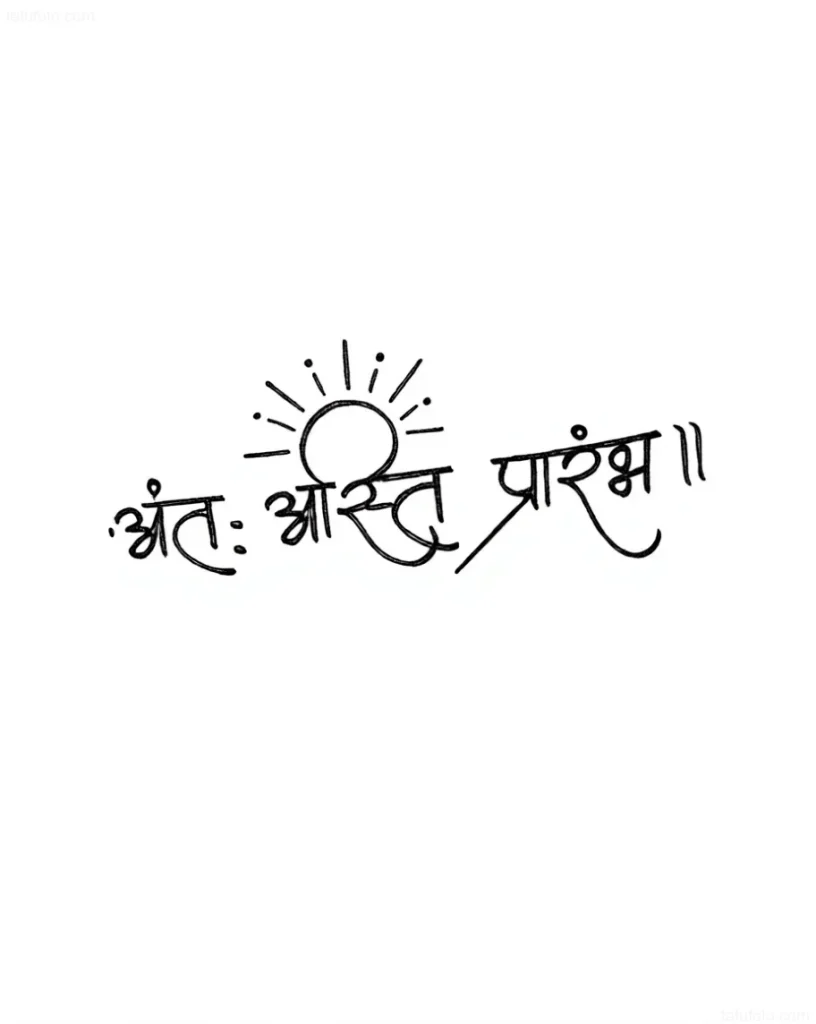
Some artists offer stylized versions of Sanskrit that may be inspired by calligraphy or modern fonts.
- Calligraphic Style: Involves using thicker lines, shadows, or gradients to give the text volume and artistry while maintaining the clarity of the symbols.
- Minimalism: Extremely thin lines, no unnecessary decorative elements. This style emphasizes the purity and simplicity of the spiritual message.
Important Warning: Never use fonts that try to “disguise” Devanagari as European style or, conversely, excessively stylize it to the point of being unrecognizable. Distortion of matras (vowel signs) or visarga (aspirate mark) is the most common cause of grammatical errors in Sanskrit tattoos.
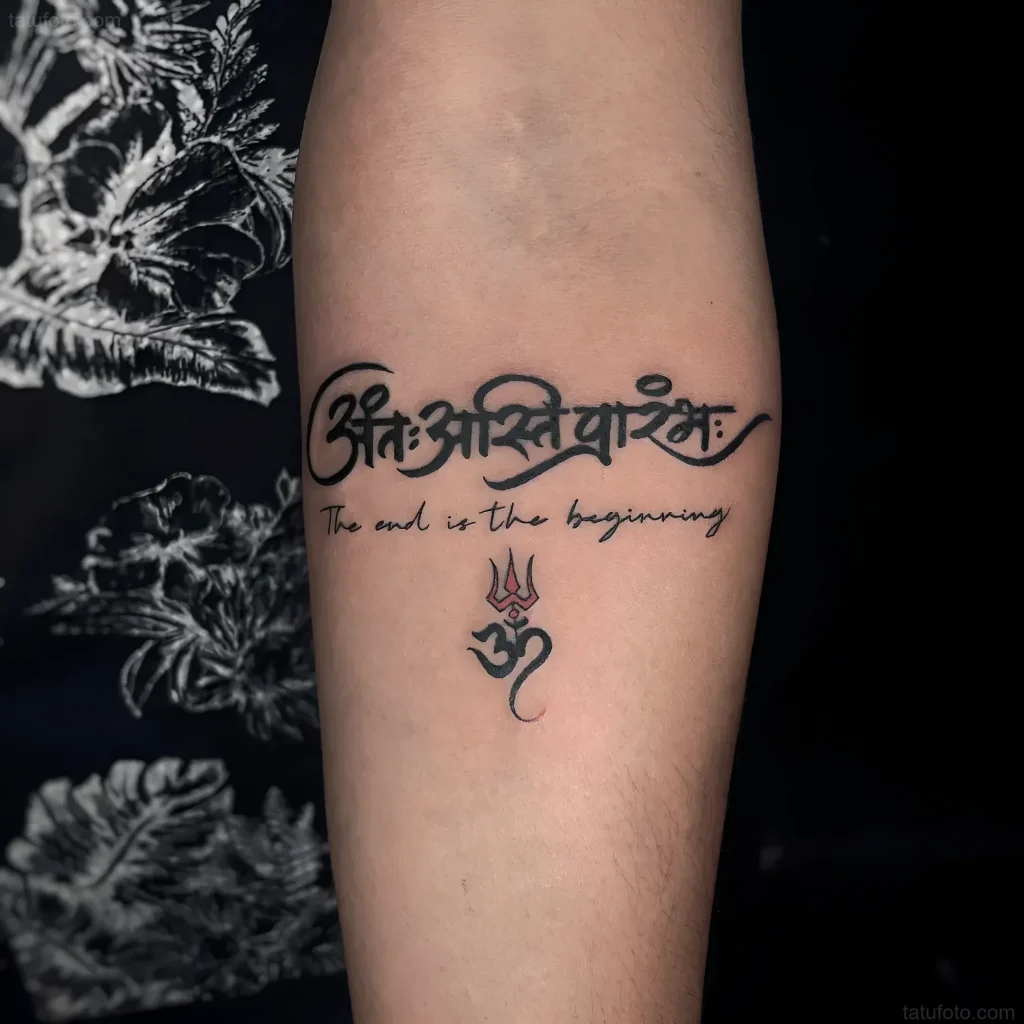
Best Places on the Body for a Sanskrit Inscription Tattoo
The choice of location for a Sanskrit tattoo is determined not only by aesthetics but also by deep respect for the cultural and spiritual traditions that this language carries. Since Sanskrit texts often contain sacred mantras and divine names, their placement on certain parts of the body is considered unacceptable (ashuddha), or “unclean.”