
Choosing a tattoo is always a search for balance between aesthetics and deep inner meaning. Among the many industrial and technical symbols, the meaning of a circular saw tattoo holds a special place, representing a unique blend of brutality, craftsmanship, and a philosophical outlook on life. At first glance, such a design might seem aggressive or purely professional, but for a true connoisseur of tattoo art, the saw blade is a powerful archetype, symbolizing the ability to cut through any obstacles, separate the important from the secondary, and create something new from the raw material of reality. In this article, we will delve into why this tool has become a popular subject in modern tattooing and what hidden meanings it carries.
Circular Saw Tattoo: The Meaning and Symbolism of the Tool in Body Art

In the context of the tatufoto.com portal, we often encounter how ordinary objects, in the hands of a talented artist, transform into sacred signs. The meaning of a circular saw tattoo is multifaceted. First and foremost, it is a symbol of continuous movement. The circular shape of the blade refers us to ancient solar symbols and the Wheel of Samsara, but with a modern, industrial twist. The saw teeth, arranged around the perimeter, speak of readiness for defense and the ability to overcome resistance.
For many wearers, such a tattoo becomes an embodiment of a “sharp mind” and analytical ability. Just as a saw instantly cuts through hard wood, a person with this symbol on their skin is accustomed to making quick decisions, cutting away doubts and superfluous emotions. It is the choice of people of action who prefer constructive work and tangible results over empty reasoning.

Furthermore, the following aspects of symbolism are worth considering:
- Professional Pride: For carpenters, builders, and cabinetmakers, it is a sign of respect for their craft.
- Cyclicality: The closed circle of the blade symbolizes the infinity of processes and the inevitability of change.
- Dangerous Beauty: The combination of the perfect geometry of the circle and sharp, dangerous teeth creates an aesthetic tension characteristic of strong personalities.
The History of the Circular Saw: From Invention to Iconic Status

To better understand the meaning of a circular saw tattoo, it’s useful to look into the history of the tool itself. Legend has it that the invention of the circular blade is attributed to Tabitha Babbitt, a weaver from the Shaker community, who in 1813 noticed how inefficient the ordinary two-handed saw was. She proposed using a rotating disc, which revolutionized woodworking.
This historical context adds the meaning of innovation and efficiency to the tattoo. By choosing such a sketch, you emphasize your commitment to progress and your unwillingness to waste energy. In 20th-century popular culture, the circular saw became a symbol of industrialization, the power of factories, and later, an icon of “industrial” aesthetics and even horror culture. In tattooing, this symbol has evolved from simple old-school depictions of tools to complex hyper-realistic works where every tooth of the blade is rendered with anatomical precision.
Deep Meanings of a Circular Saw Tattoo: Power, Precision, and Transformation

If we dig deeper, we find that the meaning of a circular saw tattoo is closely linked to the concept of transformation. A saw doesn’t just destroy; it changes the shape of an object, turning a raw log into useful material. In an esoteric sense, this can mean working on oneself, “polishing” one’s character, and removing superfluous traits that hinder growth.
Let’s consider the main philosophical interpretations:
- Absolute Precision: Unlike an axe, a saw requires precise movements. It is a symbol of a person who values details and does not tolerate negligence in their affairs.
- Inner Energy: The rotating disc is associated with immense speed and hidden power that manifests at the right moment.
- The Boundary Between Life and Death: In some subcultures, the saw symbolizes fatalism, reminding us how easily something built over years can be destroyed.
The table below shows the main meanings depending on the context of the image:
| Sketch Element | Main Meaning |
|---|---|
| Blade with drops of blood | Danger, past trauma, overcoming pain |
| Saw cutting through a skull or heart | Victory of reason over emotions or fatal changes |
| Tool surrounded by flowers | Harmony between creation and destruction, the aesthetics of contrast |
| Rusty, old blade | Experience, loyalty to traditions, a “tempered” character |
Circular Saw Tattoo Styles: From Realism to Geometric Minimalism

The choice of style directly influences how the meaning of a circular saw tattoo will be perceived. The modern tattoo industry offers many ways to execute this subject.
Realism and Hyperrealism. This is perhaps the most striking option. The artist conveys the shine of the steel, the texture of the metal, the sharpness of each tooth, and even the sparks flying from the blade. Such a tattoo looks maximally masculine and technological. It emphasizes the materiality of the world and the wearer’s love for specifics.
Trash Polka. The ideal style for those who want to imbue their tattoo with a rebellious meaning. The combination of a realistic saw blade with chaotic red strokes, newspaper fonts, and abstract spots creates an atmosphere of dynamism and aggression. Here, the saw acts as a symbol of social pressure or an internal explosion.
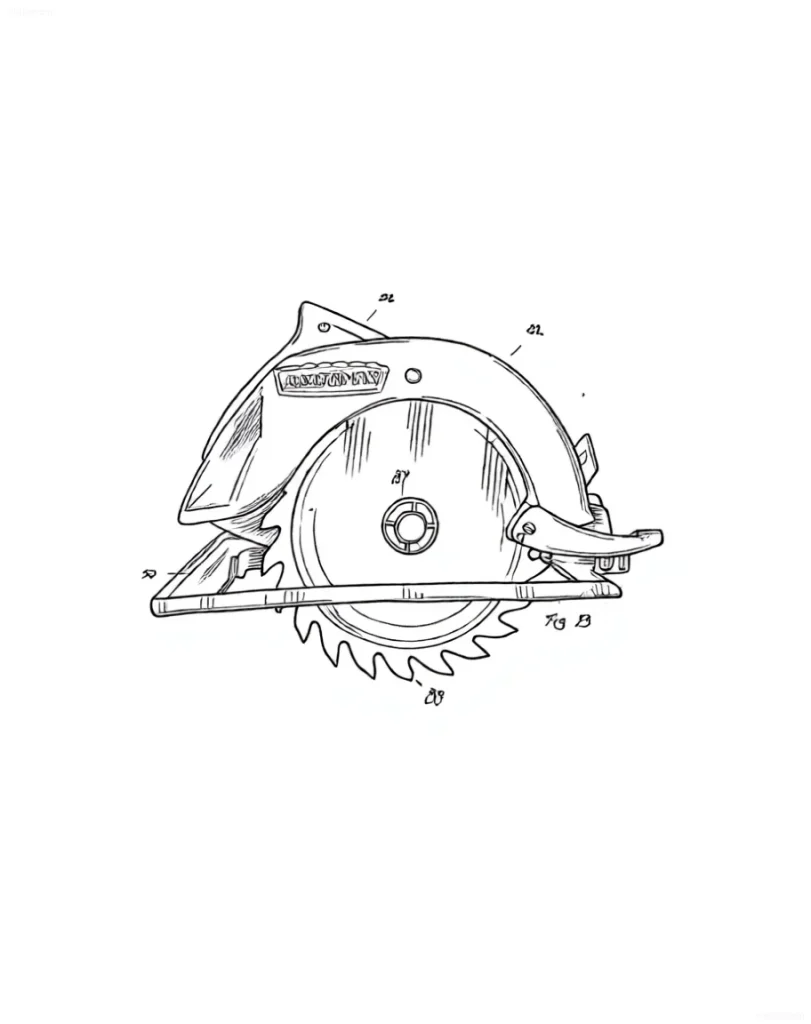
Old School and Traditional. In these styles, the saw is depicted with bold outlines and a limited color palette. Often, the blade is complemented by banners with inscriptions, roses, or daggers. This is a classic that speaks of loyalty to roots and respect for the old school of tattooing.
Geometry and Dotwork. If you want to emphasize the sacred meaning of the circle, opt for geometry. The saw blade, inscribed in complex mandalas or composed of hundreds of tiny dots, transforms from a tool into a mystical symbol of harmony and the mathematical perfection of the universe.
Best Placements for a Circular Saw Tattoo: Where to Place the Symbol of Power and Craftsmanship

The choice of placement for a tattoo depends on the size of the sketch and how openly you want to display your “tool.” The forearm is a classic option. The saw blade fits perfectly into the anatomy of this area, especially if depicted in motion. This location is chosen by those who want to emphasize their readiness for labor and action.
The elbow. Placing the center of the blade directly on the elbow joint is a bold and striking decision. When the arm bends, the tattoo “comes alive,” creating an illusion of rotation. However, it’s important to remember that this is one of the most painful areas for tattooing.
The chest or shoulder blade. Large areas allow for a grand composition, such as a saw cutting into the skin or sawing through another symbol (anchor, tree, chains). This emphasizes the fundamental nature of the chosen meaning.
Calves. An excellent place for vertical compositions, where the saw blade can be part of a more complex mechanism or biomechanical scene.
Tips for Choosing and Caring for a Circular Saw Tattoo: A Practical Guide

To ensure that the meaning of your circular saw tattoo brings you joy for years to come and the design itself remains sharp, follow the advice of tatufoto.com experts:
- Choose your artist carefully: If you plan on realism, look for an artist with an excellent portfolio in that style. Depicting metal requires special skill in working with highlights and shadows.
- Detailing: Don’t make it too small. A too-small saw can turn into an indistinct dark spot over time, as the teeth are close together.
- Color Palette: Steel gray, deep black, and bright accents (red, blue) are ideal choices. Avoid overly pale shades for the outlines.
Caring for such a tattoo is standard but important: use healing ointments in the first few days, avoid direct sunlight, and do not scratch the tattooed area. Remember that “metallic” tattoos are particularly demanding of skin hydration after healing – this will make the shine of the steel look more natural.
Frequently Asked Questions About Circular Saw Tattoos: Everything You Need to Know

Does getting a saw tattoo hurt? The pain depends not on the subject matter but on the placement. It hurts on the elbows and knees, and is quite bearable on the shoulder or thigh. Given the detail of the teeth, the session can be lengthy.
What does it mean if the saw is depicted as broken? This is a powerful symbol of stopping, the end of a certain life stage, or the rejection of aggressive problem-solving methods. It can also signify a master’s “retirement” or a career change.
Is such a tattoo suitable for women? Absolutely. In a female interpretation, the meaning of a circular saw tattoo often shifts towards the “dangerous woman” who can stand up for herself, or symbolizes a sharp, insightful mind and independence.
Interesting Facts About Circular Saws and Their Place in Tattoo Culture

Did you know that the first circular saws were powered by water? This adds a connection to the elements to the symbol. In the world of tattoos, the circular saw often becomes an element of biomechanics, where parts of the human body are replaced by mechanisms. This emphasizes the idea of a “human-machine,” maximally efficient and devoid of weaknesses.
It is also interesting that in some prison traditions (though this is rare for modern artistic tattooing), tools could signify a certain occupation within correctional facilities, but today this meaning has been almost completely replaced by artistic interpretation. In modern culture, it is more of a sign of a “self-made man” – a person who carves their own destiny from the mass of life.
By choosing the meaning of a circular saw tattoo, you declare your strength, precision, and readiness for transformation to the world. This is a tattoo for those who are not afraid of sharp edges and know the value of true craftsmanship.