
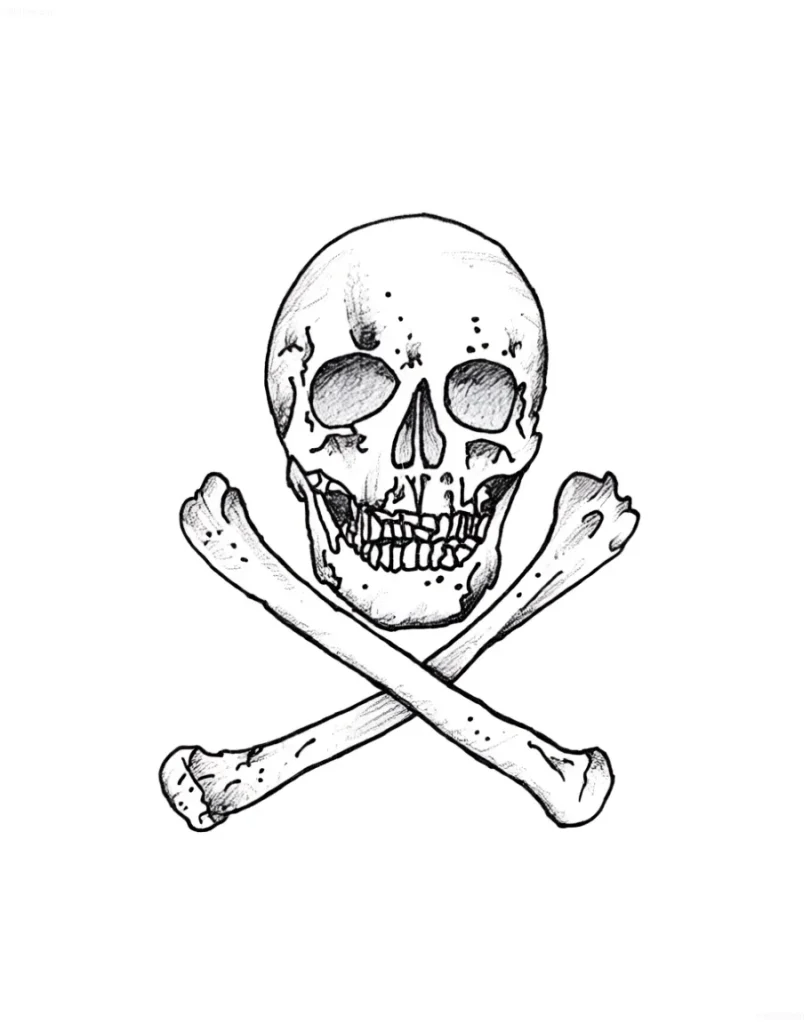
The skull and crossbones tattoo is one of the most recognizable and myth-shrouded symbols in the world of body art. Despite its seemingly grim appearance, this image carries a profound philosophical subtext that has evolved over centuries. For some, it’s a formidable sign of danger and defiance; for others, a powerful amulet reminding them of the value of every fleeting moment. In this article, we, as experts from tatufoto.com, will delve into what lies behind this iconic image, how its perception has changed over time, and why it remains relevant in the modern tattoo industry.
Choosing a tattoo is always a search for balance between aesthetics and inner meaning. The skull with crossbones (also known as “Jolly Roger” or “Adam’s Head”) is perfect for those who are not afraid to face fate and openly declare their beliefs. This symbol is versatile: it looks equally striking in brutal realism as it does in minimalist graphics. However, before getting such a design, it’s crucial to understand all the nuances of its interpretation so that your tattoo conveys precisely the meanings you intend.
Skull and Crossbones Tattoo: What This Symbol Means

The primary meaning of the skull and crossbones tattoo in modern times is fearlessness in the face of death and an acknowledgment of the transience of life. Unlike many other symbols, this image doesn’t try to sugarcoat reality. It states that death is a natural end, and it’s the awareness of this fact that compels people to live life to the fullest. For many who wear this tattoo, it serves as a kind of “Memento Mori” (remember death), urging them not to waste time on trivialities.
Beyond the philosophical aspect, this symbol is often interpreted as a sign of protection and guardianship. In ancient times, it was believed that the image of a skull could ward off death itself or evil spirits. It was thought that if a person already bore the mark of death, it would pass them by, mistaking them for one of its own. This is why the tattoo is often chosen by people in dangerous professions or those whose lives involve constant risk: stunt performers, military personnel, rescuers, and bikers.

The following aspects of its meaning are also worth highlighting:
- Rebellion and Freedom: rejection of societal norms and adherence to one’s own rules.
- Brotherhood and Loyalty: belonging to a specific group or ideology, readiness to stand by one’s own until the end.
- Rebirth: in some cultures, the skull symbolizes not an end, but transformation and transition to a new state.
- Danger: a warning to others that the tattoo wearer is a decisive person capable of defending themselves.
The History of the Skull and Crossbones Tattoo: From Pirates to the Present Day

The history of this symbol dates back to ancient times, long before the advent of the first professional tattoo machines. One of the earliest official mentions of crossed bones beneath a skull is its use in Christian tradition. The image became known as “Adam’s Head.” According to legend, Adam’s remains were interred at Golgotha, and when the blood of the crucified Christ washed over his skull, it symbolized the atonement of humanity’s sins and victory over death. In this context, the symbol carries a bright, purifying meaning.
However, the symbol gained worldwide fame thanks to the “golden age” of piracy in the 17th-18th centuries. The famous “Jolly Roger” on the black flag didn’t always look the same, but the skull and crossbones became the classic version. For sailors of that era, such a tattoo was a sign of renunciation of state laws and an oath of allegiance to the pirate code. It was a symbol of people who chose a short but vibrant life at sea, full of danger and adventure.

In the 18th and 19th centuries, the symbol migrated to the regular armies of Europe. For example, in Prussia and later in the Russian Empire, there were “immortal” hussar regiments whose headwear bore the “death’s head.” For soldiers, it signified contempt for death and readiness to sacrifice themselves for victory. In the 20th century, the symbol was unfortunately discredited by its use in Nazi Germany. However, in tattoo culture, it quickly regained its original meaning – a symbol of risk, courage, and rock-and-roll drive, thanks to the biker movement of the 1950s.
Meanings of the Skull and Crossbones Tattoo: The Multifaceted Symbolism

The symbolism of a tattoo can radically change depending on the additional elements you incorporate into the design. It’s important to understand that the skull and bones are the foundation upon which you build your personal message to the world.
- Skull, Bones, and a Rose: a classic juxtaposition of life and death, beauty and decay. Such a tattoo suggests that love and passion can last forever, even beyond earthly existence.
- Skull and Bones with a Dagger: a symbol of revenge, determination, and fighting spirit. It often indicates that the person has experienced a severe betrayal and emerged stronger.
- Skull in a Crown: a desire for power, nobility of spirit, and the realization that everyone is equal before death – kings and beggars alike.
- Skull and Hourglass: an emphasis on the relentless passage of time. It’s a sign of wisdom and understanding that every moment is priceless.
- Skull with a Snake: a snake emerging from an eye socket symbolizes the immortality of the soul and the knowledge that remains after physical departure.

If you choose a skull and crossbones tattoo, the meaning can also be purely professional. In chemistry and medicine, this symbol was long used to denote poisons. In a tattoo context, this can be interpreted as a “poisonous” nature or a warning that it’s best not to get into conflicts with the wearer.
Styles of Skull and Crossbones Tattoos: From Realism to Abstraction

The choice of style is not just a matter of aesthetics but also a way to convey the mood of the tattoo. The same subject can look aggressive, ironic, or philosophical.
- Realism: a highly detailed depiction where every crack on the bone and the texture of the enamel on the teeth is rendered. Such a tattoo looks impressive and serious, emphasizing the biological truth of life.
- Old School: a traditional style with bold outlines and a limited color palette. It’s a tribute to sailors and tattoo classics. Skulls in this style are often complemented by banners with inscriptions.
- Trash Polka: an aggressive, dynamic style that combines realistic elements with paint strokes, blots, and typography. It perfectly conveys chaos and a rebellious spirit.
- Minimalism and Graphics: concise lines, clear geometry. Suitable for those who want to get the symbol as a neat sign or emblem without drawing excessive attention to details.
- Dotwork: an image created from thousands of tiny dots. It gives the tattoo depth and a mystical, “sandy” texture.
Placement of the Skull and Crossbones Tattoo on the Body: Best Ideas and Their Meaning

The location of the tattoo plays an important role in its perception. Since the skull and crossbones is a rather active symbol, consider how openly you want to display it.
| Body Part | Meaning and Features |
|---|---|
| Shoulder and Forearm | The most popular location. Symbolizes strength and readiness for action. The tattoo is easily displayed and just as easily hidden by clothing. |
| Chest | A symbol that the meaning of the tattoo is “close to the heart.” Often it’s a protective charm or a memory of someone important. The large area allows for a detailed composition. |
| Hand (Handpoke) | A challenge to society. A tattoo on the hand is always visible, it declares the wearer’s straightforwardness and openness. |
| Back | A canvas for large-scale designs. Here, the skull and crossbones can become the centerpiece of a complex allegorical picture. |
| Calf or Thigh | Often chosen for dynamic designs. Tattoos on the legs are associated with moving forward and stability in life. |
How to Choose a Skull and Crossbones Tattoo Design: Tips for a Unique Look

To ensure your tattoo doesn’t look like a generic internet image, heed the advice of professionals. You can make the design unique by adding personal details.
First, decide on the emotion of the skull. It can be menacingly bared, neutrally calm, or even “smiling” (as in the Mexican Day of the Dead tradition). This sets the tone for the entire tattoo. Second, consider the shape of the bones. They can be classic femurs, crossed swords, torches, or even tools related to your hobby or profession.
Don’t be afraid to experiment with color. While black and gray are classics, adding bright red, deep blue, or neon shades can transform a grim symbol into a modern art object. Be sure to discuss the composition with your artist: will it be a standalone symbol or part of a larger “sleeve”?
Skull and Crossbones Tattoo Aftercare: Maintaining Brightness and Clarity for a Long Time

Since these tattoos often feature a lot of black pigment and fine details (especially in realism or graphics), proper aftercare is crucial for preserving their original appearance. You don’t want your “Jolly Roger” to turn into a shapeless blob after a couple of years, do you?
- First few days: strictly follow the artist’s recommendations. Use healing ointments with panthenol and prevent the skin from drying out.
- Sun protection: UV rays are the main enemy of tattoos. After complete healing, always use sunscreen with SPF 50+, especially if the tattoo is on an exposed area of the body.
- Moisturizing: healthy, hydrated skin holds pigment better. Use lotions without harsh fragrances.
- No saunas or steam rooms: for the first 2-3 weeks, forget about steaming the skin and swimming in chlorinated pools.
Frequently Asked Questions About Skull and Crossbones Tattoos (FAQ)

1. Does such a tattoo bring bad luck?
On the contrary, in most cultures, a skull tattoo is considered a powerful amulet that “wards off” misfortune and reminds one of the value of life.
2. Can women get such a tattoo?
Of course. In a feminine interpretation, the skull and crossbones are often complemented by flowers, lace, or done in a watercolor style, making the image more elegant and mysterious.
3. Does the angle at which the bones are crossed matter?
In classic tattooing, there are no strict rules. However, in heraldry and military symbolism, the angle can change. In tattoos, it’s more a matter of aesthetics and composition for specific muscle anatomy.
4. Is it painful to get such a tattoo?
The pain depends on the placement (it’s more painful on bones, for example, ribs or knees), not on the design itself. However, skulls often require dense shading, which can be sensitive.
Interesting Facts About the Skull and Crossbones Symbol

Did you know that the skull and crossbones symbol is used not only in tattoos and on pirate flags? Here are a few curious facts:
- At the elite Yale University, there is a secret society called “Skull and Bones,” whose members have included many US presidents.
- In chemistry, the “skull and crossbones” sign became an official international symbol for toxicity only in the 1850s.
- In Tibetan Buddhism, skull cups (kapalas) are used in rituals as a symbol of the destruction of ego and attachments.
In conclusion, the skull and crossbones tattoo is a choice for strong individuals ready to embrace the truth of life in its entirety. It’s a symbol that has journeyed from a religious relic and a fearsome pirate banner to an icon of modern pop culture. Whatever meaning you imbue in your design, at tatufoto.com, we will always help you find inspiration and professional advice to bring your idea to life.