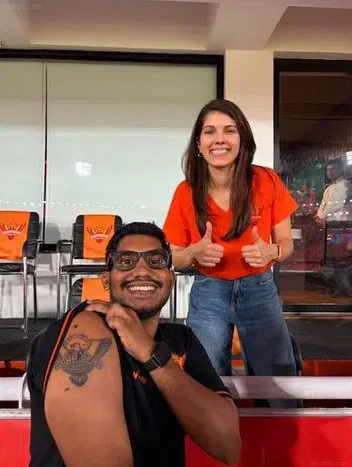
In the world of modern sports, the line between simple passion and a lifestyle is becoming increasingly blurred, and for some fans, loyalty to their favorite team is literally absorbed under the skin. A prime example of such absolute fanaticism is the story of 26-year-old Kandukuri Dharma Rakshit, the founder of the official fan club “Orange Army,” who decided to immortalize his 13-year love affair with the Sunrisers Hyderabad (SRH) cricket franchise with a large-scale tattoo. For the young man from Hyderabad, this gesture became not just body art, but a manifesto of loyalty to his hometown and the team he calls nothing less than an “emotion.”
Rakshit’s journey among the fans began in 2013 when his father first took him to the Uppal Stadium for a match against KKR. That day marked a point of no return: the atmosphere of live play and the energy of the stands forged a deep emotional connection that has only strengthened over thirteen years. Since then, Kandukuri has not missed a single SRH match in the IPL, and in 2026, his passion took on an international scale – he traveled to South Africa to support the expanded team roster. Such a long path of devotion required a fitting symbol, and it became an impressive depiction of the club’s logo on his forearm.
Technical Details and Artistic Execution
The realization of the idea was entrusted to master Rahul from Body Inked Tattoo Studio, located in the Habsiguda area. The work on the 9 by 4 inch (approximately 23 by 10 centimeters) tattoo required a six-hour continuous session. From a tattoo art perspective, applying corporate and sports logos requires the artist’s precision: any distortion of geometry or violation of the brand mark’s proportions is immediately noticeable. In this case, the technique of dense black coloring with detailed elaboration of the eagle elements, symbolizing the team’s power and flight altitude, was chosen.
Experts in the tattoo industry note that such works fall into the category of “identity tattoos” – tattoos of identity. They serve as a visual marker of belonging to a particular social group or community. The choice of placement on the forearm is also not accidental: it is an open area that allows one to demonstrate their beliefs to others, which is especially important for a leader of a fan movement.
From Family Resistance to Franchise Recognition
Interestingly, the path to this tattoo was not easy, not only because of the physical pain during the session but also due to Rakshit’s family’s conservative views. For a long time, relatives did not approve of the idea of a permanent drawing on the body. However, seeing the sincerity of his feelings and the scale of his fan club development activities, the family finally gave their blessing this IPL season. “When your passion is sincere, even dreams find recognition from loved ones,” shares Rakshit, emphasizing that the support of his father, who instilled in him a love for SRH, remains his main motivation.
The team’s reaction exceeded the fan’s expectations. After the video of the tattoo process was posted on social media, the official Sunrisers Hyderabad account reposted it. The gesture was appreciated not only by the players and staff but also by the franchise owner Kavya Maran herself. For Rakshit, this became the highest form of recognition for his merits as the founder of the “Orange Army Fan Club.”
Context of Tattoo Culture in Sports
Sports fanaticism and tattoos have a long-standing synergy. In Western culture, tattoos with emblems of football or basketball clubs have long been the norm, but in India, this trend is just gaining momentum, transforming under the influence of the IPL. If earlier fans were limited to face paint on match days, today we see a shift towards more radical and permanent forms of self-expression.
Rakshit’s story is noteworthy because he consciously chose the path of supporting a local brand. While many of his peers choose idols among star players, migrating from club to club following transfers, Kandukuri remains true to his roots. “The name Hyderabad carries heritage, culture, and pride. I chose my city,” he states.
The Role of the Fan Club and Social Significance
The creation of the “Orange Army Fan Club” in 2013 was a response to the existence of powerful fan communities for other teams, such as the “Whistle Podu Army” of CSK. Starting as a modest Facebook group, this community is now a powerful force uniting thousands of people. The leader’s tattoo in this context serves as a banner around which like-minded individuals rally.
For tattoo culture, such precedents are important as proof that tattoos have definitively ceased to be a marginal phenomenon. Today, it is a communication tool between the brand (team) and the consumer (fan), where the skin becomes a canvas for broadcasting values. The large-scale work on Rakshit’s arm is not just a tribute to fashion, but a story of loyalty documented in ink that will stay with him forever, reminding him of every triumph and every defeat of his beloved “Orange Army.”