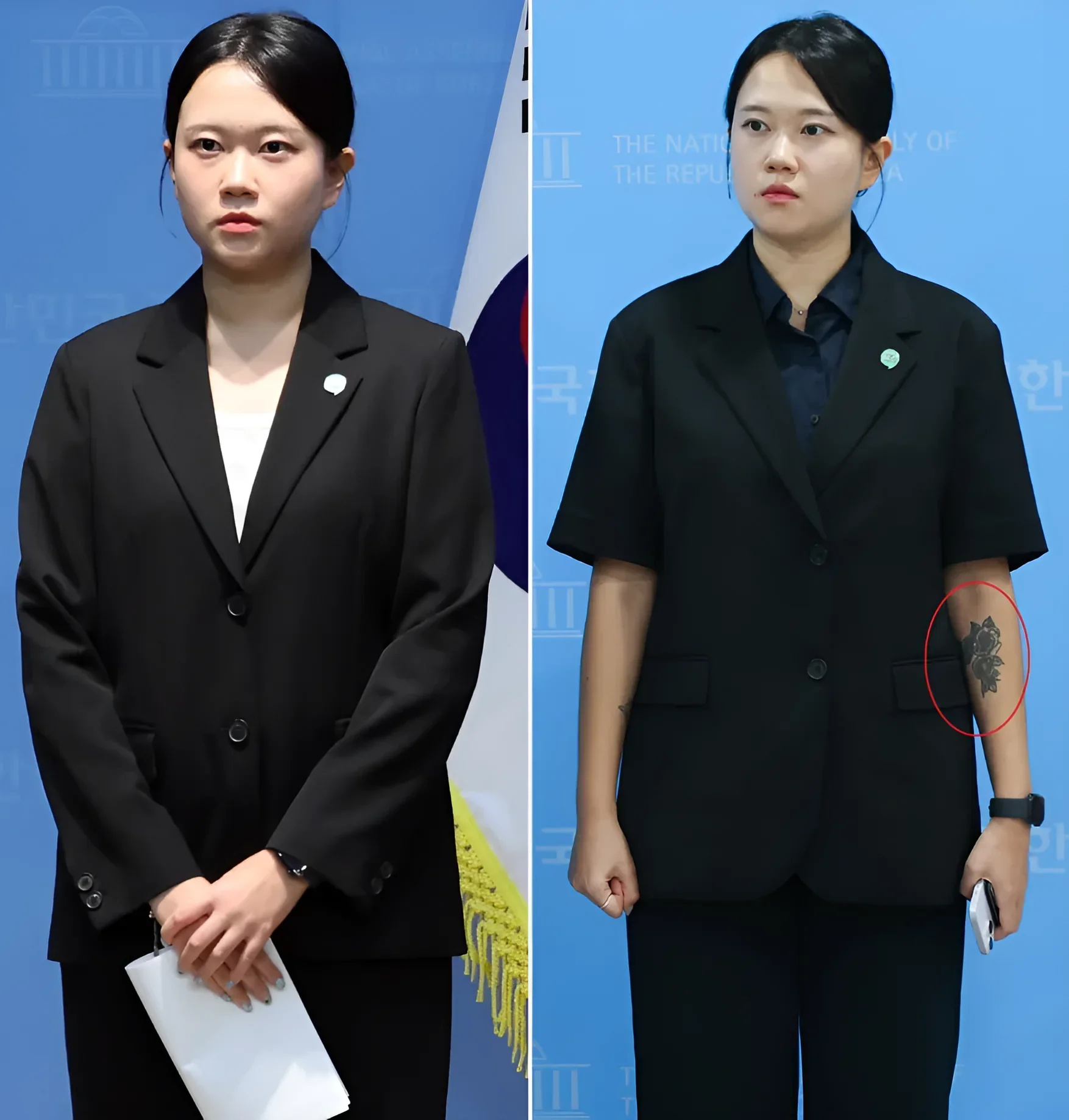
An unusual scandal has erupted in South Korean political circles, with a tattoo on an forearm, rather than ideology or budget, at its center. Kim Jin-seo, deputy spokesperson for the Basic Income Party, publicly apologized for her personal skin art drawing undue attention. The incident began at a briefing in the National Assembly, where party spokespersons were defending accusations against the candidate for Minister of Gender Equality and Family, Young Hae-in. Journalists’ cameras captured a rather large floral design on the inside of Kim’s arm, and the photo quickly spread across social media.
How the Incident Unfolded
Initially, on Monday, Kim Jin-seo appeared at a press conference in short sleeves. Party spokespersons Shin Jae-hyo and Noh Seo-young were also present. The following day, on Wednesday, when the briefing was repeated in a format to defend against new claims regarding financial and personnel management, Kim wore a long-sleeved jacket – an obvious gesture aimed at concealing the design. However, during the Q&A session with journalists, she commented on the situation and apologized, stating that she regretted how a personal matter had “unintentionally caused controversy.”
Kim added a point significant for the tattoo community: since tattoos were legalized in the National Assembly last year, she hopes this case will become an opportunity for a more progressive discussion on the topic. According to her, society should move forward, not regress to old prejudices.
Why the Tattoo Became a Political Issue
To a Western observer, the situation might seem almost comical: a tattoo on an arm is a common occurrence, not requiring an apology. But in Korea, the context is different. For many years, tattoo culture in the country was marginalized and strongly associated with criminal subcultures, military traditions, and “indecent” behavior. Even after the Constitutional Court ruled the ban on tattoos for non-specialists unconstitutional in 2022, and a law legalizing the work of tattoo artists came into effect in 2024, public perception changed slowly.
Politicians in Korea traditionally adhere to a strict visual code: a neutral suit, a restrained appearance, no “extra” details. A tattoo on a public figure is perceived by some of the audience as a violation of this unwritten agreement. This is precisely why the reaction of the media and a portion of the public was so sharp, and the apologies so public.
Expert View: A Shift in Tattoo Culture
Kim Jin-seo’s case is a clear example of how tattoo culture in Asia is going through a stage of “political sensitivity.” On one hand, the younger generation of Koreans freely gets tattoos, the industry is growing, and festivals and professional associations of artists are emerging. On the other hand, in conservative institutions, such as parliament and party structures, the body remains a territory where the “personal” is still considered “indecent.”
Several factors are worth noting that determine the dynamics:
- The legalization of tattoo services has removed the legal taboo, but not the social one.
- Public figures become “litmus tests”: their appearance tests the boundaries of what is acceptable.
- Social media accelerates reactions: a single frame can ignite a national discussion within hours.
- A politician’s apology for a tattoo is both a concession to the conservative part of the audience and a signal that the topic can no longer be ignored.
In the future, such episodes will likely become less resonant. Tattoos are ceasing to be exotic and are transforming into an element of everyday visual culture, including the sphere of politics. However, the transitional period, where one has to apologize for a forearm design at a press conference, is a characteristic feature of societies where tattoo culture is just solidifying its place in the mainstream.
The takeaway: the scandal surrounding Kim Jin-seo is not just a story about an “unseemly” mark on a jacket. It is a marker of how quickly (or slowly) attitudes towards the body, skin adornment, and the boundary between the personal and the public are changing in one of the region’s most conservative countries in terms of external code.