For half a century, cats and dogs lived alongside her – forty individuals who came from shelters, the streets, and acquaintances, and departed at different times. Sue, an American blogger, decided that after her divorce and separation from her current pets, she needed more than just a souvenir; she needed a constant reminder of each of these lives. Thus, a thin line appeared on her left forearm, adorned with forty paw prints. The story was published on September 12, 2026, and it represents not only aesthetics but also a significant aspect of modern tattoo culture that deserves a separate discussion.
A Vine Instead of a List: How the Tattoo is Structured

The composition is thoughtfully arranged: a thin line begins below the collarbone and extends down the left arm, stopping just above the elbow. It connects forty small paw prints, each representing a separate animal. The uppermost print, closest to the heart, belongs to a dog named Jenny, whom Sue’s cousin found as a puppy in a neighbor’s trash can. The last one, about an inch from the elbow, is a cat named Mollie, the youngest of the “collection.” Between them lie forty stories that Sue calls her greatest joys in life.
The choice of form here is not accidental. The artist, Zero from KSD Tattoo Studio in Greenfield (the studio is opposite the Giant Eagle store), suggested connecting the paw prints with a vine-like line: just as a vine holds leaves, flowers, and thorns together in a single plant. This decision transforms a set of repeating elements into a continuous story, spanning fifty years – from Jenny to Mollie.
Context: Why “Narrative” Tattoos Are Trending Now
What Sue has done falls into one of the most enduring trends in modern tattooing – so-called narrative or “diary” works. Unlike large-scale realism or complex blackwork, the emphasis here is on minimalism and personal meaning: each element carries a specific memory, and the entire composition reads like a visual diary. Such projects – paw prints, dates, coordinates, small symbols arranged in a line or vine – have become widespread precisely because they are scalable: a person can add a new element years later without disrupting the overall design.
Tattoo industry experts note that such works are particularly popular among women aged 30-55, who come to the studio not for an “image,” but for life documentation. The tattoo here acts as an anchor for memory: Sue explicitly states that the line of paw prints is a “visible trigger” that brings back those small flashes of memory that are usually hidden somewhere deep inside.
First Tattoo and the Artist’s Role
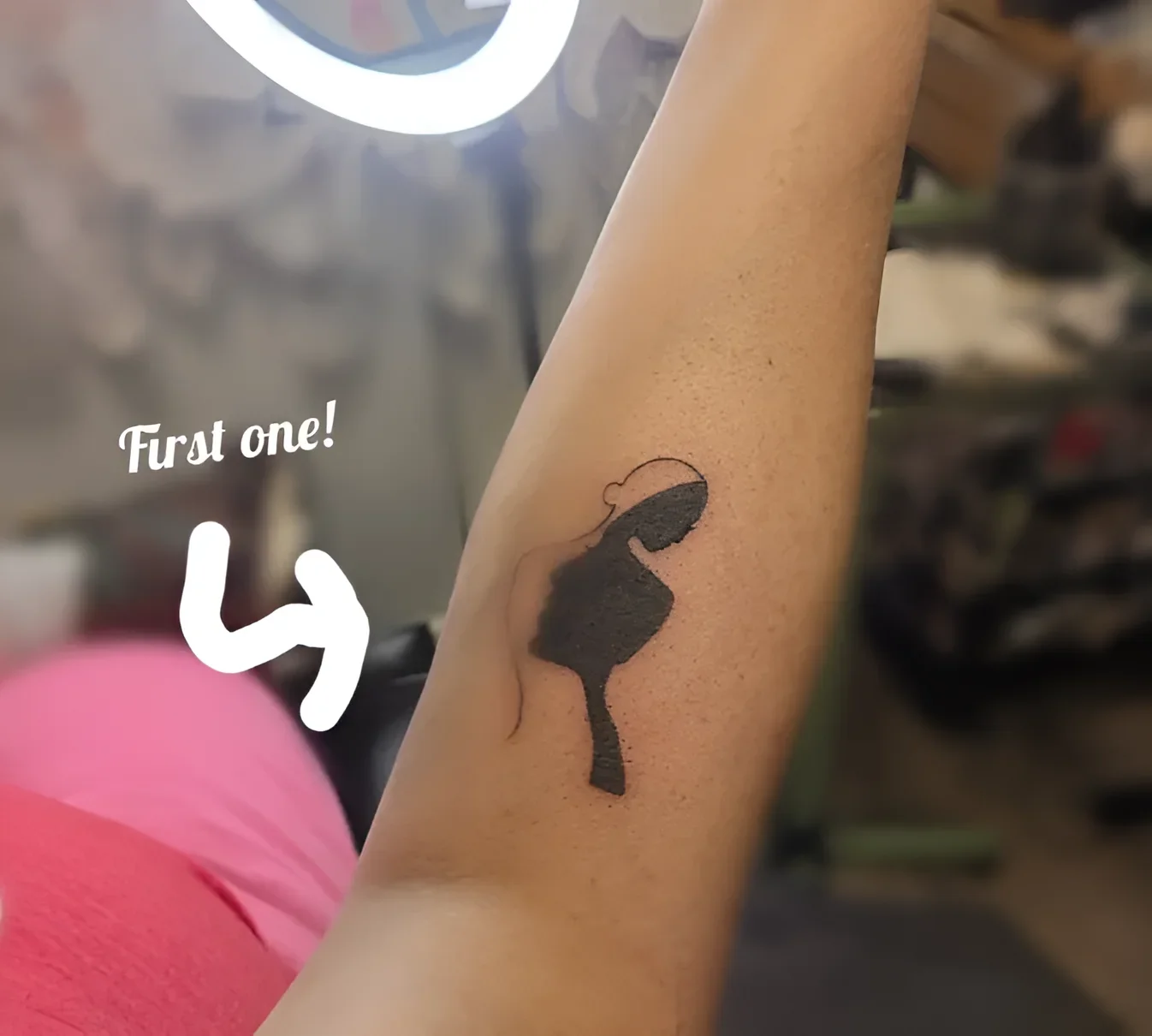
Interestingly, this is not Sue’s first tattoo. Back in December, she got her blog’s logo tattooed on the inner side of her right forearm, closer to the elbow – the tattoo faces her and reminds her of what she has accomplished and that she loves her work. The same artist, Zero, also did a new version of the logo, emphasizing support for the trans community. This means both tattoos are the result of a trusting relationship with the same artist, which, according to Sue herself, was decisive: after working together on the logo, she realized the time had come.
She describes the process honestly: yes, it hurt, her arm bled a little, but the most unpleasant part was holding her arm in one position for about two hours. Sue had been contemplating the tattoo for a long time, since she was thirty, but kept postponing it. Her friend Sarah, who also wanted a tattoo, became her “tattoo buddy,” and got her second tattoo in the same session.
Divorce, Cats, and Legal Reality
Behind the beautiful composition lies a difficult personal context. Due to her divorce, Sue is losing contact with her current pets – all the cats. According to the law, she reminds us, all animals are considered property, and the court has the right to divide them equally. Since she will not have housing, she herself found homes for three cats that her ex-partner planned to give away. Visiting them without a strong incentive, she says, will be difficult when she is focused on her own survival.
This is precisely why the tattoo becomes a kind of memory insurance: it cannot be taken away during the division of property. Sue asks her readers to support her Legal and Living Expenses Fund – for a lawyer, food, and safe housing – and turns a personal story into a public appeal. The story has a warm ending: as she types the text, the cats look at her reproachfully because their “red dot” has run out of time. A small everyday detail that makes the whole story come alive.
For tattoo culture, Sue’s case is telling: the tattoo here is not an adornment or rebellion, but a tool of memory, a way to maintain a connection with those we loved when life itself no longer allows us to keep them close. And in this, perhaps, lies the greatest strength of minimalist narrative works – they grow with the person and are not afraid of time.