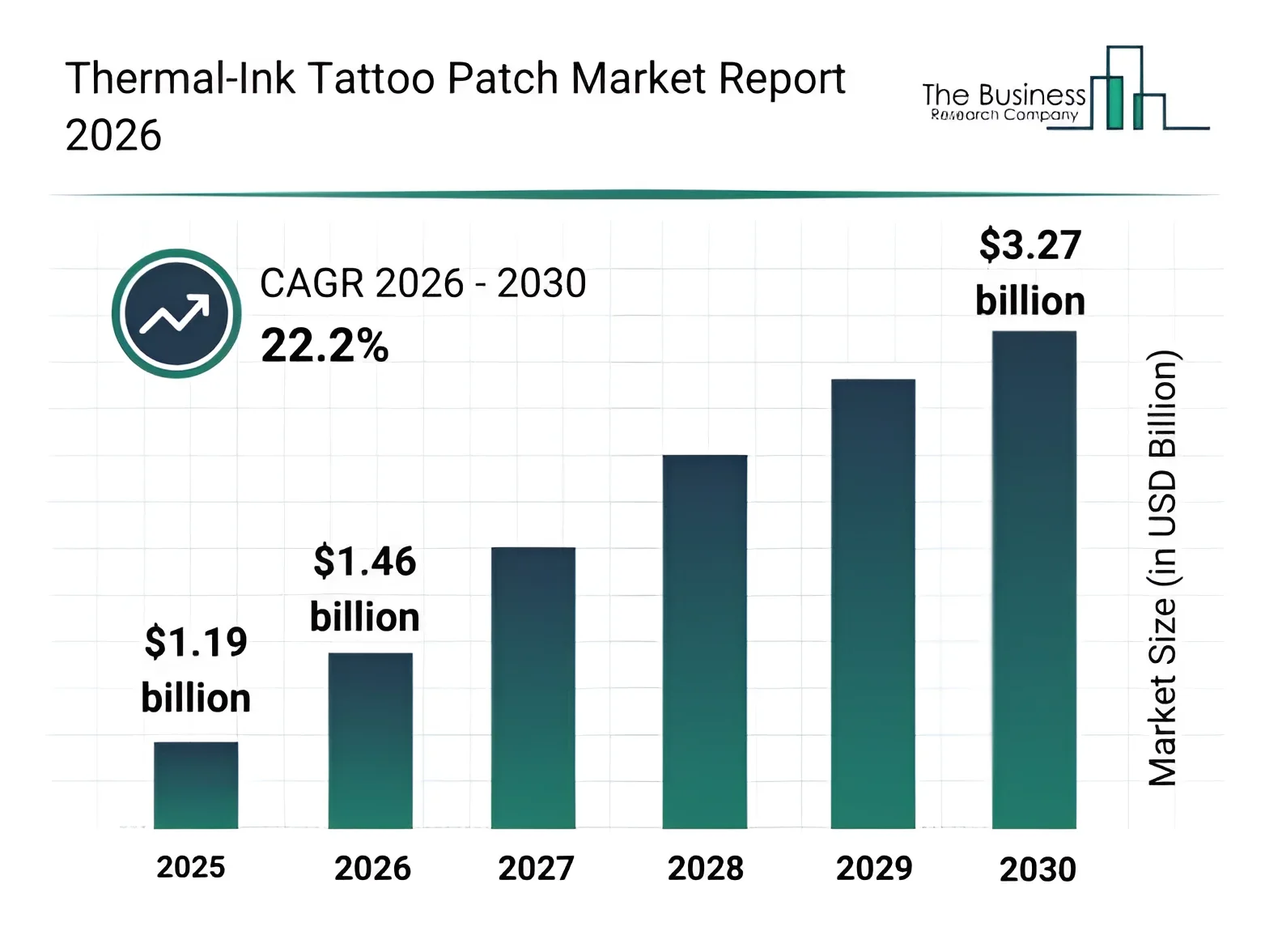
The line between tattoo culture and wearable electronics is blurring before our eyes. What was once perceived as a fun festival accessory is today transforming into a full-fledged medical monitoring tool. We’re talking about thermo-sensitive tattoo stickers – thin films with a thermochromic ink layer that change color in response to skin temperature changes. According to a recent industry report, this segment is experiencing explosive growth: while its valuation was $1.19 billion in 2025, it will rise to $1.46 billion in 2026, and by 2030, it is projected to reach $3.27 billion. The compound annual growth rate for the period 2026–2030 is estimated at 22.2%, and the transition from 2025 to 2026 is characterized by even higher dynamics – 22.5%.
Market Scale and What Lies Behind the Numbers
Such a trajectory is not accidental. In recent years, thermo-sensitive patches have become a mass-market product due to several simultaneous shifts: the popularization of non-invasive temperature measurement, the boom in wearable gadgets, the growing interest in continuous health monitoring, and the strengthening of the preventive medicine model. The sports segment stands out separately, where such stickers are used to control overheating and recovery. It is the combination of “medicine plus fitness plus fashion” that makes the market so sustainable: the product integrates into people’s habits rather than requiring them to change their lifestyle.
Key Growth Drivers
Analysts highlight several factors that will fuel demand in the coming years:
- personal diagnostics – integration of thermochromic stickers into individual health monitoring schemes;
- real-time remote monitoring, including for pediatrics and elderly care;
- expansion of applications in consumer wellness products and in manufacturing, where temperature control is critical for safety;
- technological breakthroughs: new thermochromic inks, flexible and stretchable electronic circuits, smart sensors, and AI-driven skin data analytics.
Importantly, demand is not only generated by clinics. The average user values simplicity: the sticker just needs to be applied to the skin, and it provides feedback without needles, wires, or complex calibration. For the tattoo industry, this is a signal: the aesthetics of temporary tattoos are becoming carriers of function, not just visual effect.
Who is Playing in This Field
The market is heterogeneous: giants of the chemical and cosmetic industries coexist with niche studios specializing in temporary tattoos. Leading players include L’Oréal S.A., Henkel AG & Co. KGaA, Rotex Global Inc., and Grifoll Print Promotions S.L. Specialized brands are also actively developing: Chaotic Moon Studios, Tattoo Manufacturing International, Inkbox Ink Inc., Tattly, Savvi LLC, Prinker Korea Inc., TattooFun Inc., Ephemeral Tattoo Inc., Momentary Ink, MC10 Inc., Conscious Ink, and SafetyTat LLC. Competition here is built around three axes – product development, partnerships, and distribution expansion.
Market Segmentation
For ease of analysis, the market is divided along several axes. By product type, disposable and reusable stickers are distinguished. Disposable ones include single-use temperature indicators, diagnostic ink patches, single-application heat-sensitive stickers, and single-session sensors. Reusable ones are reprogrammable, washable, and durable versions that can be used repeatedly. By sales channels, direct sales, distributors, and online channels dominate. By application areas, the product operates in medical monitoring, fitness and wellness, fashion, and cosmetics. End-users include hospitals and clinics, sports and fitness centers, as well as private individuals.
A Look at the Context
For tattoo culture, this trend signifies a paradigm shift. Temporary tattoos are ceasing to be a “light” alternative to permanent ones and are transforming into a functional interface between the body and data. This opens up space for collaborations: tattoo studios can offer not only designs but also “smart” stickers with diagnostic functions, and wellness brands can integrate tattoo aesthetics into their products. However, the main challenge remains – trust. The buyer must be confident that the inks are safe for the skin and that the data is accurate. This is precisely why the report emphasizes the focus on research into biocompatible materials and flexible electronics. If these areas develop at the expected pace, by 2030, the thermo-sensitive tattoo sticker will become as common an attribute of self-care as a fitness tracker is today.