
Aviation is not just a profession or a hobby; it is a calling that requires absolute dedication, courage, and deep respect for the elements. For pilots, mechanics, and other flight crew members, a tattoo becomes more than just decoration. It is a profound, often sacred, symbol of experienced journeys, overcome challenges, and an eternal connection to the sky. In this expert guide, we will delve into the unique world of aviation tattoos, their meanings, styles, and the cultural context that makes them so important to those who command winged machines.
Aviation Tattoos for Pilots: Taking Flight into the World of Symbolism
An aviation tattoo is a personal manifesto. It testifies to belonging to an elite community where precision, self-control, and the ability to make decisions at critical speeds are valued. For a pilot, such a tattoo serves as an anchor, reminding them of the ground during long flights, and a charm that, according to old traditions, helps them return home.
When choosing a design, pilots rarely settle for just a pretty picture. Every element—from the type of aircraft to the navigation instrument—carries a deeply personal or professional meaning:
- Reflection of Career: An image of a specific aircraft model (e.g., F-16, Boeing 747, or Mi-8 helicopter) on which the pilot has spent most of their flight time.
- Mission Memorabilia: Tattoos dedicated to specific squadrons, combat missions, or important civilian flights.
- Personal Charms: Symbols associated with luck, safety, and overcoming challenges (e.g., antique compasses or swallows).
The History of Aviation Tattoos: From the First Aviators to the Present Day
The tradition of tattooing among aviators began almost simultaneously with the conquest of the sky itself. In the early 20th century, when aviation was an extremely dangerous and unpredictable endeavor, tattoos served several key functions—from purely practical to mystical.
Practical Necessity and Superstitions of World War I
The first pilots, especially during World War I, often got tattoos with personal identification information (blood type, first name, last name). This was done so that in case of a crash and the inability to identify the body, the pilot could be identified and buried with honors. This tradition quickly evolved into superstition.
- Wings and Propellers: Depicted as amulets, guaranteeing “returning wings” and uninterrupted engine operation.
- Stars and Compasses: Symbolized the ability to find the way home, even if navigation instruments failed.
The Golden Age of Aviation and World War II
During World War II, aviation tattoos experienced a real boom, especially among military pilots. It was during this period that the classic traditional (old school) style emerged, with its bright colors and bold outlines. Tattoos served not only as charms but also as markers of brotherhood and shared experiences.
The most popular motifs of that era included:
- “Pin-up” girls on bombs or aircraft: A symbol of good luck, a reminder of home and feminine beauty awaiting their return.
- Skulls in helmets: A common motif among fighter pilots, symbolizing fearlessness in the face of death and a readiness for risk.
- Depictions of the “Lucky Spirit”: Often cartoon characters or mythical creatures believed to sit on the wing and protect the aircraft from “Gremlins” (mythical pests).
Meanings of Aviation Tattoos: What They Symbolize for Pilots

The symbolism of aviation tattoos is multifaceted and depends on the type of flying (civilian, military, sport) and the pilot’s personal experience. We will explore the most common motifs and their profound meanings.
Wings and Emblems
Wings are undoubtedly the most universal and powerful symbol in aviation. However, their execution and context can vary significantly:
- Pilot Wings: An exact depiction of the official badge awarded upon completion of flight school. Getting this symbol tattooed is the highest form of pride and a confirmation of professional status. Sometimes pilots get wings tattooed around their heart, symbolizing that flight is a part of their soul.
- Wings of Icarus: Less common, but they appear. They serve as a reminder of the importance of caution, adherence to rules, and respect for limitations (not flying too high or too low).
- Wings with a Skull or Sword: Characteristic of military pilots. They symbolize readiness for combat and the defense of the skies.
Specific Aircraft and Navigation Instruments
The depiction of an aircraft is not just a tribute to the machine; it’s a reflection of an entire era or a specific mission.
| Motif | Symbolism for the Pilot | Context |
|---|---|---|
| Specific Aircraft Model (with tail number) | Loyalty, personal experience, a “combat buddy” on which thousands of hours have been flown. | Civilian or military aviation. |
| Attitude Indicator | Balance, stability, ability to orient oneself in any conditions, even with zero visibility. | A critically important instrument for instrument flight. |
| Compasses and Wind Roses | Hope for return, correct course, ability to make sound decisions. | A classic maritime and aviation charm. |
| 10,000-Hour Mark | Mastery, experience, membership in the “club” of highly skilled professionals. | A symbol often stylized as a patch or medal. |
Numbers and Dates
For pilots, numbers hold immense significance: altitude, speed, coordinates. Tattoos often immortalize:
- Coordinates: The location of the first solo flight, an important landing, or the birth of children.
- Tail Numbers: The number of an aircraft that became significant in their career.
- Flight Altitude: A number reflecting the maximum altitude reached on a critical or record-breaking flight.
Popular Styles of Aviation Tattoos: From Realism to Old School
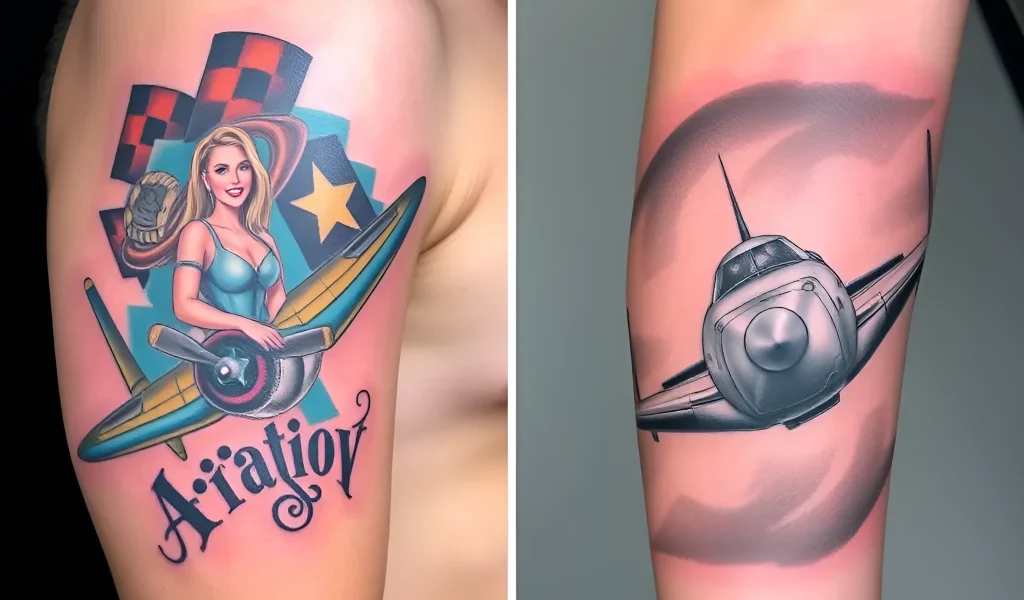
The chosen style for an aviation tattoo determines its mood, visual weight, and longevity. Pilots typically prefer styles that either convey the aircraft with maximum accuracy or possess classic symbolic power.
1. Realism (Photorealism)
Realism is the choice for those who want to immortalize a specific aircraft with maximum precision. This style requires high skill, especially in rendering metallic surfaces, rivets, and shadows. Realistic tattoos often depict:
- Aircraft Portraits: A detailed profile of a fighter jet or a close-up of the cockpit.
- Scenes in the Clouds: Images of an aircraft breaking through cloud cover with dramatic lighting.
- Monochromatic Realism: Black and gray works that emphasize the technical complexity and power of the machine.
Expert Tip: Realism is ideal for showcasing a specific, recognizable piece of machinery but requires a large area for placement (shoulder, thigh, back).
2. Traditional (Old School)
Old school is a style historically associated with aviation, particularly from the 1930s to 1950s. It is characterized by bold outlines, a limited color palette (red, yellow, green, black), and solid fills. Old school aviation tattoos often serve as charms:
- Wings with a Ribbon: A classic motif with an inscription (e.g., “Fly High” or a call sign).
- Airplane in Flight: A stylish, simplified silhouette of a vintage aircraft or bomber.
- Heart Pierced by a Propeller: A symbol of love for the sky and flying.
3. Graphics and Blackwork
Modern pilots often opt for graphics or blackwork for their minimalism and clarity. These styles are excellent for depicting:
- Schematics and Blueprints: An image of an engine cross-section, a turbine, or an aircraft blueprint rendered with fine lines. This emphasizes respect for engineering precision.
- Minimalist Silhouettes: Clean, geometric depictions of an aircraft or flight path.
Ideas for Placing Aviation Tattoos: Where Best to Depict Your Passion for the Sky

The choice of placement for a pilot’s tattoo is often dictated not only by aesthetics but also by uniform regulations and symbolic meaning.
Forearm and Bicep: Visibility and Pride
The forearm is one of the most popular locations. A tattoo here is easily visible when the pilot shakes hands or salutes. This area is ideal for:
- Wings or Squadron Emblems: Symbols that the pilot is proud of and wants to display.
- Navigation Instruments: Compasses or attitude indicators placed so they are easily visible, as a reminder of the course.
- Cuff Tattoos: Designs that encircle the forearm, mimicking, for example, a horizon line or a flight path.
Chest and Ribs: Personal and Sacred Meaning
Tattoos on the chest and ribs often carry a more personal and profound meaning, as they are closer to the heart and hidden beneath the uniform.
- An airplane flying towards the heart: A symbol of the love for the sky that drives the pilot.
- Large Compositions: The ribs can accommodate elaborate scenes of aerial combat or complex aircraft blueprints.
- Names of Loved Ones or Dates: Often accompanied by wings or clouds, symbolizing that family is what the pilot returns to the sky for.
Back and Shoulder Blades: Scope and Scale
The back is an ideal canvas for large, detailed works. Shoulder blades are traditionally used to depict wings, as if they are growing from the pilot’s body. This area allows the artist to work with maximum scope, depicting:
- Full-Scale Scenes: Aerial combat, flight over mountain ranges, or a stylized world map with flight paths.
- Technical Drawings: A detailed aircraft plan rendered in a graphic style.
Tips for Choosing a Design and Artist for an Aviation Tattoo
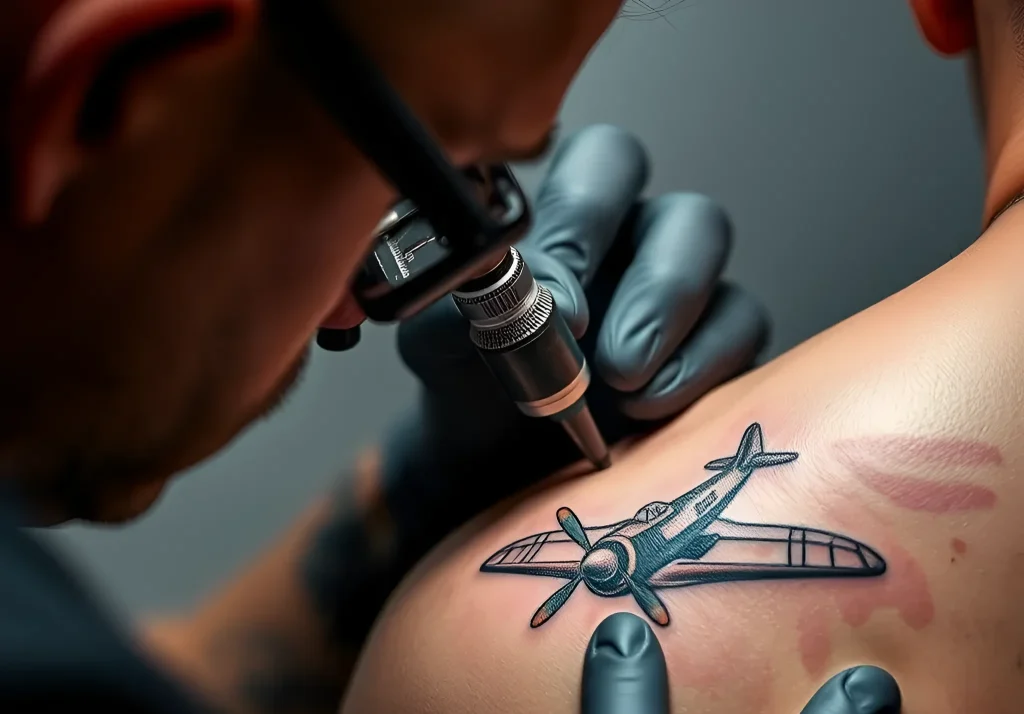
Since aviation tattoos often require high precision (depicting machinery, maintaining proportions), the process of choosing a design and an artist should be particularly thorough.
1. Technical Accuracy First
If you plan to depict a specific aircraft model, ensure the artist understands the fundamentals of technical drawing. An inaccurate wing angle, incorrect landing gear placement, or a distorted silhouette can ruin the impression and draw criticism from the aviation community.
- Use References: Provide the artist with photographs and, if possible, engineering drawings of the chosen aircraft.
- Check Proportions: During the sketch phase, carefully examine whether the drawing matches the real proportions of the aircraft.
2. Choosing a Style and Artist
The tattoo style should match your vision and the artist’s skills. If you want realism, look for a specialist whose portfolio is filled with works featuring machinery, not just portraits. If it’s old school, you need an artist who perfectly masters the technique of bold outlines and solid fills.
Important Questions for the Artist:
- “Have you worked with technical or aviation themes before?”
- “Which style (realism, graphics, old school) do you consider your primary one?”
- “Can you guarantee the preservation of small details (e.g., rivets or inscriptions) after healing?”
3. Integrating Symbolism
The best aviation tattoos combine machinery with personal symbolism. Discuss with the artist how to incorporate additional elements important to you into the aircraft depiction:
- Flight Path: A thin line can be used passing through the aircraft, symbolizing your career path.
- Clouds and Weather: Depicting storm clouds can symbolize overcome difficulties, while clear skies represent success and tranquility.
- Flags and Emblems: Adding a national flag or squadron emblem to emphasize patriotism or affiliation.
Frequently Asked Questions About Aviation Tattoos (FAQ)

1. Are there restrictions on tattoos for pilots in civil aviation?
Most major civil airlines (as well as military aviation) have strict rules regarding the visibility of tattoos. Generally, tattoos should not be visible when the pilot is in standard uniform (long-sleeved shirt, trousers). This means tattoos on the face, neck, and hands are usually prohibited. Forearm tattoos are permissible if they can be covered by a sleeve.
2. Can you get a tattoo of a current military aircraft?
Yes, this is a common practice. However, if you are not a member of the relevant unit, using official logos, patches, or protected symbols may be unethical or even violate copyright laws. It is recommended to use stylized images or tail numbers that have personal significance, rather than exact copies of official insignia.
3. How durable are the small details on navigation instruments?
The durability of small details (e.g., numbers on dials, fine lines of a blueprint) depends heavily on the style and quality of the work. In realism or graphics, small elements can blur or merge over time. To prevent this, it is essential to choose an artist experienced in micro-detailing and opt for slightly enlarged elements so that there is enough space between the lines for healing.
Interesting Facts About Aviation Tattoos and Pilots
The culture of aviation tattoos is rich with unique traditions and superstitions that are still alive among flight crews.
Fact 1: “Gremlins” and Protection
During World War II, the legend of “Gremlins”—small pests that caused aircraft malfunctions—was born. Many pilots got tattoos depicting cartoonish, benevolent creatures or strong animals (eagles, panthers) as “anti-Gremlins.” It was believed that the tattoo protected vital parts of the aircraft, and thus, the pilot himself.
Fact 2: The “Around the World” Flight Tattoo
There is an unofficial tradition among pilots who have completed a circumnavigational flight (or flown through all meridians) to commemorate this achievement. The tattoo can be a stylized map encircling a limb or an image of an aircraft flying over the globe. It is a symbol of ultimate mastery and overcoming vast distances.
Fact 3: “Lost” Aircraft
Among military pilots, especially those who have participated in conflicts, there is a tradition of getting tattoos depicting the silhouettes of aircraft lost in combat or crashed. This is not a symbol of failure but a tribute to fallen comrades and a reminder of the high price paid for service. Often, the date of loss is indicated next to the silhouette.
Fact 4: Two Swallows
Although swallows are traditionally associated with sailors, they quickly migrated into aviation culture. For a pilot, a swallow (or two swallows) symbolizes a safe return. The superstition holds that if a pilot dies, a swallow will carry his soul to heaven. Two swallows often signify that the pilot has flown over 10,000 miles (or hours), which is a significant professional achievement.
Aviation tattoos are a powerful way to express identity and devotion to the sky. By choosing such a symbol, you are not just decorating your body but inscribing your personal story of flight, courage, and professionalism onto your skin.