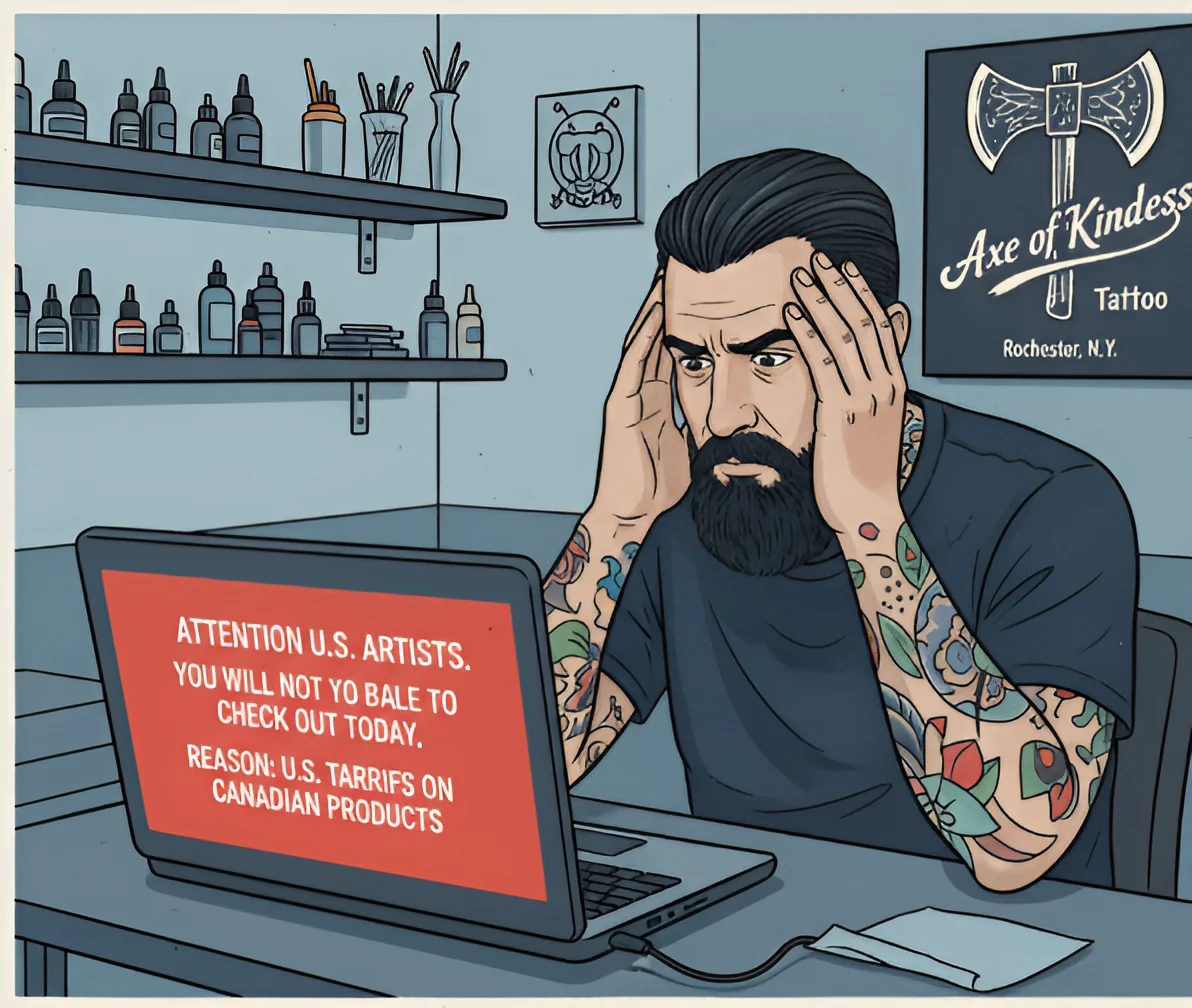
Major tattoo parlors in the United States are facing unprecedented logistical challenges. Studio owners are being forced to urgently seek alternative supply sources, as Canadian distributors, who traditionally supplied the American market with high-quality consumables, have completely stopped shipments. The reason is a protracted trade conflict and the tariffs on Canadian goods imposed earlier this year by the Trump administration. This situation, recorded on October 27, 2025, is dealing a tangible blow to the stability of an entire segment of the industry.
Trade Barriers: How It Looks in Practice
A problem that until recently seemed like mere abstract political rhetoric has sharply materialized in the form of an empty warehouse and a notification on a screen. This was reported by Adrien Moses Clark, owner of Axe of Kindness Tattoo studio in Rochester, New York.
Clark, whose professional career spans over two decades, is accustomed to relying on trusted northern partners. Canadian suppliers often offer a unique combination of quality and competitive pricing, which is critically important for professionals working in the premium tattoo art segment.
“I was stunned when I saw this,” Clark recalls the moment he tried to place another order with his long-term partner. Instead of the usual payment form on the website, a stern message appeared: “Attention, American artists. You will not be able to place an order today.” The reason was stated directly: American tariffs on Canadian products.
“It definitely caused a bit of chaos and scrambling,” Clark admits. When you have to urgently find replacements for specialized and specific materials, it’s not just a logistical glitch, it’s a direct threat to the continuity of the workflow.
The Economics of Quality: Why Canadian Suppliers Gave Up
For the tattoo industry, where the quality of pigments, sterility of needles, and reliability of equipment are not just a matter of convenience but a standard of safety and artistic integrity, the sudden disappearance of key suppliers is a catastrophe. Clark regularly ordered goods from two Canadian distributors, citing their high quality and favorable pricing policy, which has now been completely destroyed.
The problem is that the tariffs imposed by the US have sharply increased import costs. Canadian companies have stated that they can no longer absorb these financial costs themselves. If previously they could offset duties through volume or minimal markups, now, apparently, trading with the US has simply become unprofitable.
The situation has been exacerbated by political pressure. Trump announced plans on Saturday to increase tariffs on Canadian goods by another 10%. This move was a response to anti-tariff television advertising launched by the province of Ontario. Such an escalation of the trade war effectively closes the possibilities for resuming supplies in the foreseeable future.
- Reasons for stopping shipments: Canadian suppliers refuse to absorb rising tariff costs.
- Political background: Threat of a 10% tariff increase due to Ontario’s retaliatory advertising.
- Result: Shortage of high-quality consumables in the US.
Expert Analysis: The Tattoo Artist Pays for Their Reputation
In tattoo culture, the choice of tools and pigments is part of the creative process, almost a religious ritual. Artists spend years honing their work with specific brands, knowing how the ink will behave during healing or how a particular needle configuration will lay into the skin. Being forced to switch to other, often less proven American alternatives, even if they are more expensive, carries risks for the final result.
Adrien Moses Clark notes that price increases are already noticeable. “I’ve definitely seen an increase in the cost of some items,” he says. Despite Clark, anticipating the general trend, having replenished his stock in advance before the tariffs came into effect, he admits he did not expect a complete cessation of supplies. “No, not at all. I didn’t anticipate this turn of events.”
The most interesting aspect of this situation is the artist’s reaction. Clark was able to find some necessary items from American suppliers, albeit at an inflated price. However, he categorically refuses to pass these increased costs on to his clients.
“My price, what I charge, is based on my experience and my skill level,” Clark explains, articulating a crucial principle of a professional tattoo artist. “It doesn’t depend on the cost of my consumables. If I incur losses on materials, then so be it.”
This approach reflects the ethics of many old-school tattoo artists: the price of work is the price of art and experience, not just a calculation of material costs. The studio is willing to “take the hit” to maintain client loyalty and trust, and most importantly, not to compromise on quality, which could suffer from the use of cheaper or unproven alternatives.
Cultural Context: The Art of “Going with the Flow”
For the tattoo industry, which has historically always been on the periphery of the official economy, the ability to adapt to external shocks is a key skill. Whether it’s sudden changes in pigment regulations or logistical disruptions, artists have always found a way to continue working.
Clark perceives the tariff crisis as a temporary inconvenience, not a fatal business collapse. “Usually, I just take life’s punches and go with the flow,” he concludes. This philosophy – “roll with the punches” – is an integral part of tattoo culture, where improvisation and resilience are valued no less than perfect technique.
Nevertheless, if the trade war continues and tariffs increase by another 10%, studios like Axe of Kindness Tattoo, which prioritize quality over profit, will find themselves in an extremely difficult situation. Increased costs could force even the most resilient artists to either raise prices or, worse, seek cheaper and possibly less safe consumables, jeopardizing the standards of the entire industry.