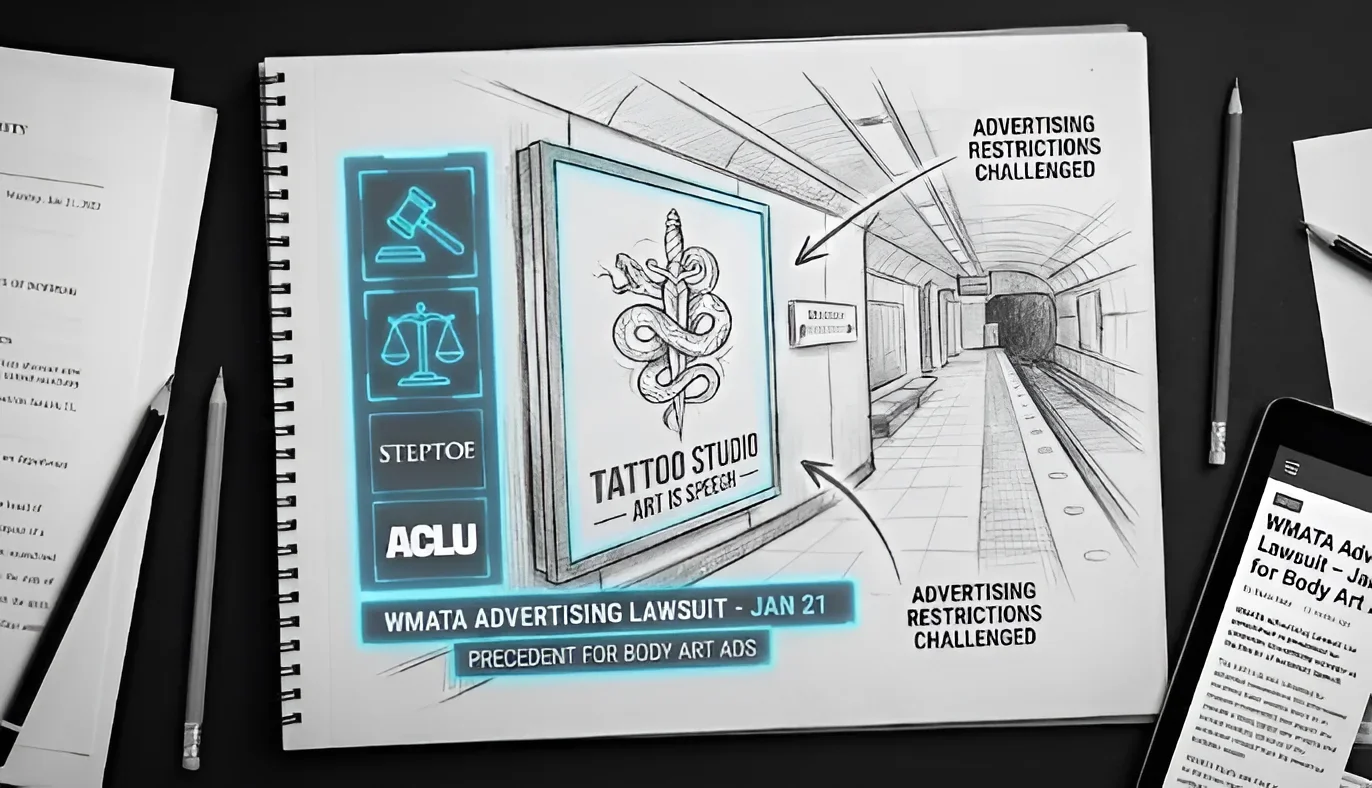
The global tattoo industry is entering an era of strict legal transformation, where the fight to be recognized as a legitimate art form is moving from studios to courtrooms and the offices of Eurocrats. On January 21st, legal giant Steptoe, in conjunction with the American Civil Liberties Union (ACLU), initiated a high-profile lawsuit against the WMATA transport system, challenging discriminatory advertising restrictions. Although the lawsuit formally concerns freedom of speech on public transport, this event holds sacred meaning for the tattoo community: it sets a precedent that will allow tattoo parlors and body modification artists to advertise their services on par with hairdressers or art galleries, moving out of the “gray zone” of public perception.
Advertising Blockade and Legal Breakthrough
The situation with the Steptoe lawsuit highlights an old problem in tattoo culture – stigmatization at the institutional level. WMATA’s restrictions, prohibiting the advertisement of “body services,” effectively equate tattooing with something shameful or dangerous. Industry experts emphasize that a victory in this case will send a powerful signal worldwide: tattooing is not just a service, but a form of self-expression protected by the constitution. In the context of marketing, this will open doors for large-scale campaigns by tattoo brands on municipal platforms, which was practically impossible before.
The European Knot: Pigments Under the REACH Microscope
While the US is fighting for the right to talk about tattoos, Europe is tightening the noose of chemical regulation by 2026. REACH and CLP regulations continue to evolve, creating new challenges for ink manufacturers. Regulators are primarily focused on PFAS (per- and polyfluoroalkyl substances), which are often found in durable pigments. By March 2026, the Committee for Socio-Economic Analysis (SEAC) will present an updated opinion on restricting these substances across the EU. For tattoo artists, this means another wave of “color famine,” where familiar shades may become illegal due to trace amounts of fluorine.
Light at the End of the Tunnel: The “Omnibus” Package and Simplified Rules
However, there is also positive news. In July 2025, the so-called “chemical omnibus” was introduced – a legislative initiative aimed at reducing the bureaucratic burden on businesses. For the tattoo and cosmetics industry, this could mean:
- The introduction of digital labeling, which will simplify things for pigment manufacturers who won’t have to print microscopic text on bottles.
- Relaxation of reporting requirements for small businesses.
- More flexible adaptation periods for new component bans.
These measures are projected to save the industry up to 363 million euros annually, which could theoretically slow down price increases for high-quality consumables.
British Drift: UK REACH and Uncertainty
The UK, after leaving the EU, continues to forge its own path. The UK REACH system, intended to be an analogue of the European one, currently only causes irritation among industry representatives. The deadlines for registering chemical substances have been postponed to 2029, 2030, and 2031. This creates a dangerous gap: the same inks may be legal in London but banned in Paris, and vice versa. For tattoo culture, this means market fragmentation – artists will have to more carefully check conformity certificates depending on their region of work.
Artificial Intelligence and Copyright in Tattoos
The entry into force of the AI Act in August 2026 cannot be ignored either. In the world of tattooing, where the generation of sketches by neural networks has become commonplace, new transparency rules will become mandatory. If an artist uses AI to create a design, they must clearly inform the client. Furthermore, control over the use of copyrighted images for training neural networks is being tightened, which could lead to a series of lawsuits from famous tattoo artists against tech giants.
Expert Analysis: What Should Artists Prepare For?
Analyzing the legal landscape of 2026, several key trends for the tattoo community can be identified:
| Area | Expected Changes | Impact on Tattoo Culture |
|---|---|---|
| Advertising | Lifting of bans in the US and growth of online promotion | Legitimization of business, influx of new clients |
| Chemistry (Ink) | Complete ban on a range of PFAS and TFA | Shortage of certain colors, price increase for “bio-inks” |
| Business | Implementation of CSDDD (responsible business conduct) | Verification of ethical supply chains for needles and equipment |
| Digital | Control over AI sketches | Protection of artists’ copyrights, transparency of the process |
2026 will be a watershed year between the “wild” tattoo market and a fully regulated industry. On one hand, we see state attempts to restrict the use of chemicals, which impacts artists’ palettes. On the other hand, powerful legal movements like the Steptoe lawsuit are restoring tattooing’s status as a high art form with the right to a voice in the public sphere. An artist’s professionalism will now be measured not only by the quality of their lines but also by their ability to navigate the complex world of certificates, regulations, and copyrights.