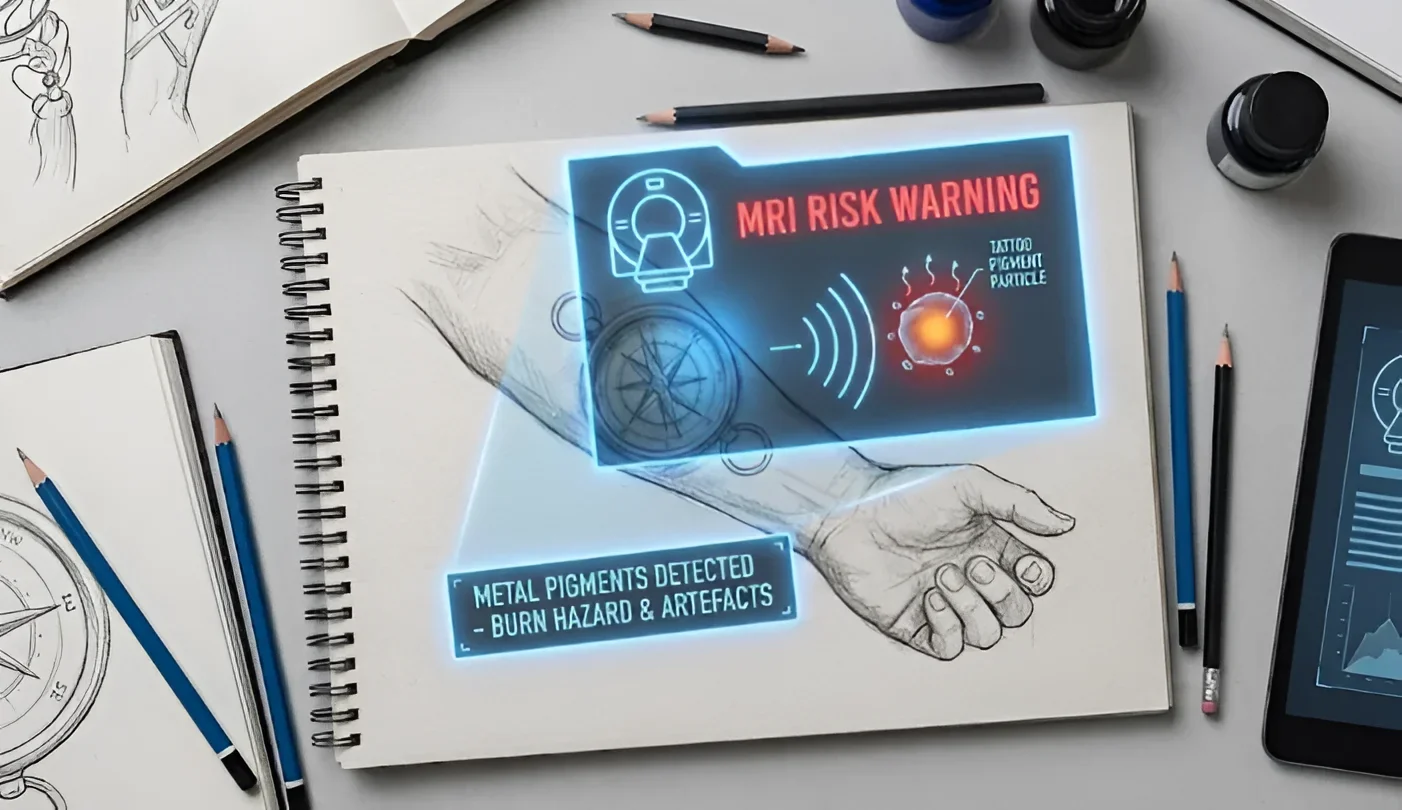
Modern tattoo culture is undergoing a period of deep integration into everyday life. However, the rapid rise in the popularity of body art is raising new questions for medical science. In late January 2026, the medical community was alarmed by a publication in the authoritative journal Anesthesiology News, where experts presented a detailed report on the risks of magnetic resonance imaging (MRI) for individuals with tattoos and permanent makeup. A problem previously considered hypothetical has now become a critical factor in preparing patients for diagnostic procedures.
The Physics of the Process: Why Skin Starts to “Heat Up”
The main threat during MRI for tattoo owners lies in the composition of the pigments used. Despite the trend towards organic formulations, many inks, especially those used several years ago or produced in countries with lax regulations, contain ferromagnetic particles – iron oxides and other metals. When exposed to the powerful magnetic field of the scanner, these microparticles begin to interact with radiofrequency pulses. Expert analysis shows that during the scanning process, an electromagnetic induction effect occurs, leading to localized heating of the pigment directly within the dermal layers. In the worst-case scenario, this results in first and second-degree thermal burns, which are strictly localized along the contour of the design.
Artifacts and Diagnostic Accuracy: An Invisible Barrier
In addition to physical discomfort and the risk of injury, there is another, more hidden problem – the distortion of examination results. Metallic inclusions in tattoos create so-called “artifacts” on MRI scans. These are areas of visual interference that appear as black spots or “blurring” of the image. For a radiologist, this becomes a nightmare: if a tattoo is located in the projection of the organ being examined (e.g., on the lower back when examining the spine, or on the face when scanning the brain), the artifact can completely obscure a pathology, tumor, or area of inflammation. Thus, the presence of a tattoo can render an expensive and vital examination practically useless, leading to an incorrect diagnosis.
Comprehensive Health Impact: What the 2026 Figures Say
The study, published on January 29, 2026, does not limit itself to MRI risks. Scientists conducted a deep analysis of the long-term effects of tattoos on the body, and the results give pause even to the most devoted fans of the industry. The accumulation of pigment particles in the lymphatic system is a proven fact: pigment migrates from the skin into nearby lymph nodes, which can provoke chronic inflammation and hinder the diagnosis of oncological diseases.
| Risk Factor | Identified Consequences and Statistics |
|---|---|
| MRI Procedure | Localized burns and image distortion (artifacts) |
| Oncological Risks | 29% higher probability of skin cancer development in individuals with large tattoos |
| Lymphatic System | Pigment accumulation in nodes, correlation with lymphoma risk |
| Immune Response | Possible weakening of vaccine effectiveness (including COVID-19) |
Impact on Immunity and Vaccination
One of the most unexpected conclusions of the report was the hypothesis about the potential impact of tattoo pigments on vaccination effectiveness. The constant presence of a foreign body (ink) in the dermis and lymph nodes keeps the immune system in a state of permanent tension. This “distracts” the body’s resources, which, according to preliminary data, may weaken the response to modern vaccines. Although this aspect requires further study, it has already become a topic of heated discussion in academic circles.
Recommendations for Clients and Artists
In light of the new 2026 data, safety culture in tattoo shops must reach a new level. Experts recommend adhering to several rules: firstly, always request the Material Safety Data Sheet (MSDS) for the inks used from the artist and ensure they do not contain heavy metals. Secondly, before undergoing an MRI, it is essential to inform the doctor about the presence of tattoos or permanent makeup, even if they appear old and faded. Modern scanners have special operating modes that reduce the risk of heating, but they are only effective when the staff is warned in advance. A tattoo today is not just an adornment, but a medical factor that must be considered throughout one’s life.