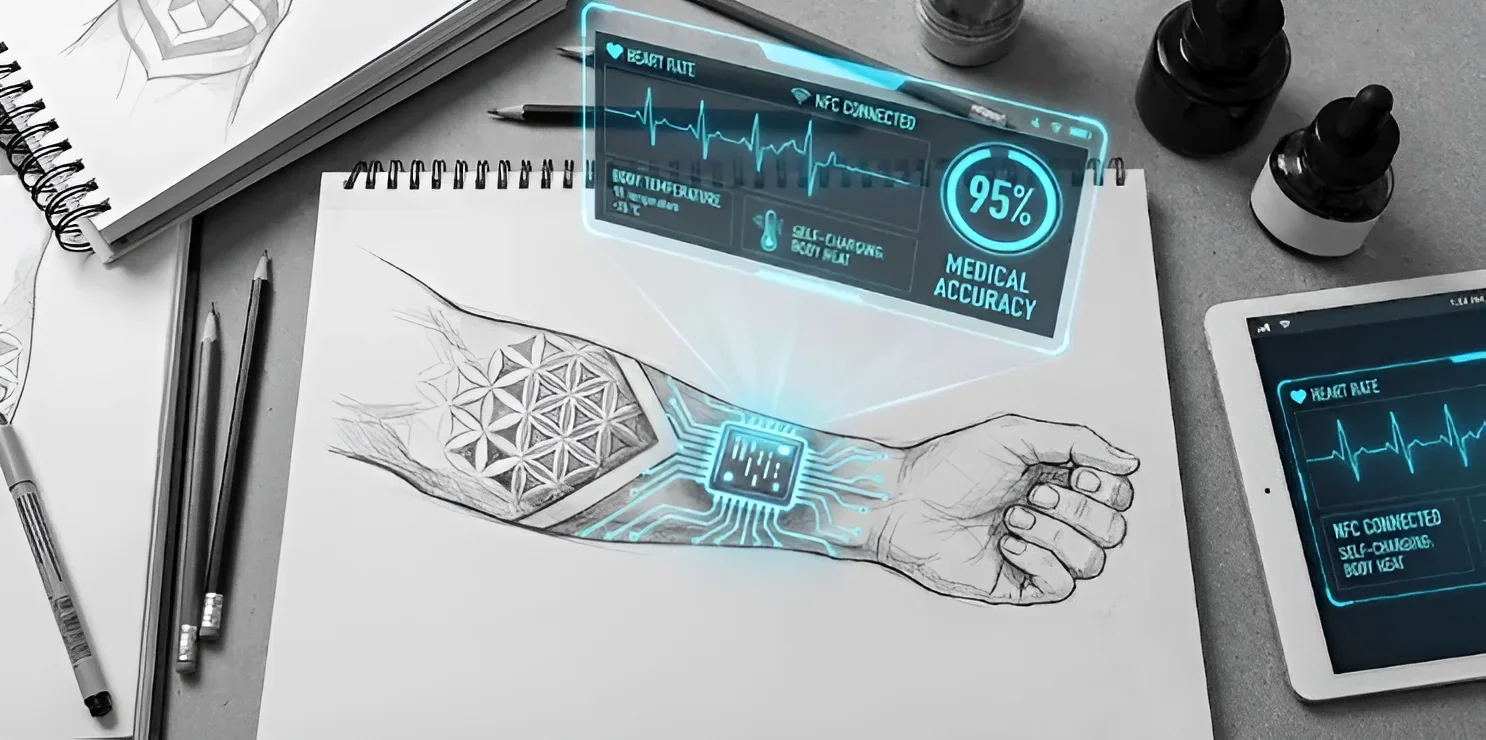
Modern tattoos are rapidly transforming from pure art into functional tools, blurring the lines between the human body and the digital world. If body art once served as a means of self-expression or a tribute to traditions, today we are witnessing the birth of a new era – the era of “smart” biometric tattoos capable of saving lives and replacing complex medical devices. These high-tech solutions turn the skin into an interactive interface that is always at hand, yet completely imperceptible in everyday life.
Technological Breakthrough: From Pigment to Nanosensors
According to a recent industry development report dated December 1, 2025, digital tattoos are no longer a concept from science fiction. The technology is based on ultra-thin flexible electronic patches and specialized conductive inks. Unlike bulky fitness trackers or smartwatches, such devices are integrated directly into the epidermis, becoming literally a “second skin.” To create these systems, engineers use advanced materials: graphene, carbon nanotubes, and conductive polymers. This ensures incredible flexibility and durability – the tattoo stretches and compresses with the skin without losing its properties.
Accuracy on the Verge of Fantasy: 95% Accuracy
One of the most impressive facts presented in the study is the accuracy of data reading. Modern prototypes of biometric tattoos demonstrate a 90-95% accuracy compared to professional medical equipment. This is a huge leap for wearable electronics. The sensors are capable of tracking in real-time:
- heart rate and rhythm variability;
- muscle activity and tension levels;
- body temperature with minimal error;
- biochemical markers in sweat, including glucose and lactate levels.
This level of detail makes smart tattoos an indispensable tool for people with chronic diseases, allowing them to manage episodes before they become apparent.
Energy from Nowhere: NFC and Human Body Heat
One of the main problems with wearable gadgets has always been the need for recharging. Smart tattoos solve this issue elegantly. Thanks to NFC (Near Field Communication) technology, data is instantly transmitted to a smartphone when the device is brought near. However, the use of triboelectric nanogenerators and energy harvesting systems from body heat appears even more promising. In essence, your body becomes a battery for the tattoo. Muscle movement and natural thermoregulation generate enough microcurrents to power the nanosensors 24/7, freeing the user from wires and the need to remember the charger.
Expert Analysis: How This Will Change Tattoo Culture
As experts from tatufoto.com, we see this not just as a technical novelty, but as a fundamental shift in society’s perception of tattoos. The traditional community might view “chipping” with apprehension, but it’s important to distinguish aesthetics from functionality here. Most likely, in the coming years, we will see a symbiosis: classic artistic works will be complemented by hidden technological elements. Imagine a biomechanical style tattoo where the “gears” are not just a drawing, but actual working pulse sensors.
| Characteristic | Traditional Smartwatch | Biometric Tattoo |
|---|---|---|
| Method of Wearing | Wrist strap | Applied to the skin (patch/ink) |
| Autonomy | Requires charging every 1-7 days | Self-charging from heat and movement |
| Monitoring Accuracy | Medium (depends on fit) | High (90-95%, direct contact) |
| Visibility | Obvious accessory | Invisible or integrated into the design |
Application Areas: From the Gym to the Metaverse
Besides medicine, enormous potential lies in professional sports. Coaches will be able to track an athlete’s hydration levels and muscle fatigue in real-time, preventing injuries. In the entertainment industry and VR technologies, such tattoos can serve as controllers: a slight movement of a finger on the forearm and your avatar in the metaverse performs an action. This is a new level of immersion, where the body becomes a manipulator.
Safety and Ethical Issues
Of course, integrating electronics into the skin raises safety concerns. Developers are relying on biocompatible materials that do not cause allergies or irritation. Most current solutions are temporary or semi-permanent, allowing for “upgrades” when new models are released. However, privacy becomes a primary concern: who owns the data about your heartbeat transmitted via NFC? Protecting biometric information will be the main challenge for lawmakers and programmers in 2026. Nevertheless, progress cannot be stopped – the tattoo of the future promises to be not only beautiful but also incredibly useful.