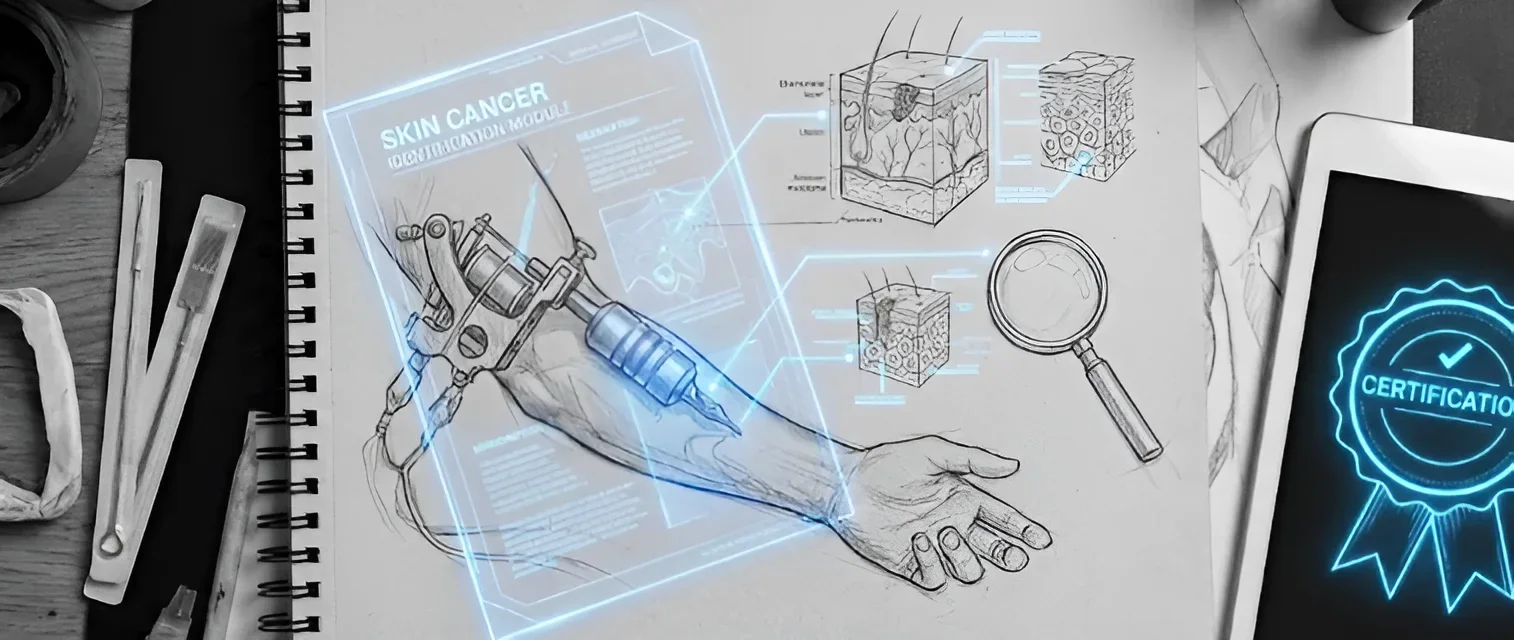
Contemporary tattoo culture is definitively ceasing to be a marginal art form, transforming into a high-tech industry at the intersection of aesthetics and evidence-based medicine. At the beginning of 2026, we are witnessing fundamental shifts that will affect every market participant – from a novice artist to the owner of a large studio, forcing a re-evaluation of approaches to safety and workplace technical equipment.
Medical Scrutiny: The Tattoo Artist as a Diagnostician
Since January 2026, revolutionary amendments to the legislation regulating the activities of tattoo artists and permanent makeup specialists have come into effect in Virginia, USA. Now, obtaining and renewing a license requires not only proficiency with a tattoo machine but also in-depth knowledge of clinical dermatology. A key innovation is the mandatory training hours on recognizing early-stage skin cancers. A tattoo artist, working with a client’s skin for many hours, effectively becomes the first line of defense in public health and epidemiological surveillance. The training program includes a detailed study of the visual signs of basal cell carcinoma, squamous cell carcinoma, and melanoma. In addition to the medical aspect, Virginia’s new standards strictly regulate knowledge of local regulatory frameworks, color theory, and human anatomy. This signals a global trend towards professionalization: the tattoo industry is striving for maximum transparency and clinical responsibility, gradually aligning with professional cosmetology.
Technological Breakthrough: From Temporary Solutions to Perfect Transfer
Concurrently with legislative changes, the technology sector is offering tools that are radically transforming the daily practice of studios. The Prinker S device opens a new niche – direct body printing. Unlike classic transfer printers, this gadget uses certified cosmetic inks for instant application of temporary designs directly onto the skin. In the context of professional work, this is an ideal tool for a “test drive” of a future tattoo. Clients can live with the design for up to three days, evaluating its placement, how it moves with the body, and its scale, before committing to a full session. For artists specializing in complex styles such as blackwork, ornamental, or dense tribal, the new S8 Tattoo Series 8 has become a real lifesaver. This device, developed in partnership with tech giant Brother, is specifically optimized for working with tattoo stencils and carbon compounds. Engineers have made hardware modifications that completely eliminate paper jamming issues when printing areas with extremely high contrast. The even distribution of the ink layer without the slightest smudge allows for the transfer of the most intricate details to the skin with surgical precision, which is critically important for maintaining clean lines during the tattooing process.
A Scientific Look at Pigments: The End of Biological Passivity
February 2026 became a landmark month for the scientific community. The publication of a series of clinical studies in toxicology has forced a new look at what happens under the skin after a tattooing session. For a long time, it was believed that tattoo pigments remained biologically inert, but new data refutes this myth. Researchers have discovered that ink particles actively interact with the immune system and are incorporated into the body’s metabolic pathways. This discovery changes the paradigm of safety: it is no longer just about sterile needles but also about the long-term impact of ink components on the lymphatic system. Expert analysis indicates that in the coming years, we will see a mass update of ink formulations from leading brands towards increased biocompatibility.
The Future of the Industry in Numbers and Facts
| Parameter | Old Standard | New Standard (from 2026) |
|---|---|---|
| Training | Hygiene and safety | Dermato-oncology, anatomy, law |
| Stencil Transfer | Manual or standard thermal printer | Specialized systems (Series 8) |
| Artist Status | Artisan | Aesthetic medicine specialist |
In conclusion, it can be stated that we are entering an era where tattooing is no longer just an act of self-expression. It is a conscious choice, supported by scientific data, the highest safety standards, and the artist’s deep expertise. For professionals, this means the necessity of continuous learning, and for clients, it means an unprecedented level of health protection and quality of execution.