Modern tattoo culture is undergoing a profound technical transformation, where the lines between classic craftsmanship and high technology are finally blurring. In the week beginning February 2, 2026, the professional equipment market was enriched with devices that set new standards for efficiency and precision. This is not just another update of model lines, but a full-fledged integration of artificial intelligence directly into the workflow of sketch preparation and its transfer to the skin. The main protagonists of this technological leap are intelligent stencil printers and a new generation of wireless rotary machines focused on maximum integration into the digital ecosystem of a modern studio.
Intelligent Transfer: How AI is Changing Session Preparation
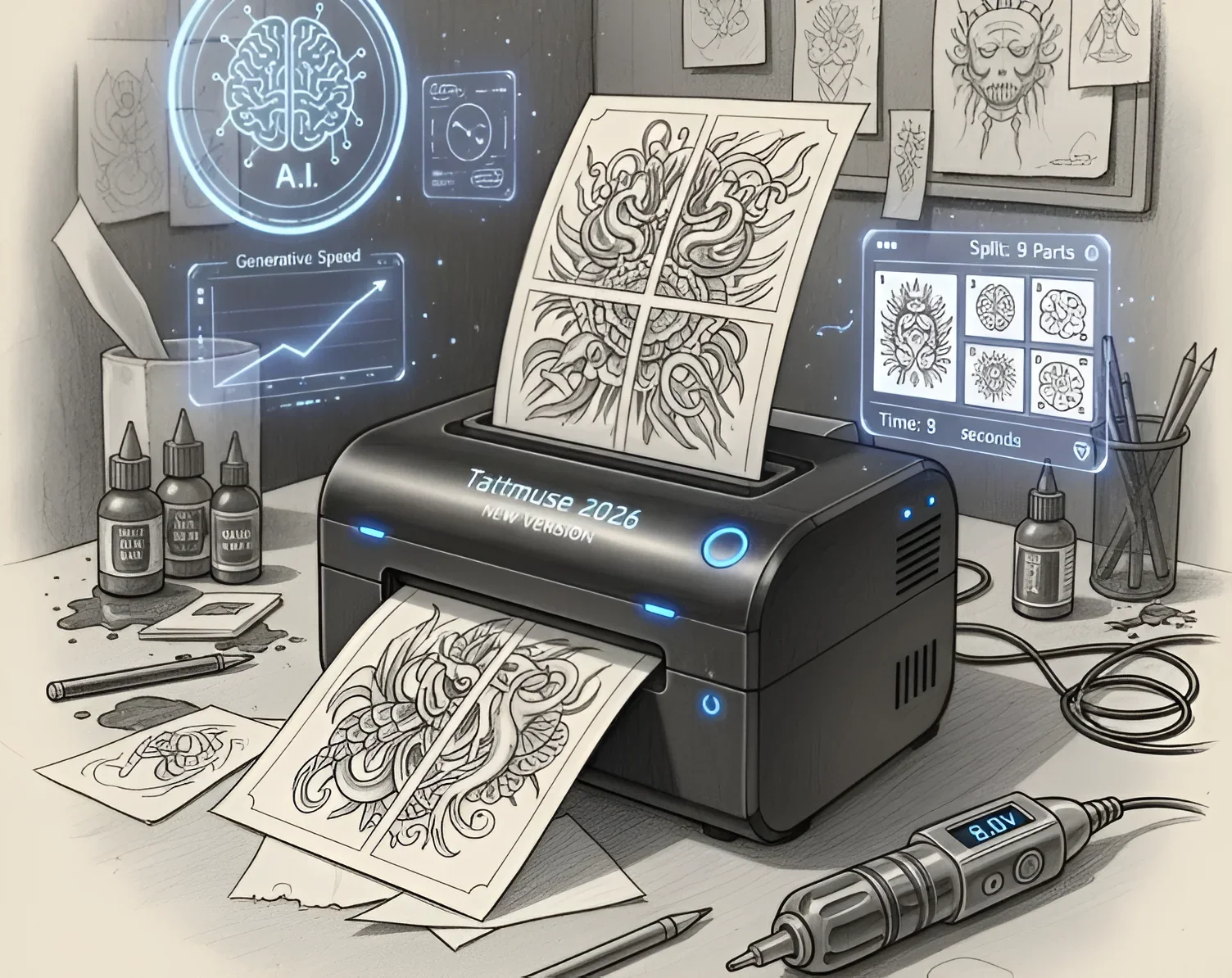
One of the most discussed innovations is the Tattmuse 2026 wireless thermal printer. Unlike its predecessors, this device is equipped with a built-in AI module that handles the most routine and labor-intensive part of the artist’s work – the technical preparation of a complex sketch for printing. The main challenge when working with large-scale projects, such as “costumes,” full back pieces, or intricate sleeves, has always been the manual division of the image into fragments for printing on standard transfer paper sheets. Tattmuse 2026 solves this problem in seconds, automatically breaking down detailed layouts into parts (up to nine segments) while ensuring perfect line alignment for subsequent transfer to the body.
Expert analysis shows that the integration of neural networks into printers is not just a marketing ploy, but a response to the industry’s demand for increased detail. AI can analyze the contrast and line density in a sketch, optimizing them for thermal printing so that the transfer remains clear and does not fade even after many hours of aggressive work. The use of Bluetooth connectivity allows projects to be sent for printing directly from tablets or smartphones, which finally frees up the artist’s workspace from unnecessary wires and the need for stationary PCs.
Technical Analysis of Ninja Nova: A New Standard for Wireless Machines
In parallel with innovations in printing, the hardware segment has introduced the Ninja Nova model – a wireless tattoo machine that embodies all the ergonomic and power requirements relevant for 2026. The device is based on a compact yet powerful 20×10 mm brushless motor with an impressive torque of 180 g/cm. This configuration allows the needle to enter any type of skin stably and confidently, minimizing excessive trauma and ensuring a solid fill or perfect outline on the first pass.
For professionals who work 6-8 hours a day, autonomy and weight balance are critical. The Ninja Nova weighs only 170 grams with dimensions of 130×34 mm, which prevents premature hand fatigue. The high-quality alloy casing effectively dissipates heat, and the noise level in the range of 43-45 dB makes the work process almost silent. This creates a calmer atmosphere in the studio, which is psychologically comfortable for both the artist and the client, especially during long sessions.
Below are the key technical specifications of the Ninja Nova model that set it apart from its competitors:
- Motor Type: High-efficiency brushless motor;
- Rotation Speed: 10,000 RPM at 8V;
- Operating Voltage Range: from 4.0 to 12.0 V with adjustment steps;
- Needle Stroke: Universal 4.0 mm in the base with the option to replace with 3.5 mm;
- Power Independence: 2000 mAh battery providing up to 8 hours of operation;
- Fast Charging: Full power recovery in 1.5 – 2 hours via USB-C port.
Impact on Tattoo Culture and Expert Forecast
The emergence of tools like Tattmuse 2026 and Ninja Nova signifies the industry’s transition into the era of “smart” equipment. If previously a tattoo artist spent up to an hour preparing and assembling a transfer for a large piece, this process is now reduced to a few minutes. The freed-up time can be directed by the artist towards creative refinement of details or more in-depth consultation with the client, which ultimately enhances the artistic value of the tattoo.
However, technological progress also sparks discussions within the professional community. Some experts believe that the excessive simplification of technical stages could lower the barrier to entry into the profession, allowing less experienced artists to take on complex projects. On the other hand, it’s important to understand: no artificial intelligence or the most advanced brushless motor can replace artistic vision, knowledge of anatomy, and a sense of style. The tools of 2026 merely eliminate technical barriers and routine, allowing the artist’s talent to fully unfold. Wireless technologies and intelligent image processing are becoming the new “hygienic minimum” for top studios striving for perfect results and client safety.