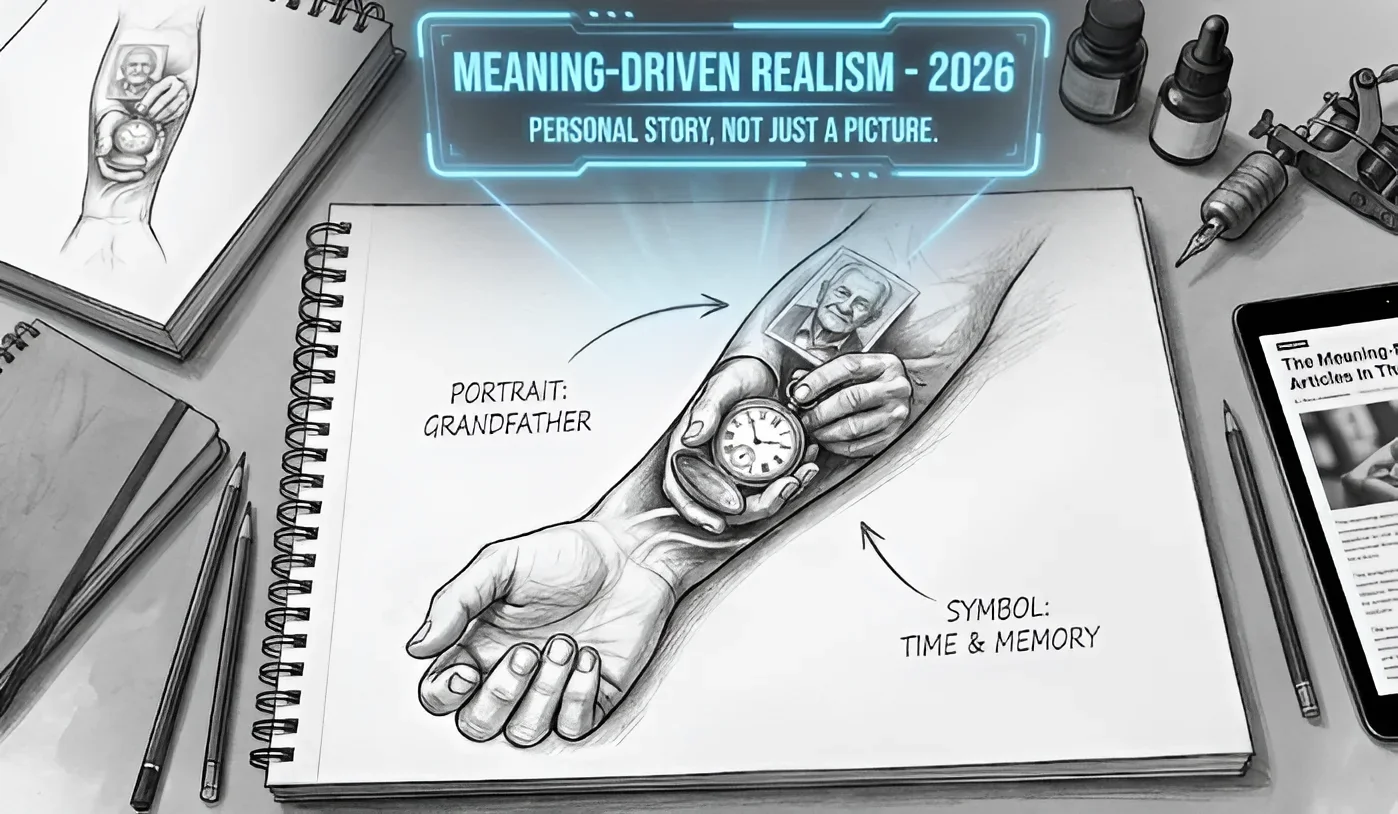
Modern tattoo culture is undergoing a massive transformation, moving from a purely aesthetic appreciation of body art to a deep philosophical and social statement. Today, we are witnessing the decline of the era of “just beautiful pictures” and the rapid rise of a concept that experts call “Meaning-Driven Realism.” This direction combines impeccable technical precision with a powerful emotional subtext, where every highlight and every shadow serves the purpose of telling the owner’s unique story.
Evolution of Style: From Copying to Storytelling
Meaning-driven realism is not just a photorealistic portrait or an image of an animal. It is a conscious choice of a subject that reflects key life milestones, spiritual quests, or a person’s cultural code. If previously clients of tattoo parlors often chose ready-made sketches from catalogs or social media, then in 2026, the focus has definitively shifted towards personalized design. People strive to immortalize not just beautiful images on their skin, but symbols of their achievements, memories of loved ones, and important life stages.
This shift in preferences directly affects the industry’s economy. The high-art permanent tattoo segment shows the highest growth rates in service costs. Masters who can not only “color” well but also act as visual biographers are becoming the most sought-after specialists in the market.
Market Analysis: Figures and Forecasts up to 2034
Financial indicators confirm that the tattoo industry has ceased to be a niche craft and has transformed into a globally investment-attractive sector. According to recent reports, the global standard tattoo market was valued at $2.14 billion in 2024. However, by 2026, this figure will grow to $2.58 billion, and long-term forecasts for 2033–2034 predict growth to an impressive $4.92 billion.
The high-growth segment deserves special attention, where complex realism and original works are the key drivers. Here, the numbers are even more optimistic: by 2034, the volume of this segment could reach almost $6 billion. The compound annual growth rate (CAGR) for the permanent segment is projected at 10.67%, indicating the industry’s incredible resilience to economic fluctuations.
| Market Indicator | 2024 (billion $) | 2025 (billion $) | 2026 (forecast) | 2033/34 (forecast) |
|---|---|---|---|---|
| Global Market (Standard) | 2.14 | 2.35 | 2.58 | 4.92 |
| Global Market (High Growth) | — | 2.43 | 2.66 | 5.99 |
| European Regional Market | — | 0.81 | 0.88 | — |
| US Regional Market | — | — | 0.45 | 1.25 |
The regional distribution is interesting: Europe holds a significant share in 2025 with a volume of $0.81 billion, while the US market shows potential for threefold growth – from $0.45 billion in 2026 to $1.25 billion by the middle of the next decade.
What Lies Behind Meaning-Driven Realism: Key Themes of 2026
Expert analysis shows that the popularity of this direction is driven by people’s desire to find solid ground through self-identification. In an era of digital instability, a tattoo becomes the only constant. Masters note five main themes that are most often chosen by adherents of meaning-driven realism:
- Life Milestones: marking pivotal moments that have changed a person.
- Personal Journey and Transformation: metaphorical depictions of overcoming difficulties or inner growth.
- Memory of Loved Ones: portraits and symbols that allow for maintaining an emotional connection with dear people.
- Achievements: visualization of triumphs, whether professional success or personal victory.
- Spirituality and Heritage: drawing on roots, religious symbols, or philosophical concepts that shape one’s worldview.
This trend is particularly attractive to those getting their first tattoo. Meaning-driven realism helps avoid the fear of an “accidental design,” as the tattoo is inherently imbued with deep personal meaning. Instead of loud and provocative images, people choose art that “warms the soul” and remains relevant for decades.
Professional Perspective: Why This Matters for the Industry
The shift to meaning-driven realism requires tattoo artists to have a fundamentally different level of preparation. Now, a master is not just an executor but a psychologist and conceptual artist in one. It is necessary to be able to listen to the client, extract the essence from their story, and translate abstract feelings into visual language. Technically, this also presents a challenge: working with subtle gradients, micro-detailing, and play of light requires modern equipment and deep knowledge of color theory.
In conclusion, it can be said that tattoos have definitively emerged from the shadows of the underground and solidified their status as high art. The market growth, supported by the pursuit of consciousness and individuality, makes meaning-driven realism not just a temporary fashion, but a foundation on which tattoo culture will be built in the next decade. For those planning to adorn their bodies, now is a golden age: the level of skill of artists and the depth of meaning exploration have reached their historical peak.