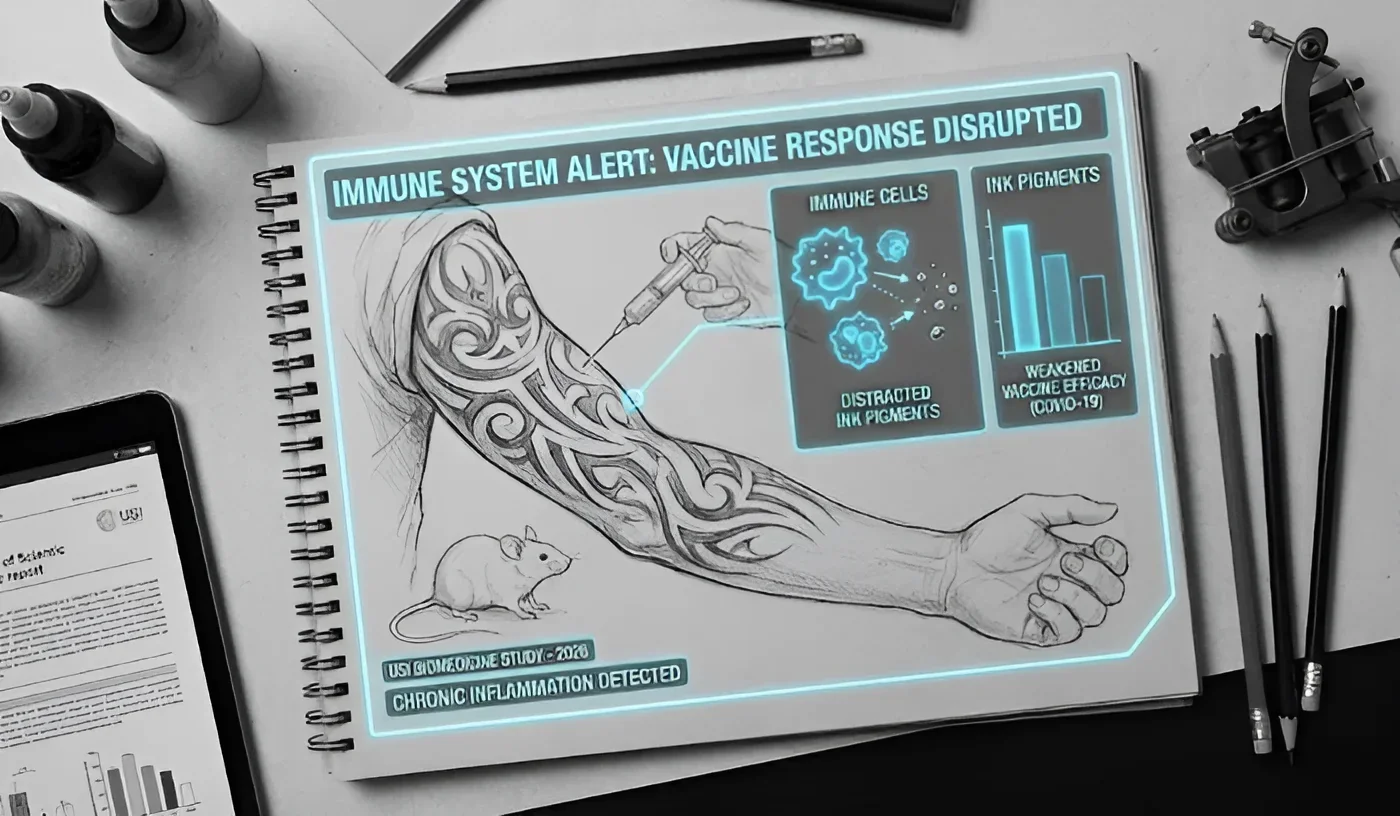
Modern tattoo culture has long ceased to be solely a matter of aesthetics or self-expression, becoming an object of close attention from fundamental science. While artists hone their realism techniques and clients choose designs, scientists are trying to understand how the presence of foreign pigment in the dermis affects the complex mechanisms of our immune system over the years. This week, the professional community was stirred by the results of a recent study conducted by specialists from the Institute of Biomedical Sciences (USI) in Switzerland. Experts have found that the usual process of wearing a tattoo creates a specific biological background in the body that can directly correct the effectiveness of modern vaccines, including those against COVID-19.
The scientific work, focused on studying the long-term interaction of ink with living tissues, revealed a curious and somewhat alarming pattern. During experiments on laboratory mice, it was established that the presence of tattoos provokes a weakening of the immune response to certain types of immunization. In particular, this applies to vaccines against coronavirus infection. The reason lies in the behavior of macrophages – key immune system cells that are the first to rush to the body’s defense when foreign particles enter. In the context of tattoo culture, this discovery forces us to look anew at the safety of pigments and their systemic impact on human health.
Biological Dead End: How Macrophages React to Pigment
To understand the essence of the problem, it is necessary to delve into the physiology of the tattoo healing process. When the needle introduces ink under the skin, the body perceives it as an invasion. Macrophages, acting as “sanitarians,” absorb pigment particles, trying to digest and remove them. However, particles of modern tattoo ink are too large and chemically stable for intracellular breakdown. As a result, the cells find themselves trapped: they cannot destroy the “enemy,” but they cannot leave it either. The USI study showed that this process often ends in the death of macrophages. Upon dying, the cell releases the pigment back into the intercellular space, where it is immediately absorbed by a new macrophage, initiating an endless cycle of chronic inflammation.
This “distraction maneuver” leads to the immune system’s resources being constantly occupied with fighting the ink. When a COVID-19 vaccine is administered, requiring a rapid and coordinated response from all defense systems, the immune cells “tired” from tattoos show a much less pronounced response. Scientists have recorded a decrease in antibody production in tattooed individuals, raising the question of the need to consider the presence of tattoos when planning mass medical events.
The Paradox of Immunity: COVID-19 vs. Flu
The most unexpected discovery by Swiss scientists was the fact that the influence of tattoos on immunity is not unequivocally negative. While the response to the coronavirus vaccine weakened, the reaction to the UV-inactivated flu vaccine, on the contrary, strengthened. This indicates a complex “reprogramming” of the immune system under the influence of ink. It seems that the constant presence of pigment keeps certain links of immunity in a state of heightened readiness, which in some cases helps the body, and in others – depletes its adaptive capabilities.
For the tattoo industry, this means moving to a new level of responsibility. Experts at tatufoto.com note that the composition of inks and their interaction with the lymphatic system will now be discussed not only at conventions but also in medical offices. It is important to understand that a tattoo is not just a drawing, but a long-term biochemical intervention.
Technical Progress: Tools for Professionals
Despite the medical discussions, the technical side of the tattoo industry continues to develop rapidly, offering artists increasingly sophisticated tools for their work. The quality of application directly depends on the accuracy of stencil transfer, and this is where modern thermal printers come to the forefront. This season, two models have become market leaders, meeting the needs of both traveling professionals and beginner artists.
- Itari M08F: A Lightweight Companion for the Guest Artist. This device, weighing less than 1 kilogram (about 2 pounds), has become a real hit among “guest artists.” Its minimalist design and stable Bluetooth connection allow for transfer preparation in any conditions – from a hotel room to a noisy studio. The “set it and forget it” principle makes it an ideal tool for those who value mobility without sacrificing line quality.
- ATS-886: A Reliable Workhorse. For those just starting their journey in the industry or looking for a budget-friendly yet durable solution, this model remains the number one recommendation. Despite its affordable price, the printer produces surprisingly clear outlines. Yes, it falls short of premium models like INKSOUL in terms of rendering complex shadows, but its durability in the demanding conditions of a busy studio is undeniable.
Expert Analysis and Conclusions
Bringing together data on immune function and equipment advancements gives us a clear picture: the tattoo industry is maturing. We see how the aesthetic component is closely intertwined with biological safety. Chronic inflammation caused by pigment is a factor that cannot be ignored, but it should not be demonized either. Rather, it is a stimulus for ink manufacturers to create more biocompatible formulations, and for artists to approach the selection of consumables even more responsibly.
The table below provides a brief comparison of the impact of tattoos on different types of vaccines according to the USI study:
| Type of Exposure | Immune System Response | Probable Cause |
|---|---|---|
| COVID-19 Vaccine | Weakened response | Distraction of macrophages by pigment particles |
| Flu Vaccine (UV) | Enhanced response | General stimulation of defense mechanisms |
| Long-term Tattoo Wear | Chronic inflammation | Cycle of macrophage cell death and engulfment |
In conclusion, it can be said that tattooing remains a safe procedure when all norms are observed, however, its systemic effect on the body is much deeper than previously thought. The future of the industry lies in the synergy of art, high technologies (such as Itari printers), and deep medical knowledge. We will continue to follow the publications of the Institute of Biomedical Sciences to keep you informed about how your favorite skin drawings interact with your body at the cellular level.