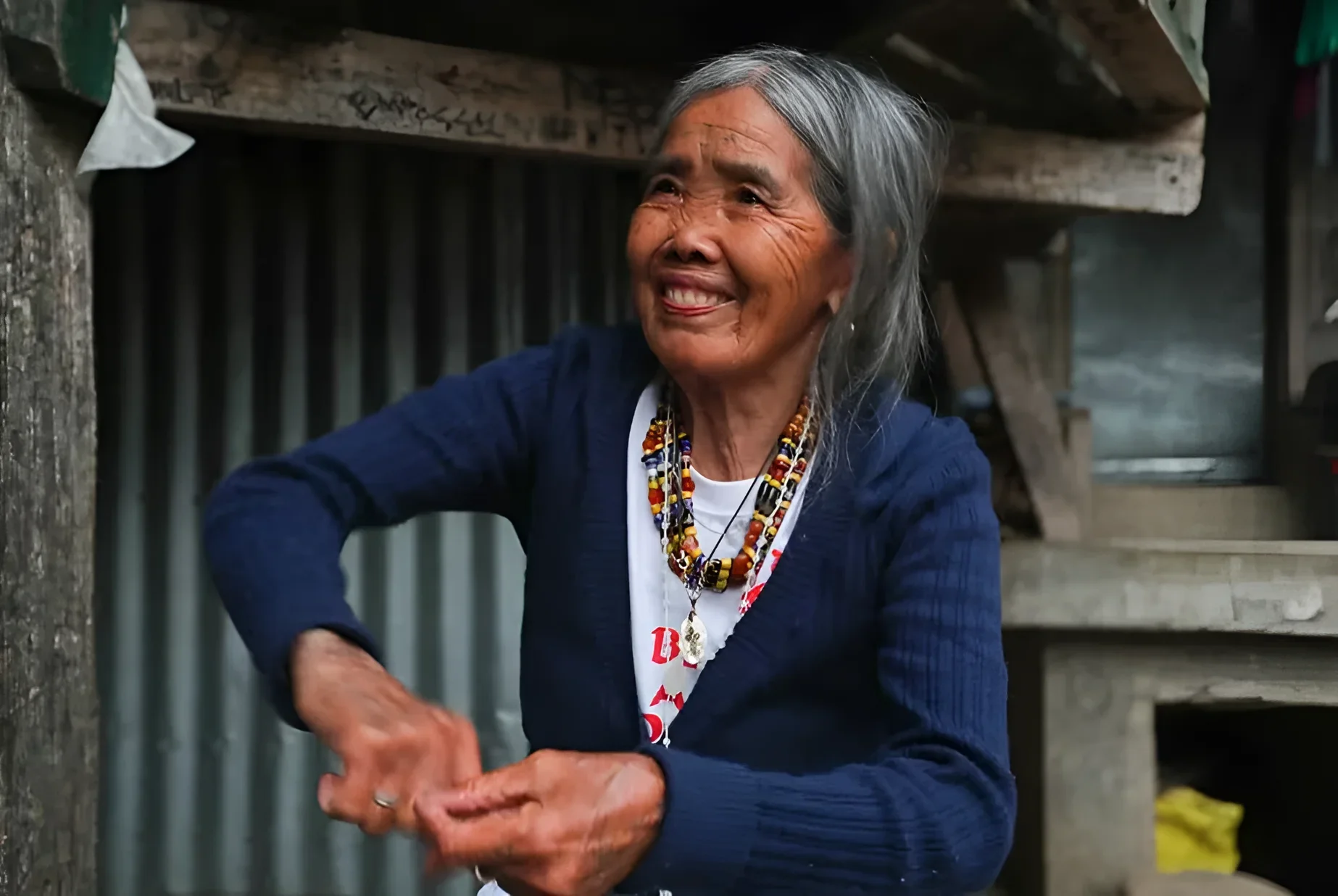
In the mountain village of Buscalan, where time seems to flow slower than in any other corner of the Philippines, 109-year-old Apo Whang-Od has once again found herself in the media spotlight. This time, the reason is not another session of applying a ‘batok’, but a story about a foreign tourist who asked the elderly woman to tattoo a traditional pattern on an intimate part of their body. Local authorities in Tinglayan, Kalinga province, have issued a statement reminding the public about the boundaries of what is acceptable and that living heritage should not be turned into an object of experimentation.
The situation escalated after reports of an “inappropriate” request appeared online. The district authorities, in a statement published on their Facebook page, urged tourists, content creators, and all interested parties to observe cultural etiquette. The key message of the statement is crystal clear: Kalinga’s ‘batok’ should not become a novelty, a spectacle, or a personal challenge. The text emphasizes that Apo Whang-Od likely saw nothing objectionable in the request and agreed to fulfill it, but the master’s consent does not make the request itself appropriate.
Where is the line between interest and intrusion?
Within the tattoo culture expert community, such cases are discussed with mixed feelings. On one hand, ‘batok’ is not just a drawing on the skin, but a ritual where each element of the pattern carries meaning: age, status, spiritual connection with ancestors. On the other hand, when tradition enters the sphere of global tourism, it inevitably encounters requests that the requesters themselves do not even consider strange. For someone who grew up in a culture where tattoos are a part of growing up and identity, the idea of “tattooing a pattern somewhere else” might seem absurd, but to an external observer, it’s just another spot on the body.
The authorities of Tinglayan, in their appeal, carefully distinguished between two things: the master’s personal decision and the visitor’s responsibility. A quote from the statement reflects this position: “We respect the personal decision of Apo Whang-Od as a ‘mambabatok’, but we emphasize that visitors are obliged to approach Kalinga’s traditions with respect, sensitivity, and cultural understanding.” This is an important nuance because it does not condemn Apo Whang-Od herself, but shifts the focus to the ethics on the part of those who come for an “experience.”
Culture is not a prop
The wording that has perhaps become the main slogan of the entire discussion deserves separate mention: “Come to Kalinga with curiosity, but also with respect. Our culture is not a prop. Our traditions are not a joke. Our heritage is not a souvenir.” For a Russian-speaking reader, accustomed to tattoos having long become a mass adornment, such words might sound like excessive strictness. But in the context of ‘batok’, this is not strictness, but a basic condition for interaction: you come not for a “beautiful drawing,” but into a space where the pattern is applied by hand with thorns and plant pigments, where the process can take hours, and the result accompanies a person for a lifetime.
For clarity, several principles can be highlighted, which are essentially embedded in this statement:
- ‘Batok’ is a ritual, not a service on demand for “tattoo something.”
- The location of the pattern is determined by tradition, not by the convenience or boldness of the client.
- The master’s consent does not absolve the guest of responsibility for the wording of the request.
- International interest is welcomed, but only on the condition of a sincere desire to learn, not to consume.
Why Apo Whang-Od is a figure of national importance
To understand why the authorities’ reaction was so measured, one must remember who Apo Whang-Od is. She is a recognized national treasure of the Philippines, a recipient of the Presidential Medal of Merit and the Dangal ng Haraya Award for Intangible Cultural Heritage from the National Commission for Culture and the Arts. She lives in the remote mountain village of Buscalan and has been passing down the ‘batok’ technique for decades, a technique that is on the verge of disappearing. Among those who have entrusted her with their skin are not only locals but also famous personalities: Filipino-American comedian Jo Koy, actor Piolo Pascual, former Miss Universe Philippines Michelle Dee, and TV host Kim Atienza.
This is why every new “incident” surrounding her name is perceived not as a domestic story, but as a test of how stable the boundary is between living heritage and its tourist packaging. In global tattoo culture, where the lines between the sacred and the decorative blur with each passing year, the case of Apo Whang-Od serves as a reminder: there are practices that cannot be reduced to content, and there are people whose work is not entertainment for the brave. Respect in this case is not politeness, but a condition for the tradition to survive the next century at all.