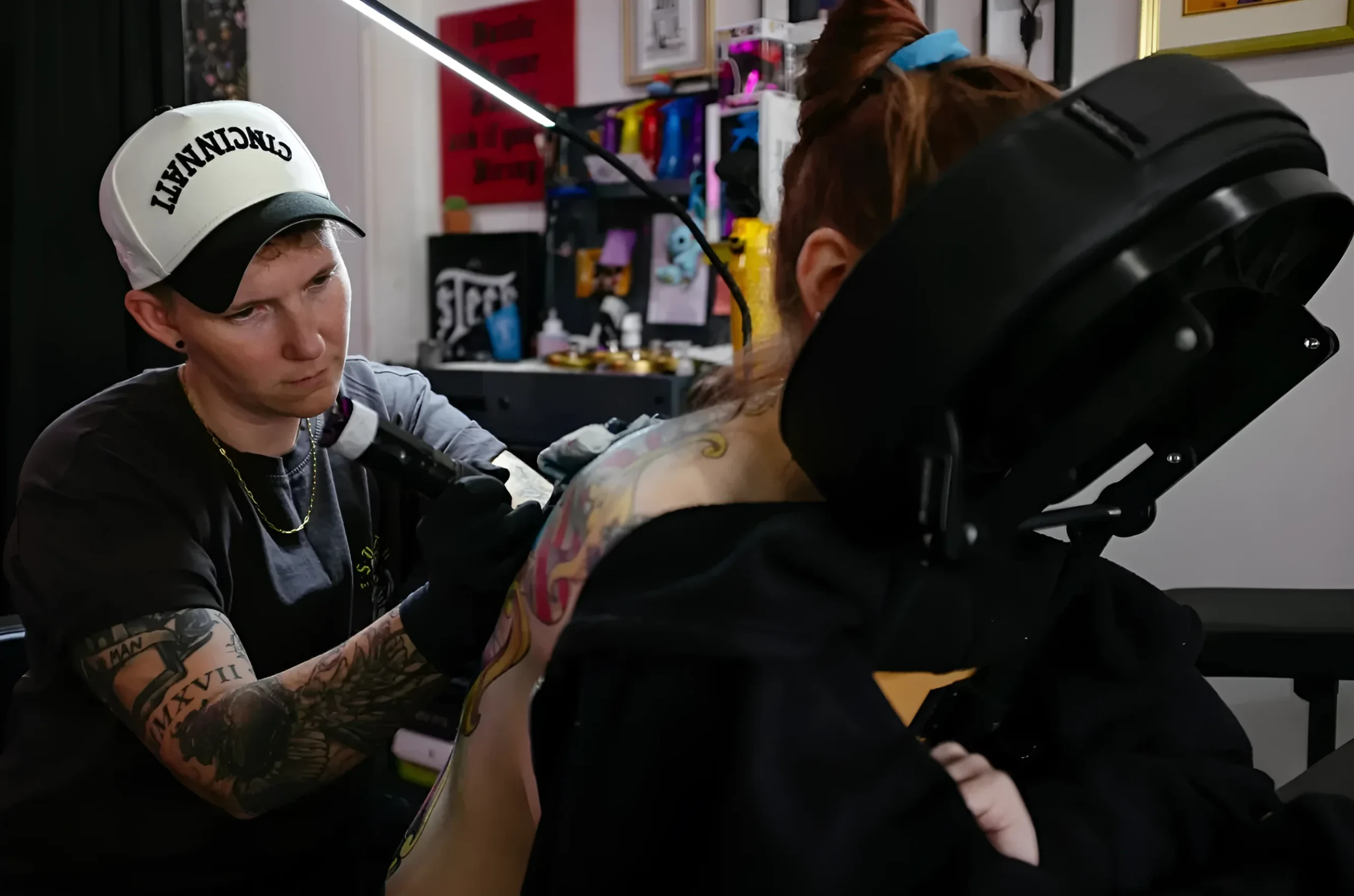
Taylor Stackman calls herself someone who doesn’t accept “no.” “If they tell me I can’t do something, I say, ‘Hold my beer,’ and go do it,” says the 34-year-old artist, who, along with her wife and business partner Brittany Wagers and investor Shelly Okoro, runs the Soul Rage Tattoo studio in Cincinnati’s O’Bryonville neighborhood. Her journey from emergency medicine to tattoo art is a rare example of how a chronic diagnosis didn’t break her career but redirected it into a path where creativity became both healing and purpose.
From Ambulance to Tattoo Machine
Stackman had a long road before tattooing: in college, she drew and sold paintings to classmates, then interned at a tattoo shop in Indiana, but ultimately chose a career as a rescuer and became an emergency medical technician. The first two years were adrenaline-fueled, but one day, while trying to load a patient into an ambulance, her legs went numb. At the hospital, she was diagnosed with multiple sclerosis, a chronic nervous system disease that, according to the National Multiple Sclerosis Society, affects nearly a million people in the U.S. and disrupts signal transmission between the brain and body. Her initial emotions were predictable: anger and a sense of doom. But over time, her perspective shifted – the disease became something that made her pay more attention to her body and live more consciously.
A Studio as a Space of Support
Upon opening Soul Rage Tattoo in 2022, Stackman and her team intentionally created a space where clients and employees feel comfortable, regardless of gender or health status. This is an important shift for the industry: the tattoo segment is increasingly focusing on inclusivity, and an artist with a chronic illness is no longer an “exception” but a part of the community. Stackman herself undergoes an MRI annually, with no new lesions appearing in her brain. She consciously leaves detailed research about her illness to her wife to avoid anxiety and focus on her work.
Styles and Large-Scale Works
The artist specializes in large-scale compositions: back pieces, sleeves, and leg work. Her portfolio is dominated by two directions:
- black and gray realism with color accents – her main “bread and butter” technique;
- neotraditional with a bright, bold palette, as in a recent piece on the back of colleague Saint-Saint-George, who performs as a clown in her free time and got a whole circus performance on her back with a tent, curtains, and crystal balls.
For Stackman, tattooing is not just self-expression but also a form of care: hours of conversation with a client about their experiences and helping them feel confident in their own bodies. According to her, it’s a different, but no less important, kind of help than what she provided as an EMT. And the most important thing she wants to convey to her 12-year-old daughter is that in this life, you can choose any path, even one as unconventional as owning a tattoo studio.