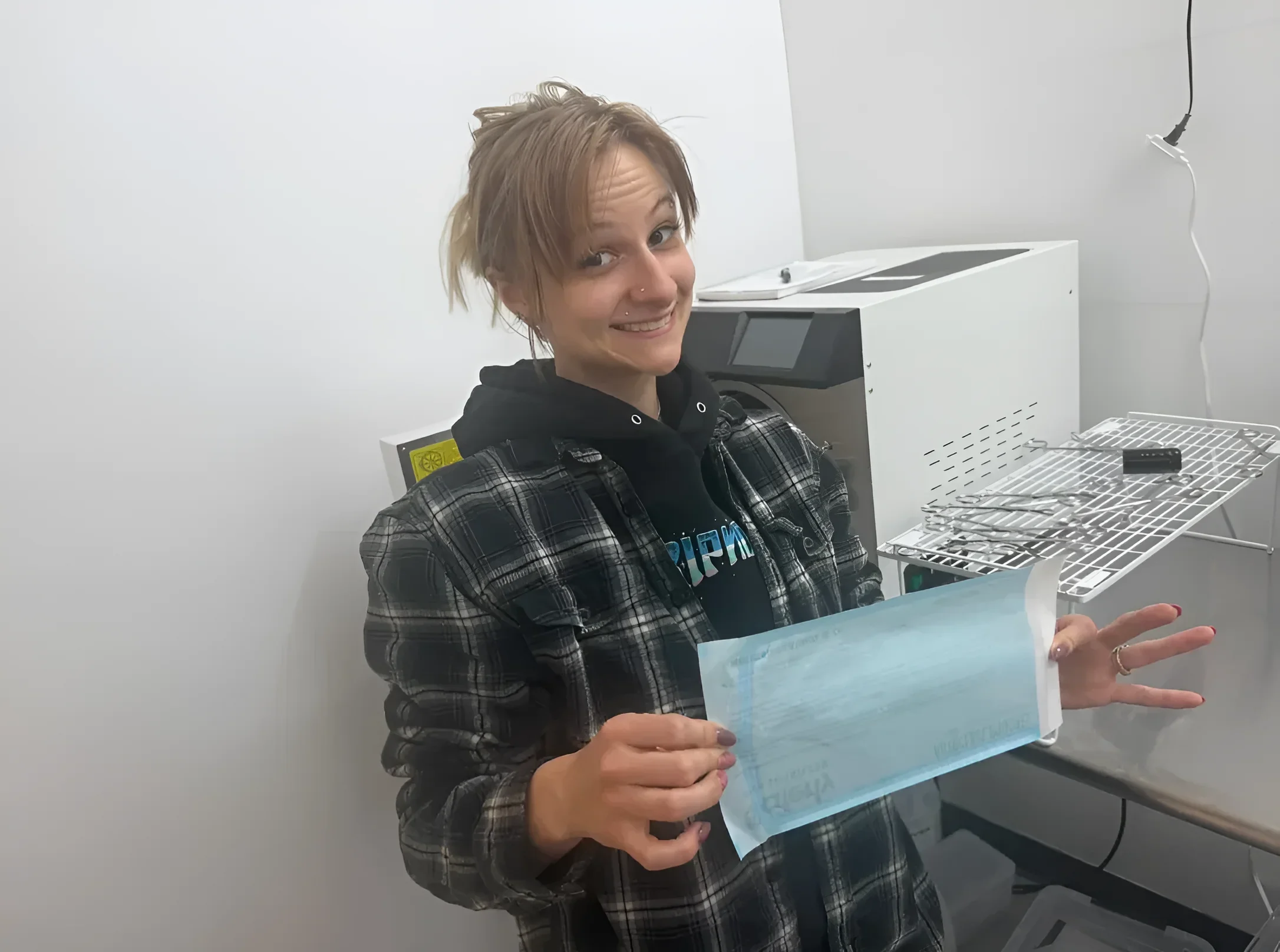
Just a couple of decades ago, tattoos were considered something marginal, but today they are a perfectly normal element of self-presentation. Along with the popularization of body art, the number of studios is growing, and, more importantly, the requirements for their work. In Alpena, Michigan, Stephanie Johnson recently opened her own space, Pin Cushion Body Art, on U.S.-23 South, and her main message is simple: clients should leave here with a tattoo, not a diagnosis.
According to Johnson, sterilization is not a formality or a “checkbox” for inspectors, but the foundation of the profession. “Sterilization is absolutely the most important thing,” she explains. “It’s something the average person doesn’t think about, and they don’t need to. When you go to a hospital, you don’t wonder if everything is clean. Everything should be clean by default.” She emphasizes that tattoos and piercings are essentially open wounds, and they should be treated as such.
The Home Tattoo Boom and Its Price
A new trend is causing particular concern among professionals: amateurs are ordering tattoo machines online and starting to “work” at home – on friends, relatives, and sometimes even paying clients. Johnson warns that this carries a real risk of transmitting bloodborne pathogens – hepatitis B, hepatitis C, and HIV – if proper equipment for processing is not used. “Learn however you want, but the risk is huge,” she says. “People don’t understand: if you tattoo with contaminated instruments and can’t sterilize them, you’re passing the infection on.” In her studio, needles are not shared even between consecutive clients from the same family – “we don’t share needles, and that’s not up for discussion.”
A practical tip for clients from Johnson: the artist should open sterilization pouches in front of you. If any metal instrument is not taken out of a sealed pouch, you should just leave. “I tell clients: if the metal isn’t from a sealed pouch, leave, because you just don’t know what’s been in there.”
Step-by-Step Sterilization: What Happens to the Instruments
The processing at Pin Cushion Body Art is a multi-stage process, and here is its sequence:
- Manual washing of instruments with Dial Gold antibacterial soap using toothbrushes;
- Soaking for 10 minutes in a medical cleaner;
- Ultrasonic cleaning – sound waves break down microscopic particles invisible to the eye (a technology also used for car parts);
- Air drying on a rack to prevent corrosion;
- Autoclave treatment – pressurized steam destroys bacteria, viruses, fungi, and spores.
An indicator of successful processing is a blue arrow on the pouch, which turns black after the cycle: this means the temperature has reached the required level to destroy pathogens.
Government Oversight
In Michigan, the Michigan Department of Health and Human Services (MDHHS) oversees compliance. Pin Cushion Body Art studio and its equipment were inspected by District Health Department No. 4 (DHD4). DHD4 Medical Director Chelsea Engle explains that the law on licensing body art studios was enacted precisely to reduce the risk of transmitting hepatitis B, hepatitis C, and HIV, and that regular inspections are the department’s responsibility. “It’s important that studios adhere to safety regulations and protect the community, especially those getting tattoos and piercings,” she notes.
For clarity, let’s compare the equipment requirements:
| Autoclave Class | Where Used |
|---|---|
| Class B | Mandatory for body art studios in Michigan (standard for dental offices) |
| Class S | Hospital and surgical settings |
Before booking an appointment, it’s worth ensuring that the studio is licensed and inspected – an up-to-date list is available on the official MDHHS website (michigan.gov/mdhhs/doing-business/licensing/body-art).
Expert opinion: The history of tattoo culture is a history of fighting the myth of the “dirty needle.” In the past, the industry’s reputation was marred by underground conditions, and today the professional community is consciously building trust through transparency: opening pouches in front of the client, visible indicators, and government inspections. For the reader, this means one thing – a safe tattoo begins not with choosing a design, but with the question “how is sterilization done here?” If the artist answers confidently and shows the process, you can safely choose your design.