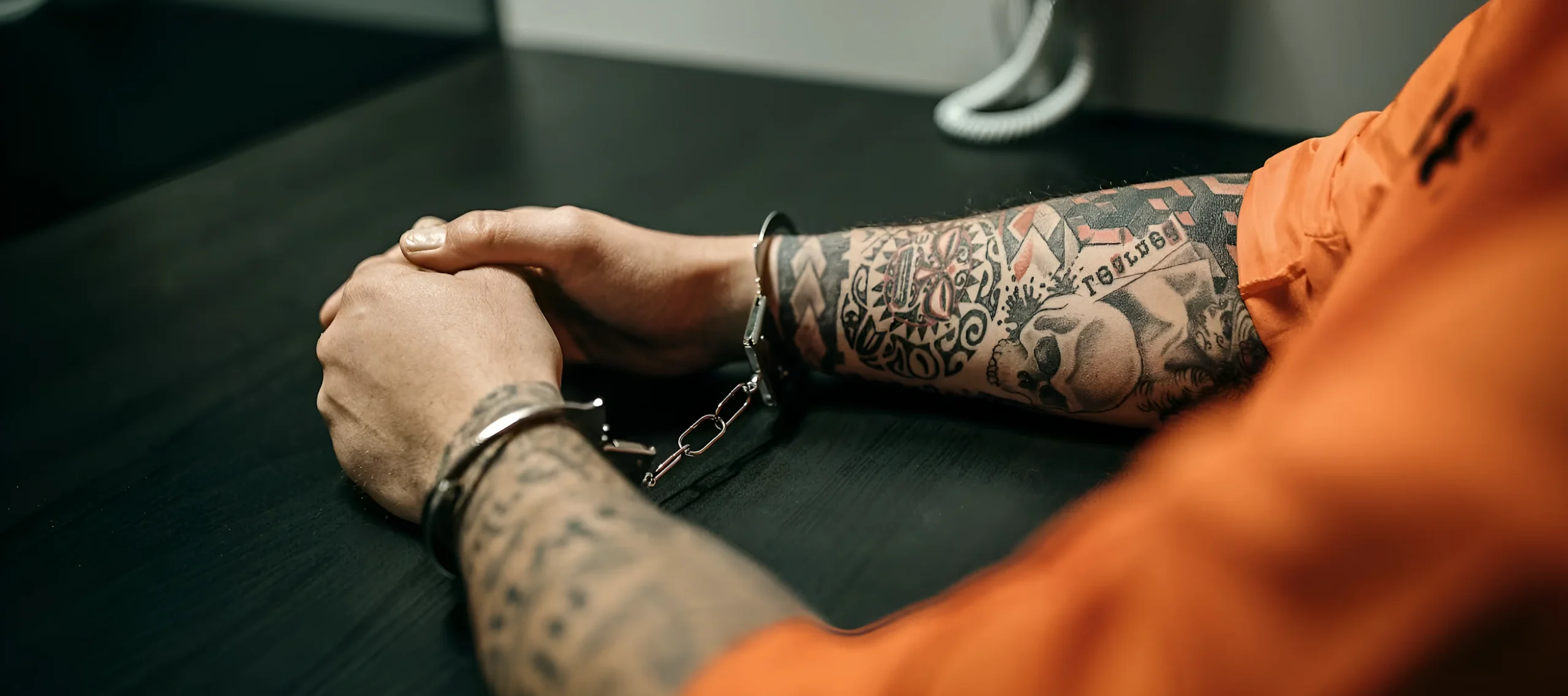
Despite a strict ban, body art remains an integral part of prison life in the United States. The practice of tattooing in correctional facilities, which began gaining popularity in the 1930s, has firmly entered both criminal and popular culture. Film and television often use strategically placed tattoos to instantly brand a character as a “hardened” or dangerous criminal. However, as Kristen O’Brien noted on November 7, 2025, the real reasons, methods, and risks associated with prison tattoos are far more complex than the stereotypes portrayed on screen.
Tattoos as a Declaration of Autonomy: The Fight for Control Over One’s Body
In a situation where individuals are stripped of almost all rights and control over their lives, a tattoo becomes a powerful tool for self-expression and, more importantly, for preserving individuality. All inmates wear the same uniform, but tattoos allow them to stand out. Megan Mitchell, an associate professor of criminal justice at the University of North Dakota, emphasizes that it’s easy for society to demonize “prison” tattoos as a sign of brutality. However, regardless of the specific reason, this act is always a form of resistance to the system and an assertion of personal autonomy.
TaLisa Carter, an associate professor in the Department of Justice, Law, and Criminology at American University, who previously worked as a correctional officer in Savannah, Georgia, confirms that the inclination towards tattoos intensifies particularly among those sentenced to life imprisonment without parole. She explains this by stating that “the less hope there is for returning to freedom, the greater the need for control over one’s life.” In this context, the penal system itself contributes to the rise of prison tattoos, which become a symbol of defiant challenge to authority and refusal to comply with rules.
Symbolism Beyond Stereotypes: What Does a “Tear” Really Mean?
Despite the common belief that prison tattoos are solely for indicating gang affiliation, their symbolism is often multifaceted. Group affiliation is undoubtedly an important factor, but it comes with significant risks. Megan Mitchell warns that if a tattoo is clearly gang-related, it will immediately attract the administration’s attention. If the group is classified as a “security threat” in a particular prison, it will inevitably lead to isolation or placement in solitary confinement.
Mitchel P. Roth, Ph.D., a professor of criminal justice at Sam Houston State University and author of works on the history of prison gangs, notes that inmates are now less likely to use facial tattoos associated with gangs. The reason is pragmatic: “When investigating, law enforcement first looks at tattoos. On the street, you don’t want anything that signals gang affiliation, or it will lead to immediate detention or problems.”
The teardrop tattoo is of particular interest. In popular culture, it’s often interpreted as an indicator of a completed murder or violent crime. However, experts claim this meaning is outdated. Today, a teardrop most often symbolizes sadness, mourning, or remembrance of loved ones who have passed away. “I’ve spoken with many people with teardrop tattoos, and they’ve said it’s a symbol of those who have left an indelible mark on their lives and the grief they carry,” Mitchell shares.
Jorge Antonio Reno, former national director of criminal justice at Latino Justice, who himself served time in Texas and was released in 2008, categorically refutes a common myth: “I never knew anyone who got teardrops on their face for the number of people they killed. Anyone who says they know that for sure is lying.”
Reno emphasizes that joining a gang almost always requires “patching up” – a tattoo signifying membership. These symbols are constantly changing to stay ahead of security measures. Reno himself, however, chose not to have prison-related tattoos. He adorned his body with his daughter’s name, her mother’s name, and a skull in honor of his artist brother, not wanting his body to bear the mark of incarceration.
The Technology of Underground Studios: How Prison Tattoo Machines Are Made
To get a tattoo, an inmate must be on good terms with their cellmates. As Reno notes, “tattoo artists” (TAs) may refuse those convicted of certain crimes, such as sexual offenses. But common drug dealers, robbers, or thieves are usually accepted.
The process of creating equipment is the pinnacle of ingenuity in conditions of scarcity. Needles are made from improvised materials:
- Springs from lighters.
- Parts from old VCRs.
These homemade needles are straightened and sharpened with fire. Tattoo machines are assembled from the motors of small handheld fans, which can be purchased in the prison commissary. The power of such a motor is sufficient to drive the needle.
Ink is also produced in a makeshift manner: TAs burn a piece of plastic, mixing the resulting soot with water and alcohol. As a result, only two main colors are available – black or dark blue. The presence of other colors, according to Reno, usually means the inmate has good connections with an officer or someone on the outside.
During the tattoo artist’s work, a “lookout” is necessary – a trusted inmate who “holds the jiggers” (prison slang for watching for guards). He warns of the approaching guard with a cough or a whistle.
The cost of TA services ranges from $20 to $200 and up, depending on size and skill. Payment is not made in cash, but in scarce commissary items or contraband:
- Packs of coffee or cigarettes.
- Postage stamps.
- Food items or drugs.
Sometimes, payment can be transferred to a TA’s trusted contact on the outside.
The Price of Risk: Infections and Solitary Confinement
Upon entering a correctional facility, staff record the number of tattoos on an inmate’s body to track all subsequent additions. If an inmate is caught getting or giving a tattoo, they face solitary confinement (the hole) or loss of privileges, including access to the commissary.
For correctional staff, any sharp object is contraband. TaLisa Carter notes that while their goal is to confiscate these items to prevent infections, there’s a more complex social aspect. “We’ve stripped these people of their humanity, and this is about personal autonomy. It’s a very complex social issue, but for an officer, it’s just contraband.”
Jorge Antonio Reno claims that with the use of alcohol and gloves, which are sometimes available, the risks are relatively low. However, Professor Mitchel Roth considers the process “quite unsanitary.” He warns, “You’d be lucky if you don’t contract Hepatitis B or C, or HIV, as I’m sure many of these needles are reused.”
Amidst staffing shortages and overcrowded prisons, authorities often lack the resources to completely suppress underground tattoo operations. Carter admits, “If it’s obvious someone just got a tattoo, but I don’t find any contraband, and the person isn’t infected, I have nothing to do. As long as you’re not creating extra work for me, I’ll leave you alone. We’re too overwhelmed for this.”
Expert Context: Tattoos as a Social Mirror
The phenomenon of prison tattooing is not merely a rule violation; it’s a deeply ingrained art form that reflects an extreme degree of commitment and authenticity. In the broader context of tattoo culture, “prison tattoos” represent one of the most extreme examples of body modification, where the price for the artwork is measured not in money, but in potential isolation and health.
While modern studio tattooing strives for sterility and aesthetics, prison art emphasizes the historical connection of tattooing with outsiders and resistance. The fact that inmates are willing to take such risks to adorn their bodies speaks to a fundamental human need for self-determination. A tattoo made in prison remains a permanent, visible testament to lived experience and rebellion, making it one of the most powerful and uncompromising symbols in the global tattoo industry.