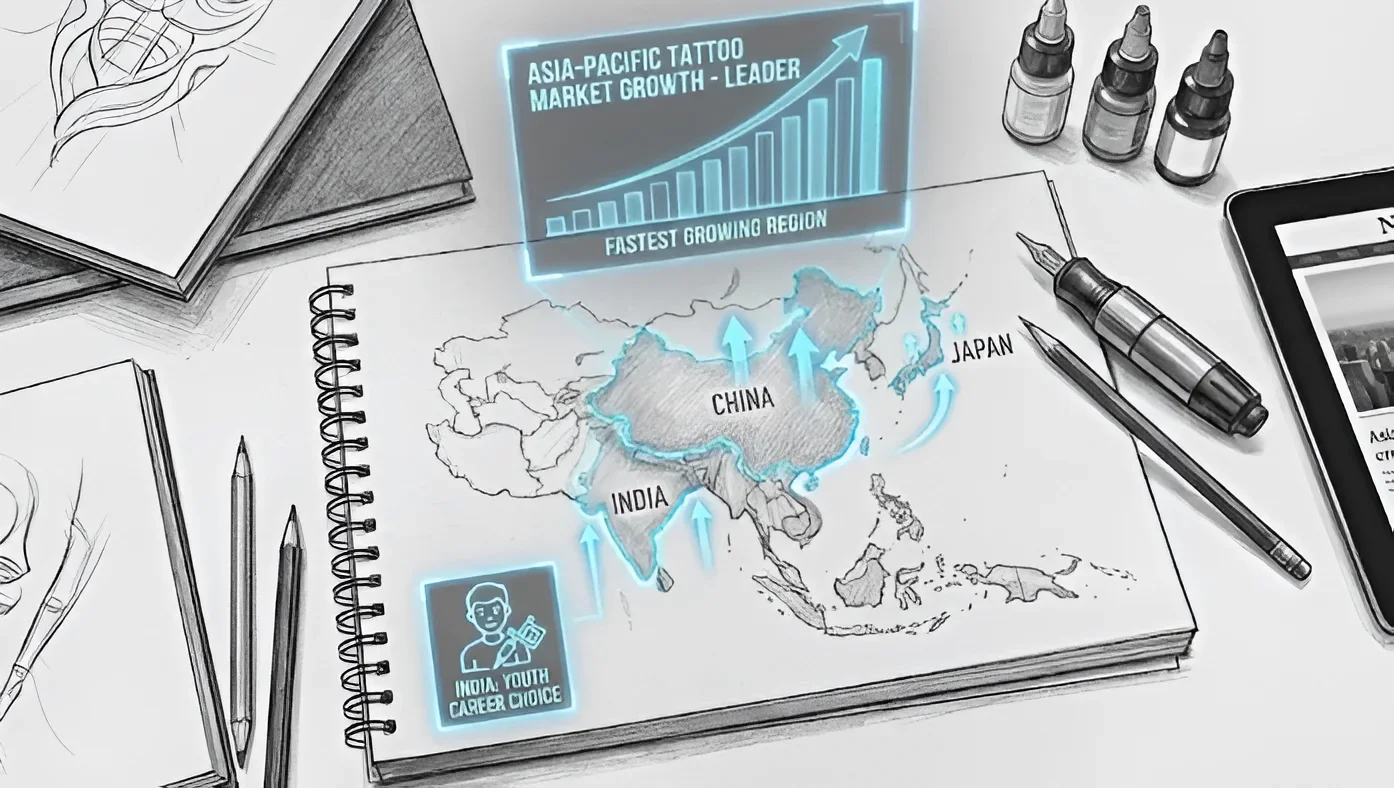
The global tattoo culture map is undergoing fundamental changes, shifting the focus from traditional Western markets to the dynamically developing Asia-Pacific region. Today, it is Asian countries that are demonstrating the highest growth rates, becoming the locomotive of the entire industry for the next decade. According to the latest analytical data, China, India, and Japan are not just adapting Western trends but are also forming their own unique ecosystem where ancient traditions, modern technologies, and radical changes in the social perception of body art intertwine.
The Indian Breakthrough: From Office Routine to Artistic Self-Expression
One of the most striking trends in the region is the phenomenal growth of the tattoo market in India. Experts note that by 2026, the volume of this sector in the country could reach an impressive $0.1 billion. However, behind the dry figures lies a deep social shift. Modern Indian youth are massively abandoning stable but monotonous careers in the corporate sector in favor of creative professions. The profession of a tattoo artist is no longer perceived as a marginal occupation and has moved into the category of prestigious and high-paying activities.
The development of specialized institutions and academies for tattoo art training across India has created a foundation for the professionalization of the industry. Young people see this not only as a means of self-expression but also as a real opportunity for entrepreneurship. Social networks like Facebook and Twitter (X) act as catalysts, allowing artists to instantly broadcast their work to a huge audience, blurring the lines between local studios and the global community.
The Chinese Paradox: State Regulation and Market Boom
China presents a unique case where state restrictions unexpectedly stimulate the development of certain industry segments. It is predicted that by 2026, the Chinese tattoo market will grow to $0.15 billion. Interestingly, a significant portion of this growth is accounted for by tattoo removal services. In December 2021, China’s General Administration of Sport introduced a strict ban on tattoos for national team footballers, requiring them to remove existing images or cover them completely.
This “clean skin” policy, extending to civil servants and athletes, has created colossal demand for laser procedures. At the same time, the overall popularity of body art among the urban population continues to grow, creating a complex but financially attractive market structure where tattoo application and removal services develop in parallel.
Japan and Technological Progress
Japan, despite its conservative history regarding tattoos, also shows stable positive dynamics with a forecast of $0.02 billion by 2026. Here, tattoo culture is gradually emerging from the shadows of associations with organized crime, becoming part of global youth style. An important factor for the entire region remains the influence of the American market, where the laser procedures segment held a dominant share of 66.26% in 2024. This trend towards technological advancement and procedural safety is actively being imported into Asia, raising the standards of local studios.
Analysis and Prospects: What Awaits the Industry
Expert analysis shows that between 2025 and 2032, the Asia-Pacific region will demonstrate the highest compound annual growth rate (CAGR). The main factors for this success will be:
- Demographic dividend: a huge number of young people striving for individualization.
- Digitalization: the influence of social platforms on aesthetic preferences.
- Institutionalization: the emergence of professional schools and hygiene standards.
- Economic mobility: growth in middle-class incomes, ready to spend on aesthetic services.
Below are the projected market size figures for key countries in the region by 2026:
| Country | Projected Market Size by 2026 (billion USD) | Key Growth Driver |
|---|---|---|
| China | 0.15 | Removal services and youth fashion |
| India | 0.10 | Youth transition to the creative sector |
| Japan | 0.02 | Modernization of traditions and social media |
In conclusion, it can be confidently stated that tattoo culture in Asia is experiencing its “golden age.” Despite legislative nuances in individual countries, the overall vector is towards professionalization and market expansion. For global manufacturers of equipment and pigments, this region is becoming a priority direction, and for tattoo artists, it is an inexhaustible source of inspiration and new stylistic solutions that combine Eastern philosophy with a Western approach to business.