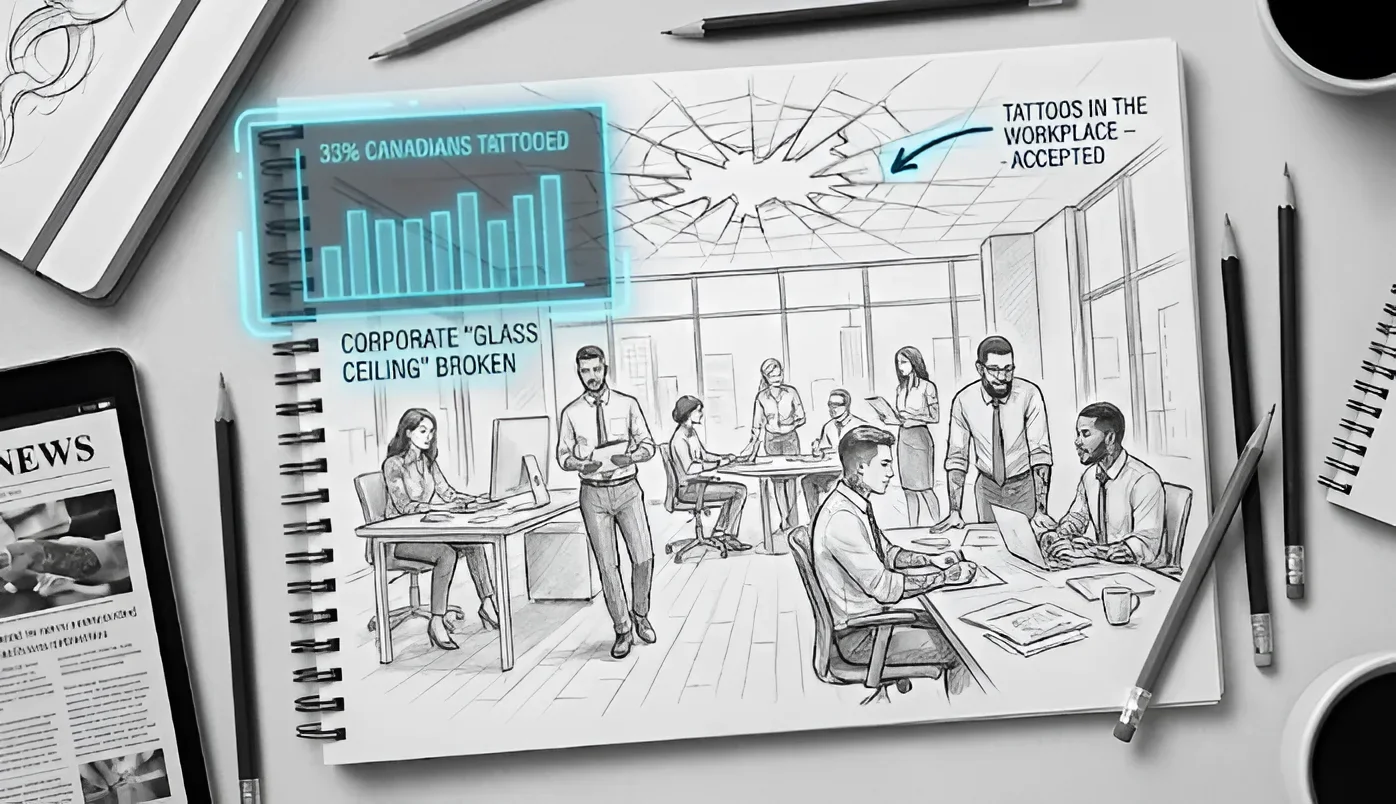
The era when tattoos were considered a sign of marginality or belonging to closed subcultures has definitively passed into the past, giving way to a new visual aesthetic in the business environment. Today, we are witnessing not just a tolerance for body art, but a full-scale cultural shift where tattoos are becoming an organic part of a professional image. If just ten to fifteen years ago, “sleeves” or designs on the hands could be an insurmountable obstacle when applying for a job at a bank or law firm, then in 2026, the corporate world demonstrates unprecedented openness. The modern office has transformed into a space where individuality is valued above conservative appearance standards.
According to recent analytical data collected within large-scale sociological research, about a third of Canadian residents have at least one tattoo. These figures are not just dry statistics but an indicator of a global trend characteristic of most developed countries. It is important to note that the so-called “glass ceiling” for tattooed employees, which for decades limited their career growth in large corporations, has been almost completely shattered. Today, the presence of pigment under the skin does not cause cognitive dissonance even in the most conservative circles, including public administration and high-tech medicine.
Generational Shift as a Catalyst for Change
The primary reason for such rapid adoption of tattoo culture is a natural demographic process. The millennial and Gen Z generations, for whom self-expression through body art is the norm, today not only form the backbone of the workforce but also occupy key leadership positions. When hiring decisions are made by someone who has a tattoo themselves, the question of the “professional acceptability” of a design on the skin becomes irrelevant. In 2026, visible tattoos – on forearms, hands, and even delicate work on the neck – have become a common sight in boardrooms and at international forums.
Expert Analysis: Tattoos as a Personal Brand
From the perspective of tattoo anthropology, we have moved from the stage of “tattoos as protest” to the stage of “tattoos as status.” High-quality execution, complexity of composition, and artistic value of a design can today tell more about the owner than their suit. An expensive, professionally executed tattoo in realism or complex geometry is often perceived as a sign of discipline, patience, and financial well-being. It is an investment in one’s own image, which modern HR specialists interpret as the ability for long-term planning and conscious choice.
Transformation of Perception Across Different Industries
Despite the general liberalization, the dynamics of change vary across different business sectors. Below is a table showing the current level of acceptance of visible tattoos in various professional segments:
| Industry | Acceptance Level (2026) | Permitted Areas |
|---|---|---|
| IT and Creative Industries | Absolute (95%) | Any, including face and neck |
| Medicine and Healthcare | High (80%) | Arms, forearms, neck |
| Law and Finance | Medium (60%) | Arms (concealed by clothing), hands |
| Education | High (75%) | Forearms, legs, open arm areas |
Interestingly, in medicine, tattoos have even become a tool for building rapport with patients. A doctor with a tattoo is often perceived as a more open, modern, and humane specialist, which helps establish a trusting connection. In the corporate sector, a top manager having a tattoo emphasizes their creativity and readiness for unconventional solutions, which is critically important in a rapidly changing market.
Why is the Stigma Disappearing Now?
In addition to demographic factors, the development of the tattoo industry itself has played a huge role. Modern pigments, equipment, and the skill level of artists have transformed tattoos from “inkings” into a full-fledged visual art. When a masterpiece comparable to the best galleries in the world adorns the skin, it is difficult to call it inappropriate. Society has learned to distinguish between aesthetic components and a person’s personal qualities.
- Breaking stereotypes about the connection between tattoos and a criminal past.
- Availability of quality information about styles and meanings.
- Popularization of tattoos among celebrities and opinion leaders.
- Increased professionalism of tattoo artists working in the premium segment.
In conclusion, it can be confidently stated that in 2026, tattoos are not a challenge to society, but a part of it. The glass ceiling has not just cracked, it has disappeared, paving the way for talent regardless of how much ink is in their dermis. For the professional community, this means a transition to a more inclusive and honest environment where substance is valued over form, and skin is merely another canvas for a success story.